2026 Health Savings Account
Participating in a Health Savings Account is a way of putting money aside tax-free throughout the year, and then later using those pre-tax dollars to pay for your health care that isn't covered by health insurance.
Contact Information
Fidelity
Customer Service: (800) 544-3716
Website: www.fidelity.com
Log In: netbenefits.com
Other Important Information
"What's Changing in 2026?"
Annual Limits - The IRS limits for 2026, inclusive of both employer and employee contributions, have increased to $4,400 individual/$8,750 family. Individuals age 55+ may contribute an additional $1,000 annually. Employee contribution amounts can be changed at any time during the year.
Set up an Account - If you are new to HSAs in 2026, you will be required to set up your HSA account before 1/1/26 so that funds can be distributed to your account. Please see the Create an Account section below.
IRS Guidelines
The following IRS-governed rules apply only while contributing to or receiving employer contributions to your Dartmouth HSA account.
-
NOT a Research Fellow or a J-VISA holder.
-
NOT enrolled in Medicare, Medicaid, Tricare, or any other type of health insurance that is not a qualified HDHP. (i.e., You MUST be enrolled in Dartmouth's High Deductible Health Plan with HSA option)
-
If you are turning age 65 and are planning to enroll in Medicare during the 2026 calendar year, please see the HSAs and Medicare section (below) for important IRS information about when you need to stop contributing to your HSA account.
-
NOT a patient of One Medical at Dartmouth.
-
NOT being claimed as a dependent on another person's tax return.
-
NOT eligible to receive medical-expense reimbursement under your own general-purpose Health Care Flexible Spending Account (HCFSA) or that of a spouse or a parent.
Other Important IRS Rules:
-
If you have a balance in your HSA account at year's end and switch medical plans or leave Dartmouth, you can no longer contribute to your HSA account, but you may continue to use the funds in the account.
-
You may not submit claims incurred prior to your initial HSA effective date.
-
You must include all contributions made to an HSA in the calendar year when electing your annual contribution. This includes contributions made through or by another employer, by Dartmouth, and/or paid directly to the account through Fidelity.
-
You must make an election every year if you wish to contribute.
-
The IRS does allow you to start, stop, increase, or decrease your contributions at any time during the calendar year. You can do this in the FlexOnline system, where you will find a section titled "Change my HSA." Please allow 10-14 days for your payroll deduction to update.
-
For additional details on the IRS guidelines, please visit IRS Publication 502
Create an Account
When you enroll in a High Deductible Health Plan with the Health Savings Account (HSA)
option, you will receive an email from Human.Resources.Benefits@Dartmouth.edu within a few weeks after enrollment, providing step-by-step instructions on how to
set up your HSA account through Fidelity. It is important to make sure that you set
up this account promptly. Your and Dartmouth's contributions will not be able to
upload funds into your account until the account has been established.
Eligibility and Enrollment
All benefits-eligible Faculty, Exempt, Non-Exempt, SEIU, and Research Associate B employees should check the IRS Guidelines section (above) carefully before enrolling in the HSA option to see if you are eligible to participate.
New Hires will be given the option to enroll in a Health Savings Account in the FlexOnline benefits enrollment system once they enroll in the HDHP with HSA medical insurance option. If you enroll in any other health plan, you will be required to WAIVE the HSA plan in FlexOnline. If you choose not to contribute your own funds to the HSA account upon hire, you may start, stop, or change your annual HSA contribution amount at any time in the FlexOnline system. If you do not elect a contribution amount during the annual open enrollment period, your prior year's contribution amount will not carry forward, and you will not have deductions starting with your first check in January.
2026 Annual IRS Limits
The IRS sets the HSA limits each calendar year. For calendar year 2026, the HSA contribution limits are as follows:
- Individual coverage: $4,400
- Family coverage: (2+): $8,750
- Age 55+ catch-up contribution: $1,000
IMPORTANT NOTE: The maximum contribution allowed is determined by the number of months you are enrolled in the medical plan during the year. For example, if you are only enrolled in the medical plan for six months, your annual limit becomes 50% of the amount shown above.
When enrolled in the HDHP with HSA medical plan option, Dartmouth will automatically make an annual contribution to your HSA account. The amount is prorated based on your Date of Hire (if new to Dartmouth). Unlike the HCFSA, this amount must be included with the employee contribution when meeting the annual IRS limit.
- Individual coverage: $500
- Family coverage: (2+): $1,000
External Contributions
HSA contributions can be made directly to Fidelity on a post-tax basis and later claimed as pre-tax during your annual tax filing. If you are also making contributions through Dartmouth payroll, please be sure to adjust your Dartmouth contributions accordingly to reflect all external contributions, so as not to exceed the annual IRS limits.
Understanding The Benefit
Health Savings Accounts are strictly regulated by the IRS. It is your responsibility to read and understand the information provided. For clarification about information on this webpage, please reach out to the Dartmouth Benefits office. If you have specific questions around the IRS's rules and regulations surrounding your HSA plan, you are advised to speak to your tax professional.
Fidelity has provided a number of important educational videos to help you get a better understanding of what a Health Savings Account is, how it works, and how you can potentially save a lot of money by combining a low-cost High Deductible Health Plan with a pre-tax Health Savings Account.
Why Choose an HSA?
- The HSA provides a triple tax advantage: money goes in tax-free, grows tax-free, and is tax-free when used to pay for eligible health care expenses.
- You and Dartmouth contribute. You can change your annual contribution amount any time during the plan year.
- The money is always yours. Besides being free to choose when and how much of your HSA funds to use, any money left over at year's end is yours to keep. You can even take your HSA dollars with you when you leave the plan, change jobs or retire.
- Expenses you pay with HSA dollars count toward your annual deductible and out-of-pocket maximums.
- You choose how to invest the money in your account, and your account can grow through investment earnings or interest payments.
- Administration is easy with no stressful submission deadlines.
- When you have an eligible expense, you have the option of using a Fidelity provided debit card, checkbook, or you may reimburse yourself through direct deposit.
- The Dartmouth contribution to your HSA account is available with your first paycheck in January and can be used once you have activated your account. Your own contributions are available as they are deposited.
- You decide when and how to use the money in your HSA account. Spend it during the year, save it for the future or open an investment account.
Other Considerations
- Consider consulting a tax professional when contributing to a Health Savings Account.
- If you will be Medicare eligible in 2026, please see the HSA & Medicare section below.
*HSA contributions and earnings are not subject to federal taxes and not subject to state taxes in most states. A few states do not allow pre-tax treatment of contributions and earnings. Contact your tax advisor for details on your specific location.
Who Can I Cover?
While the Affordable Care Act (ACA) allows parents to add their adult children who have not reached age 26 to their health plans, the tax laws regarding HSAs have not changed, and children aged 19 to 26 must be considered a tax dependent in order for an adult child's medical expenses to qualify for payment from a parent's HSA. According to the Internal Revenue Service (IRS) definition, a dependent is a qualifying child (daughter, son, stepchild, sibling, or step-sibling, or any descendant of these) who meets these three criteria:
- Has the same principal place of abode as the covered employee for more than one-half of the taxable year, and
- Has not provided more than one-half of his or her own support during the taxable year, and
- Is not yet 19 (or, if a student, not yet 24) at the end of the tax year, or is permanently and totally disabled.
One way around this is for an adult child to set up their own HSA. As long as they are covered on the family-qualified HDHP, adult children can contribute up to the full family HSA amount into their HSA account. The dependent's contributions will not reduce the amount their parents can deposit into their accounts.
How the Benefit Works
 Set up your HSA Account- If new to an HSA, Dartmouth will notify you with instructions on how to set up and
claim your HSA account with Fidelity. You must set up your account before funds can
be contributed to it.
Set up your HSA Account- If new to an HSA, Dartmouth will notify you with instructions on how to set up and
claim your HSA account with Fidelity. You must set up your account before funds can
be contributed to it.
Account is Funded - Dartmouth will load the full employer contribution to your account with your first paycheck in January, or your first paycheck after setting up your account, if you are new to Dartmouth.
Payroll Deduction - Money comes out of your paycheck each pay period and goes into your HSA Account, reducing the amount of taxes you pay each pay period. The IRS does allow you to front-load all or a portion of your annual contribution if you so choose. Please contact the benefits office if you wish to front load a contribution.
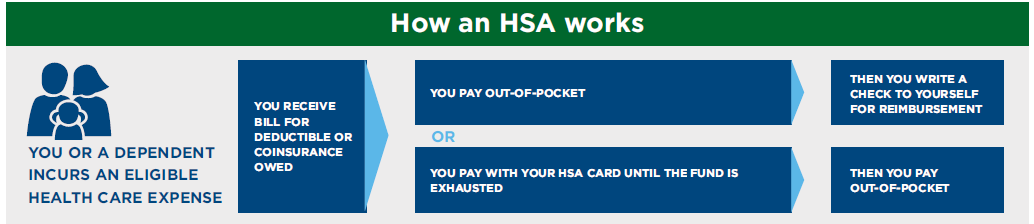
Incur Eligible Expenses - If you or an eligible dependent incurs an eligible health care expense that is not covered by your health plan, you then have the option to use HSA dollars to pay for it, or you can save your funds for future expenses.
List of Eligible Expenses (IRS Publication 502)
Filing a claim - See the Filing a claim section (below) for information on how to file an HSA claim.
Leaving Dartmouth - See the Leaving Dartmouth section at the bottom of this page.
HSA's and Medicare
Per IRS guidelines, you cannot contribute to a Health Savings Account (HSA) if you are enrolled in any part of Medicare or Social Security. Your dependents may be enrolled in Medicare and Social Security, but you as the owner and contributor to the account may not. To avoid a penalty, you should stop contributing to your HSA at least 6 months before you enroll in any part of Medicare or Social Security. The IRS and Medicare do allow you to delay enrolling in Medicare so that you may participate in an HSA, as long as you are still actively working and enrolled in a qualified health insurance plan. Please see the Medicare & You booklet for additional details.
Filing a Claim
Submit/Pay a Claim - If you incur medical expenses and wish to use your HSA funds, then you can (a) use a Fidelity HSA debit card to pay the provider directly, (b) you can use a Fidelity HSA checkbook to pay the provider or to reimburse yourself and (c) you can create a claim and reimburse yourself via direct deposit through the Fidelity portal. You cannot submit claims for reimbursement that were incurred prior to having the HSA account.
To access the Fidelity portal, click on the ACCESS YOUR RETIREMENT & HSA ACCOUNTS HERE icon on the upper left side of this screen. Log into your account. Click on HEALTH SAVINGS ACCOUNT and then PAYING. From there you will see your options.
Keep your Receipts - You do not need to submit your receipts to Fidelity for Substantiation. You will, however, still need to keep your receipts for all expenses paid from the account, in case you are ever audited by the IRS.
Year End - You do not need to spend the full balance in your account by year's end. Your full balance, including the Dartmouth contribution, is always yours and will carryover from year to year.
Deadlines - The only deadline that you need to be aware of is your tax filing deadline, as you will need to report your contributed balance and balance spent during your annual tax filing. See Year-End Tax Filing (below)
If you ever forget to pay a bill or reimburse yourself, you can do it at any time. As long as the expense was incurred while the account was active, you can reimburse yourself from your HSA account. Even if it is years later.
Year-End Tax Filing
You will be required to report both the amount contributed and/or the amount spent from your HSA account on your annual income tax return each year, regardless of whether you are still enrolled in or are contributing to an HSA account.
- In January, Fidelity will mail form 1099SA to all Health Savings Account (HSA) participants showing the total amount of HSA funds that were spent in the prior calendar year. This amount shows on line one of the form as Gross Distributions.
- Box 12c, code W on your 2025 W-2 form, will show the total amount of funds that were contributed into your Health Savings Account in 2025. This amount includes both the employer and the employee contributions.
- When filing your taxes, you will need to complete IRS Form 8889, using information found on form 1099SA and Box 12 Code W of your 2025 W-2.
- Don't forget to report any contributions that you made directly to Fidelity (outside of payroll deductions).
- Be sure to keep copies of all receipts that support the amount shown in box 1 of 1099SA, in case you are ever audited.
- Always consult a tax professional when you have questions about HSA tax filing and/or eligibility.
Leaving Dartmouth
Your Account - The amount that is in your HSA account when you leave Dartmouth is your money to keep and take with you. This includes all employer contributions made to date. Your account will remain open and active, and you may continue to spend down these funds over time as needed, regardless of the type of health plan you enroll in, in the future.
Packet of Information - Fidelity will not send you a continuation of coverage packet when your benefits end with the college.
Contributions - You may continue to make contributions to your HSA plan on a post-tax basis as long as you are actively enrolled in a qualified high deductible health plan, whether through your COBRA'd Cigna health plan, the health care exchange, or some other qualified HDHP plan. You can claim the pre-tax status of your post-tax contributions when you file your next tax return.
Contribution Limits - You may continue to contribute up to the IRS' annual limit that you are eligible for.
Administrative Fees - You will be charged a quarterly fee to maintain the account, which will be automatically deducted from your account.
Account Balances - Your unspent balance will continue to roll over from year to year.
Debit Card & Check Book - You may continue to use your HSA debit card and/or check book after you leave the college. Always make sure you keep your receipts for purchases, as you have always done.
Tax Forms - You will continue to receive tax forms at year's end and will need to file as part of your annual tax return each year.
Beneficiaries - Don't forget to review your HSA beneficiaries from time to time through the Fidelity website.
Tax Professionals - When leaving Dartmouth during the middle of a plan year, we highly encourage you to speak to a tax professional to see how loss of contribution eligibility might impact your annual limit, and how contributions in other tax-advantaged plans (like HCFSA plans) within the same calendar year could impact your status with the IRS.
Last Updated