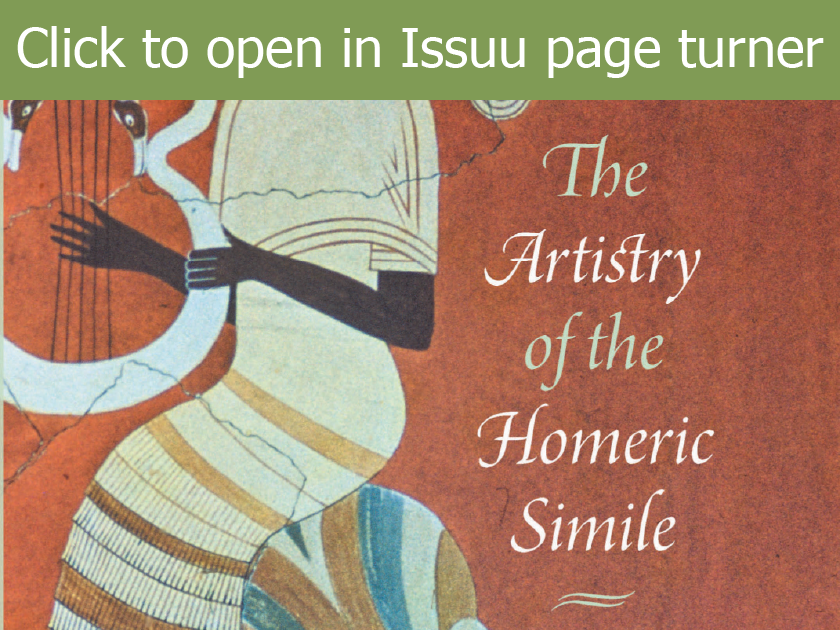
 The Artistry of the Homeric Simile
William C. Scott
University Press of New England and the Dartmouth College Library
Copyright © 2009 Copyright William C. Scott>
Read the ebook Online | PDF | Kindle Download | Epub Download
Print out the tables only (pp. 190-205) as an aid while reading
or
Buy the Print Edition
About the Book
(from upne.com)
"The similes in Homer are treasure troves. They describe scenes of Greek life that are not presented in their simplest form anywhere else: landscapes and seascapes, storms and calm weather, fighting among animals, aspects of civic life such as settlements of disputes, athletic contests, horse races, community entertainment, women carrying on their daily lives and men running their farms and orchards. But the similes also show Homer dealing with his tradition. They are additions to the narrative showing how the Greeks found and developed parallels between two scenes, each of which elucidated and interpreted the other, and then expressed those scenes in effective poetic language."
About the Author
WILLIAM C. SCOTT is emeritus professor of classics at Dartmouth College. His previous publications include The Oral Nature of the Homeric Simile, Musical Design in Aeschylean Theater, Plato's The Republic with Richard W. Sterling, and Musical Design in Sophoclean Theater
About the Electronic Publication
Professor Scott's first book, The Oral Nature of the Homeric Simile (E. J. Brill: Leiden, 1974) has been re-issued as an electronic book by the Dartmouth College Library in 2009, to coincide with the digital and print publication of The Artistry of the Homeric Simile.
The electronic versions of both books are publicly available for non-commercial uses, free of charge, at the Dartmouth College Library's Digital Publishing website.
Rights Information
Published with permission of William C. Scott.
Dartmouth College Library assigns a Creative Commons BY-NC license to the digital work and associated web site.

Bibliographic Information
Published by University Press of New England, Hanover, 2009. ISBN 9781584657972 282 pages.DOI: https://doi.org/10.1349/ddlp.769
Print edition: PA4177.S5 S28 2009