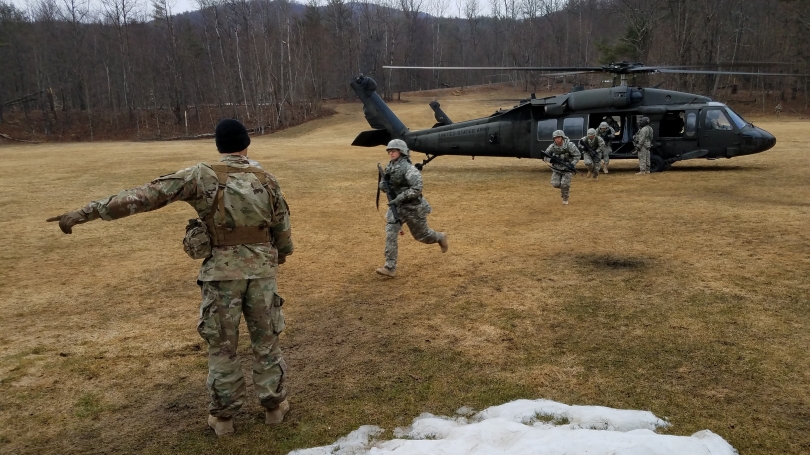
The Army at Dartmouth has had both a storied past and a bright future.
Dartmouth's relationship to the Army can be traced as early as 1779. That year John Wheelock assumed the duties as President of Dartmouth College after the death of his father Rev. Eleazar Wheelock its first president and founder. John Wheelock was a former Lieutenant Colonel in the Continental Army and one of the Inaugural Graduates of Dartmouth College. Although not an academic or minister he successfully supervised the operation of the school for almost forty years and some of his most notable exploits include; overseeing the construction of Dartmouth Hall, the founding of Dartmouth Medical School - fourth oldest in the country, and Dartmouth's financial durability due to a 23,000 acre grant procurement in Wheelock, Vermont from the Vermont Legislature. It can be surmised that his combination of his religious upbringing and military experience gave rise to what is described as John Wheelock's formal bearing and austere educational leadership.
In 1803, another young man by the name of Sylvanus Thayer entered Dartmouth College for the first time. Thayer was inducted invited to join the United Fraternity and was a member of Phi Beta Kappa. He would later graduate as the valedictorian in 1807 and be appointed by President James Madison to attend the United States Military Academy at West Point. Thayer attended West Point but was surprised at the laxness of its curriculum. He graduated from West Point in 1808 as a Second Lieutenant in the Corps of Engineers. During the War of 1812 he planned and directed the successful defense of Norfolk, Virginia. He was promoted, sent to study abroad, and later assigned as Superintendent of West Point for 16 years. After several years of Active Duty in the Army and his contributions to numerous institutions of higher learning, Sylvanus Thayer retired to Massachusetts and donated money for the founding of what would later be known as the Thayer School of Engineering at Dartmouth College.
At the behest of its European allies and believing it the right thing to do, the United States entered "The Great War" in April of 1917 with the intention to halt the imperialistic armies of its opponents and restore peace and liberty to Europe. Shortly after this declaration Dartmouth College answered the call to arms, as did most American colleges, and established on its grounds a Student Army Training Corps, a very short-lived project designed by the federal government to involve higher education in the preparation of soldiers for war. On October 1, 1918; Dartmouth College, the United States Army, and the United States Navy conducted the activation ceremony for an Army Regiment (SATC 317) and Naval Detachment that would live, study, work, and train on the Dartmouth Campus and in its facilities in Hanover, New Hampshire. During the next year, until the signing of the Armistice on September 17, 1919, the college was for all intents and purposes converted into an active duty Army training installation whose primary purpose was to develop strong, intelligent, and capable officers and soldiers for the riggers of trench warfare.
Following the infamous attack on Pearl Harbor by the Imperial Japanese Navy and in conjunction with continued provocation by Germany and Italy, the United States formally declared war on the Axis powers December 8-11, 1941. Quickly, students and professors alike from around the nation joined the armed forces to do their part in the fight for freedom against fascist and imperial dictators. The draft age was lowered and many institutions of higher learning once more turned to the task of training and fielding skilled members of the armed forces. Dartmouth College itself became host to the largest U.S. Navy V-12 training program in the country. Naval Officers and sailors from around the nation were transferred to Hanover and the Dartmouth campus was quickly transformed once more, essentially, to an active duty military training base.
On June 25, 1950, the Korean War began when some 75,000 soldiers from the North Korean People's Army poured across the 38th parallel, the boundary between the Soviet-backed Democratic People's Republic of Korea to the north and the pro-Western Republic of Korea to the south. This invasion was the first military action of the Cold War. By July, American troops had entered the war on South Korea's behalf. As far as American officials were concerned, it was a war against the forces of international communism itself. As it had done so many times in its past, Dartmouth College answered the call of service to country. In 1951, during the height of the Korean War, Dartmouth College established an Army ROTC Corps on its grounds. The students who volunteer to participate learn what it means to be a leader of soldiers and upon completion of their degrees enter into the Army as Second Lieutenants. Many of them seeing service during the Korean subsequent Vietnam War. This time however once the war ended the program did not end and ROTC became an integral part of Dartmouth College life for many years to come.
Due in part to joint coalition actions ranging from World War II through the Korean War, the United States becomes increasingly involved in Vietnam and South Vietnam's fight for independence. Great head way is made early in the War with the training of South Vietnamese Forces and brave actions by the U.S. combat forces. Unfortunately, due to strong backing from its communist allies and a U.S. directive not to attack beyond the borders of South Vietnam, North Vietnam proves to be difficult to combat and accomplishes a major Victory in with the Tet Offensive of 1968. After this enemy victory public opinion turns sharply and the U.S. Forces begin to lose the faith and support of their country's population.
Approximately 80 students stormed and took over Parkhurst Hall for 12 hours in 1969 to protest Dartmouth's ROTC program. Opposition to the College's military ties and the trustees' conflicting decision to sustain the Reserve Officer Training Corps in a time of such prominent anti-war movements drove protesters to occupy the administration building.
Many anti-war Dartmouth students in the Vietnam era centered their protest movement on the campus' army reserve training program.
A group from the time called Students for a Democratic Society (SDS) collaborated with teachers in a fervent attempt to hasten the administration's removal of the ROTC from Dartmouth. Like-minded organizations at other Ivy League campuses were rallying for the same mission.
John Spritzler '68, a leader of SDS, told The Dartmouth that he participated in candlelight vigils every week around the Green in protest against the Vietnam War. A passionate participant of the Parkhurst takeover, he recalls when the group realized they had the authority to seize the building and stir up such an anti-ROTC movement.
A group of conservative students "called for a pro-war demonstration for a Wednesday afternoon, which was exactly the time when the anti-war people had a peace vigil," he recalled. "I remember we dreaded that day approaching because we thought we'd be swamped by pro-war students against us. When the day finally came, there were about 50 people in the pro-war line and about 1500 people in anti-war line that formed a snake all the way around Green." He said that was a decisive moment in Dartmouth's anti-war movement. "From that day on we knew we were the majority," he said. "That's why we had the anti-ROTC movement in the first place."
The ROTC's noticeable position on campus in the 1960s sparked a series of debates and referendums at the time. Nearly 400 students were enrolled in the program, which granted participants sizeable scholarships and course credit. These advantages to being a member of the training program heightened the controversy over the decision of how to reform or phase it out. Students' and teachers' opinions on ROTC separated into two general categories, according to SDS member and Parkhurst protestor, Stephen J. Stoll '68. "There were students who felt the ROTC was incompatible with a liberal arts education," he remembered.
The American Civil Liberties Union backed this disapproval of mandatory ROTC programs. According to an article that ran in The Dartmouth on March 4, 1969, the ACLU said such programs "threaten the values of free inquiry and academic autonomy which are at the heart of academic freedom."
Stoll said the other general opinion — which he shared — was that the ROTC was an "instrument of the U.S. military." He said the College should not have been in support of the U.S. military at a time when so many students saw it as "morally reprehensible."
Although most students who forcefully ejected administrators from Parkhurst and seized the building were arrested and sent to jail, their goals eventually came to fruition.
By the early 1970s, the ROTC was completely abolished from Dartmouth's campus.
"There were some demands the College agreed to make toward the military that the military wouldn't accept. As a result, ROTC was taken off campus," Stoll said.
About a decade after the end of America's war in Vietnam, College President David McLaughlin allowed the return of the ROTC to campus in the early 1980s. However, only the army branch chose to start up again at Dartmouth. The Naval and Air-Force branches have not reemerged since the program was permitted back on campus.
The modern-day stance is vastly different from the campus environment of the 60s and 70s when the majority of community members opposed the country's war effort. Since the September 11 attacks, opinion polls have shown high levels of support for U.S. military action, and according to the Gallup Organization, public approval for the military campaign has run between 86 and 92 percent since the government launched its anti-terrorism effort.
In other words, even if Dartmouth students and other Americans are not rushing to join up with the army, citizens are generally supportive and more in tuned with the country's military engagements than they were during Vietnam. Stoll, who was so active during the late-1960s, acknowledged that "the focus on ROTC would not be the same now as it was then … at a time when most Americans were opposed to war efforts."
Spritzler, however, remains adamant in his radically anti-war stance: "The government fundamentally uses violence to enforce their policies and the ROTC is a part of this system of force ... it is what they use to control people to make sure this stays an unequal society." His voice might have seemed centrist in the 1970s, but today, his stance that "the whole U.S. Army should be abolished" is very extreme. He said the reason why he so adamantly opposes the army is that the country "would be better off if millions of people round the world didn't blame Americans for their problems."
In 1994, a series of faculty votes once again supported the elimination of ROTC from Dartmouth, due to their opposition to the military's don't-ask-don't-tell policy (a former law approved by congress) regarding homosexuals which has since been repealed. Harvard University banned the ROTC on its campus due to their concordant objection to this military policy but has recently accepted ROTC back on campus.
Dartmouth College will kept the Army Reserve Officers Training Corps program on its Hanover, N.H., campus. But the Dartmouth Board of Trustees, in voting to maintain its ROTC program, continued to pressure the Department of Defense to stop discriminating against gays. The board deplored the so-called "don't ask, don't tell" policy enacted by the Clinton Administration, saying it placed schools in an unacceptable situation.
Harvard did not have ROTC on campus until recently, previously its students participated in MIT's program off campus. Like Dartmouth, the University maintained its ties to ROTC at the same time that it stated its opposition to the former military policy on gays. Both Harvard and Dartmouth said they wanted their students to be able to participate in the military program. But they also wanted an officers' training program that did not discriminate against anyone based on sexual orientation.
The College has approximately fifteen students active in its Army ROTC program. Three-quarters are on scholarship. The College is an extension center of Norwich University as its program is small but is now afforded a full-time Army Staff. I would say that recruitment is very difficult at Dartmouth. Let me qualify that by saying that we never stop trying.
Dartmouth's ROTC program was once much larger. But the College is was not alone in its declining enrollment. During the early 90s during the big draw-down of the Armed Forces, many ROTC programs were closed and their students cross-enrolled in other schools' ROTC programs. This is what happened at Dartmouth. ROTC is still offered at hundreds of colleges and universities across the country, including such selective universities as Cornell and the MIT.
The Army ROTC at Dartmouth College is the one college course that helps you develop leadership skills, managerial skills, and confidence to put you on the fast track of life. Dartmouth's Cadets study abroad, train on leadership skills in the summer, and attended the prestigious schools like Airborne School, Air Assault School, Sapper Leader Course, and several others. Despite their exemplary commitment to the program, many are division one athletes, in fraternities, play in concerts, and take part in other College activities.
ROTC is an elective taken with other college courses and normally covers four years, divided between Basic and Advanced Courses. The classes, taught in Leverone Field House, require about five hours weekly. Once a term, cadets train at Norwich University, a one-hour drive up I-89. At Norwich, students gain leadership experience as they work in larger groups. They practice military tactics and maneuvers, including the task of leading thirty-five to forty cadets across field terrains, which requires considerable organization and communication. Other operations include night, mountain, and snow maneuvers. Cadets recall that the FTX (field training exercise) in Norwich was 'a great learning experience. We trudged up mountains through two feet of freshly fallen snow. Our mock enemy was the Tenth Mountain Division of the regular Army.' Despite the handicap, the program teaches leadership and technical skills. ROTC coupled with an Ivy League education produces well-rounded individuals who are better prepared to confront problems in the private sector as well as the military sector.
The Basic Course requires no commitment to the Army and includes study of Adventure Training, Life Skills Training, Basic Military Skills, and Basic Leadership Development. Students must have contracted prior to entry into the Advanced Course. Contracted students have committed to serve in the U.S. Army on active duty or in a reserve component after graduation. Advanced Course Cadets attend the Leadership Development and Assessment Course (LDAC) between their junior and senior year. Cadets are commissioned as Second Lieutenants after graduation from LDAC and Dartmouth College with at least a Bachelors degree. The curriculum of the Advanced Course includes Advanced Tactics, The Army Ethic, Cadet to Lieutenant Transition, and Advanced Leadership and Management Skills. Contracted Cadets generally serve anywhere from three to four years in active duty or six years in a reserve component.