Unit History

Recent articles on Dartmouth Army ROTC

6 February 2004 Dartmouth Free Press column "Student Soldiers at Dartmouth" by Welton Chang

20 February 2004 Dartmouth Free Press column "ROTC: Five Years of Obscurity" by Welton Chang

5 March 2004 Dartmouth Free Press column "Life in the Dartmouth ROTC" by Welton Chang

Advocates for ROTC website


Army ROTC at Dartmouth College
ROTC at Dartmouth has had both a storied past and a bright future. The ROTC Program was reinstated in 1985 after leaving campus for a number of years. Here is a short history of the program.

Compiled from:
<http://www.thedartmouth.com/article.php?aid=2001111401080>
<http://www.thecrimson.harvard.edu/article.aspx?ref=228947>
<http://www.dartreview.com/archives/2001/05/14/be_all_you_can_be_in_the_rotc.php>
<http://www.vnews.com/04132003/1037982.htm>

Approximately 80 students stormed and took over Parkhurst Hall for 12 hours in 1969 to protest Dartmouth's ROTC program. Opposition to the College's military ties and the trustees' conflicting decision to sustain the Reserve Officer Training Corps in a time of such prominent anti-war movements drove protestors to occupy the administration building.

Although the ROTC was kicked off campus in the Vietnam era, it did return -- less prominent and less subject to controversy than before -- in the mid 1980s.

Currently, with eight student members and one captain, the program's low-profile presence elicits only occasional controversy and debate -- and certainly doesn't draw a crowd of 1000 to the front of Parkhurst for a protest takeover. Even as America's war against terrorism broke out, student interest in or aversion to the campus' ROTC program has been far from passionate.


The 1969 Protest

Many anti-war Dartmouth students in the Vietnam era centered their protest movement on the campus' army reserve training program.

A group from the time called Students for a Democratic Society (SDS) collaborated with teachers in a fervent attempt to hasten the administration's removal of the ROTC from Dartmouth. Like-minded organizations at other Ivy League campuses were rallying for the same mission.

John Spritzler '68, a leader of SDS, told The Dartmouth that he participated in candlelight vigils every week around the Green in protest against the Vietnam War. A passionate participant of the Parkhurst takeover, he recalls when the group realized they had the authority to seize the building and stir up such an anti-ROTC movement.

A group of conservative students "called for a pro-war demonstration for a Wednesday afternoon, which was exactly the time when the anti-war people had a peace vigil," he recalled. "I remember we dreaded that day approaching because we thought we'd be swamped by pro-war students against us. When the day finally came, there were about 50 people in the pro-war line and about 1500 people in anti-war line that formed a snake all the way around Green."

He said that was a decisive moment in Dartmouth's anti-war movement.

"From that day on we knew we were the majority," he said. "That's why we had the anti-ROTC movement in the first place."

The ROTC's noticeable position on campus in the 1960s sparked a series of debates and referendums at the time. Nearly 400 students were enrolled in the program, which granted participants sizeable scholarships and course credit. These advantages to being a member of the training program heightened the controversy over the decision of how to reform or phase it out.

Students' and teachers' opinions on ROTC separated into two general categories, according to SDS member and Parkhurst protestor, Stephen J. Stoll '68.

"There were students who felt the ROTC was incompatible with a liberal arts education," he remembered.

The American Civil Liberties Union backed this disapproval of mandatory ROTC programs. According to an article that ran in The Dartmouth on March 4, 1969, the ACLU said such programs "threaten the values of free inquiry and academic autonomy which are at the heart of academic freedom."

Stoll said the other general opinion -- which he shared -- was that the ROTC was an "instrument of the U.S. military."

He said the College should not have been in support of the U.S. military at a time when so many students saw it as "morally reprehensible."

Although most students who forcefully ejected administrators from Parkhurst and seized the building were arrested and sent to jail, their goals eventually came to fruition.

By the early 1970s, the ROTC was completely abolished from Dartmouth's campus.

"There were some demands the College agreed to make toward the military that the military wouldn't accept. As a result, ROTC was taken off campus," Stoll said.


ROTC Returns

About a decade after the end of America's war in Vietnam, College President David McLaughlin allowed the return of the ROTC to campus in the early 1980s. However, only the army branch chose to start up again at Dartmouth. The Naval and Air-Force branches have not reemerged since the program was permitted back on campus.

Captain Gregory Goth, whose primary duty is at the Norwich Academy in Vermont, leads the student members of Dartmouth's ROTC program in its weekly classroom sessions.

Mike Breen '02 runs the training and physical sessions in his role as the cadet company commander.

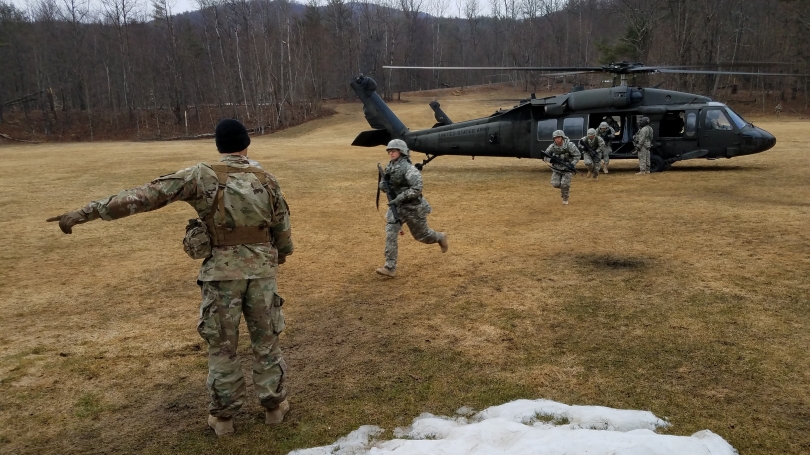
ROTC does not require an intense, strict regimen of training, but focuses more on the study of military tactics, debates over its status and talks about current events that concern the army. Once a week, the group ventures into the fields that surround Hanover to train and practice essential skills, such as camouflaging and navigating with compasses.

The ROTC is "designed to give college undergraduates training in basic military leadership … and to educate college students in general about the military," said Breen. "We have actually had some total anti-military people join up for a month," he added, to learn about different aspects of the military.

The Army provides scholarships for students who apply to join their campus's ROTC program, on the condition that these students serve in the U.S. Army on active duty and in the Army Reserve Corps for a total of eight years after graduation.

Breen will be an Officer for the Army next year, and John Craven '03, also a member, is in the process of confirming his contract that will destine him for a similar role.

Harry Camp '04, who signed a contract before his freshman year, decided before returning to school this fall to revoke his commitment.

While Camp was deterred by the fact that his keeping the full scholarship would "incur another four years of active duty," he said he would still consider joining the Army for a few years.

"The only reason I got out wasn't because my military views changed," he said. He added that the events of Sept. 11 did not affect his views -- he actually made his decision before that date. "If anything, that would have made me more inclined," to stay with the program, he said.

Interest in joining the ROTC has not noticeably increased this year, according to Breen.

"People are viewing the military in a different way now," said Craven. "The idea of serving your country is coming back a bit."


Continuing Controversy

The modern-day stance is vastly different from the campus environment of the 60s and 70s when the majority of community members opposed the country's war effort.

Since the Sept. 11 attacks, opinion polls have shown high levels of support for U.S. military action, and according to the Gallup Organization, public approval for the military campaign has run between 86 and 92 percent since the government launched its anti-terrorism effort.

In other words, even if Dartmouth students and other Americans are not rushing to join up with the army, citizens are generally supportive and more in tuned with the country's military engagements than they were during Vietnam.

Stoll, who was so active during the late-1960s, acknowledged that "the focus on ROTC would not be the same now as it was then … at a time when most Americans were opposed to war efforts."

Spritzler, however, remains adamant in his radically anti-war stance: "The government fundamentally uses violence to enforce their policies and the ROTC is a part of this system of force ... it is what they use to control people to make sure this stays an unequal society."

His voice might have seemed centrist in the 1970s, but today, his stance that "the whole U.S. Army should be abolished" is very extreme. He said the reason why he so adamantly opposes the army is that the country "would be better off if millions of people round the world didn't blame Americans for their problems."

In 1994, a series of faculty votes once again supported the elimination of ROTC from Dartmouth, due to their opposition to the military's don't-ask-don't-tell policy regarding homosexuals. Harvard University recently banned the ROTC on campus due to their concordant objection to this military's policy.

In his article entitled "Crimson Shame" published in the conservative National Review, Stanley Kurtz contested Harvard's decision. The ROTC was removed, he wrote, '"Because of a foolish and contemptible hatred of the military by a bunch of spoiled, elitist, and decidedly unpatriotic students who do not understand that everything they have depends upon the willingness of courageous young men to defend this country.'"

Breen said that while "Americans have a historic distrust of the military when we're not at war," an ROTC program, no matter how small it may be, is indispensable.

There is "underlying friction between ROTC and the administration that has to do with prevailing attitudes about the military in our society," said Craven, who considers such tensions routine. Craven grew up on Army bases in Germany in the U.S, as his father served on active duty for the military for 20 years.

Dartmouth is not currently considering removal of ROTC, although the program is kept conveniently inconspicuous.

Breen, who deals with a huge lack of school support, contends, "It would be a mistake to kick ROTC off campus if you truly believe that your school is a place that successfully educates people in values you want to educate them in." If the school "thinks ROTC is flawed, they should want people to go into the military and change it."


1994: Harvard Crimson

Dartmouth College will keep the Army Reserve Officers Training Corps program on its Hanover, N.H., campus. But the Dartmouth Board of Trustees, in voting to maintain its ROTC program, said last week that it will pressure the Department of Defense to stop discriminating against gays.

The board deplored the so-called "don't ask, don't tell" policy enacted by the Clinton Administration last year, saying it places schools in an unacceptable situation.

"The policy forces Dartmouth, as well as other colleges and universities, to make an unconscionable choice as to which students they wish to disadvantage”, said a statement released by the board.

Harvard does not have ROTC on campus, but its students can participate in MIT's program. Like Dartmouth, the University has maintained its ties to ROTC at the same time that it states its opposition to the military's policy on gays. Both Harvard and Dartmouth say they want their students to be able to participate in the military program. But they also want an officers' training program that does not discriminate against anyone based on sexual orientation. The Dartmouth board said in its statement that it might join court cases challenging the gay ban and might try to pressure the White House, Congress and military leaders.

"The trustees believe that American society is in a period of transition that will ultimately lead it to embrace full and equal participation of homosexuals in the military," the statement said.

"President Clinton's attempt to change military policy, while not wholly successful, has nonetheless accelerated this development. The trustees now commit Dartmouth College to help push the transition forward."

ROTC at Dartmouth was phased out during the Vietnam war, but the Army program was reinstated in 1985.

Four years ago, Dartmouth President James O.Freedman called on the Pentagon to drop its ban on gays.

"The security interests of the Unites States are best served by public policies that assure a supply of talented officers from our colleges and universities and that the public regards as fair and appropriate," Freedman wrote at the time.

"In my judgment, the Department of Defense's policy of discriminating against homosexuals in ROTC, at a time when all other forms of invidious discrimination have been prohibited, puts both of these goals at risk."

In an article for the Review, Dartmouth Professor Emeritus of English Jeffrey Hart credited former College President David McLaughlin with enraging the faculty 'by returning ROTC to campus, ordered to do so by the Trustees, who, like most Americans, did not see the U.S. Army as the enemy.' Though the Army may not be the enemy, the College certainly does not treat it as a friend.

The College has only eight students active in its Army ROTC program. Half are on scholarship. A single student has been commissioned each of the past two years. The College is a mere extension center of Norwich University as its program is 'too small to warrant a full-time Army Staff,' according to ROTC organizer Captain Gregory M. Goth. Says student cadet Harry Camp'04, 'From my experience, I would say that recruitment is virtually impossible at Dartmouth. Let me qualify that by saying that we never stop trying.'

Goth does try to recruit students for the program. 'Each year, during the summer,' he says, 'the ROTC program sends out a mass mailing of information packets on the Army ROTC program. These packets are sent to all incoming freshmen and contain information on the program as well as scholarship information. Also during the year we try to attend all the student activities fairs and the parents weekend activities. I am also available throughout the year to meet with incoming or prospective students.'

Dartmouth's ROTC program was once much larger. But the College is not alone in its declining enrollment. Goth explained, 'During the early ë90s during the big draw-down of the Armed Forces, many ROTC programs were closed and their students cross-enrolled in other schools' ROTC programs. This is what happened at Dartmouth.' ROTC is still offered at hundreds of colleges and universities across the country, including such selective universities as Cornell and the MIT.

The Army ROTC at Dartmouth College website (www.dartmouth.edu/~rotc) says that ROTC is 'the one college course that helps you develop leadership skills, managerial skills, [and] confidence...to put you on the fast track of life.' Dartmouth's highest-ranking cadet, Mike Breen '02, has already benefited from the unique opportunities offered by ROTC. He has been trained in digital radio and other communications technologies, traveled to Khazakstan and Uzbekistan to study foreign equipment, and attended the prestigious Army Airborne School in Fort Benning, Georgia. Despite his exemplary commitment to the program, he is still able to work toward majors in Government and Religion, sing with the Cords a capella group, and take part in other College activities.

ROTC is an elective taken with other college courses and normally covers four years, divided between Basic and Advanced Courses. The classes, taught in Leverone Field House, require about five hours weekly. The program has an office and a classroom, but upon the completion of Leverone's refurbishment, ROTC will be limited to the office space. Once a term, cadets train 'crosstown' at Norwich University, a one-hour drive up I-89 that students must make with personal cars. At Norwich, students gain leadership experience as they work in larger groups. They practice military tactics and maneuvers, including the task of leading thirty-five to forty cadets across field terrains, which requires considerable organization and communication. Other operations include night, mountain, and snow manuvers. Camp recalls that the FTX (field training exercise) in Norwich was 'a great learning experience. We trudged up mountains through two feet of freshly fallen snow. Our mock enemy was the Tenth Mountain Division of the regular Army. They had snow camo, snow shoes, and skis--needless to say we were a bit outmoded.' Despite the handicap, Camp says the program taught leadership and technical skills. ROTC coupled with an Ivy League education produces well-rounded individuals who are better prepared to confront problems in the private sector as well as the military sector.

The Basic Course requires no commitment to the Army and includes study of Adventure Training, Life Skills Training, Basic Military Skills, and Basic Leadership Development. Upon entry to the Advanced Course, students are commissioned as Second Lieutenants and are committed to serve in the U.S. Army on active duty or in an Army Reserve component. The curriculum of the Advanced Course includes Advanced Tactics, The Army Ethic, Cadet to Lieutenant Transition, and Advanced Leadership and Management Skills. Breen plans on serving at least six years in active duty, citing his family's tradition and a moral obligation to serve.

Participating students can earn up to $1,500 each year. Additionally, all ROTC textbooks, uniforms, and materials are fully furnished. Students receive a 'hands-on feeling for the Army' over a five-week paid camp between the junior and senior years.

Because, however, of a College policy of deducting outside scholarships, including ROTC monies, from financial aid packages, Breen notes that there is 'no financial incentive to incur the obligations' of the program.

Some students may be put off by the Army's 'don't ask, don't tell' policy. Referring to the policy, Captain Goth offered, 'it is hard to tell what effect it has had on the program; it may have had some negative effect on recruiting incoming students and retention of those already here.' But Goth is quick to defend the Department's policy. 'The key to understanding the Department of Defense policy on homosexual conduct,' Goth says, 'is to remember that the policy focuses on homosexual conduct, not on sexual orientation alone. Conduct is considered to be statements, acts, or marriages.'

Dartmouth's ROTC program is so inconspicuous that in late October of Breen's freshman year, a classmate mistook his uniform for a Halloween costume. Student cadets have their character tested by a College that pretends that they don't exist. 'At Dartmouth,' Breen says, 'it's all on you.'