Department of Physics and Astronomy, Dartmouth College


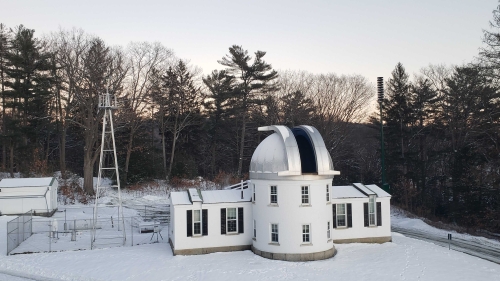
Entrance to Wilder Laboratories

People

Research

Graduate Study

Undergraduate Study

Monthly Calendar

Public Observing

Contact Information

Department News


Home

Site Map


Research Overview - Space Physics

Home > Research > Overview > Space Physics


The program in Space Plasma Physics includes both a theoretical group led by Professors Mary Hudson and Barrett Rogers, and an experimental group led by Professors Jim LaBelle, Kristina Lynch, and Robyn Millan.

Magnetic shockwave Left: Computer simulation of a shock-front in the solar wind interacting with the Earth's magnetosphere. In the upper frame, the advancing front appears as the red region in the lower left. In the lower frame, the front has passed the Earth, seriously disrupting its magnetic field (orange and white lines). [Calculation by J. Lyon]

The theoretical Space Physics group incorporates 3D global magneto- hydrodynamic (MHD) simulations (Lyon, Wiltberger) of the solar wind interacting with the earth's magnetosphere, and hybrid simulations on a finer scale of processes associated with the flow of the solar wind around the magnetosphere. Phenomena involved include the energy conversion from the pileup of magnetic flux frozen into plasma flow around the obstacle presented by the earth's magnetic field, the process of magnetic reconnection. The response of the magnetosphere to external perturbations sets up low frequency (mHz) standing and traveling waves and cavity modes which can lead to radial transport and energization of radiation belt electrons and trapping of solar energetic protons (Hudson). The buildup of the ring current, magnetic field gradient driven east-west drift of electrons and ions, during geomagnetic storm periods leads to internal excitation of mHz frequency waves and pitch angle scattering and loss of quasi-trapped solar energetic protons (Denton, Hudson).

Magnetic reconnection enables a plasma system to convert magnetic energy into high speed flows and thermal energy, and also allows the topology of the magnetic field to change. It is thought to play an essential role in a broad range of plasma systems, including the magnetosphere, the interstellar medium, molecular clouds, the solar atmosphere, accretion disks, and laboratory fusion devices.

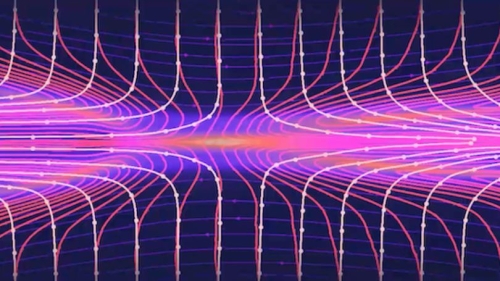
Two Fluid Reconnection Right: Magnetic field lines and plasma current in a two-fluid reconnection simulation

The basic physics of the reconnection process depends strongly on the plasma conditions in which it occurs. Research on this topic at Dartmouth (Rogers, Denton) is focused on understanding the dynamics of reconnection process in a variety of plasma systems in space and in the laboratory. This research is closely coupled to experimental work at MIT and Princeton, and utilizes both analytic and computational approaches.

Computer resources for the space plasma theory group include a eight processor Origins 2000 system, a Beowulf PC cluster, ten workstations and access to remote supercomputing resources. The experimental Space Physics group has been engaged in sounding rocket research in the northern hemisphere auroral zone and at the geomagnetic equator (Brazil). A high frequency (MHz) wave receiver has been developed and flown on several NASA sounding rockets to study electromagnetic waves excited by precipitating auroral electrons, and the effects of electron density structure on wave generation and propagation, both at high and low geomagnetic latitudes. Two upcoming sounding rocket experiments will be flown from Norway and Alaska in '05 to study auroral phenomena. An extensive network of groundbased auroral radio receivers has been deployed by the group, in Canada, Greenland and Antarctica. Most recently, an imaging array has been constructed and operated at Sondrestrom, Greenland, to coordinate with ionospheric density measurements using the incoherent scatter radar facility there.

The Dartmouth balloon group (Robyn Millan) conducts scientific balloon experiments to study the loss of relativistic electrons from Earth's Van Allen radiation belts. The main way for electrons to be lost from the radiation belts is to the Earth's atmosphere (called relativistic electron precipitation). In particular, we are trying to quantify the loss rate and understand the processes that scatter electrons into the atmosphere. This information will be a vital component of any successful physics-based radiation belt model. Our current projects include continued analysis of data from the 2000 MAXIS balloon flight which detected two types of relativistic electron precipitation, and building hardware for a balloon campaign in Churchill, Manitoba this coming January (2005).

Web link: http://www.dartmouth.edu/~ rmillan/index.html

The Heliosphere The extended solar wind (beyond planetary distances) carves out a bubble in the surrounding interstellar gas. This so-called heliosphere is a large region of space where solar wind and interstellar plasma interact, and where interstellar neutral particles form yet another distinct distribution. Weak ion-neutral coupling such as charge exchange complicates the involved physics, and large-scale computer simulations (multifluid and neutral kinetic) are carried out to model the heliosphere, as well as analogues from stellar winds of other cool main-sequence stars. The models are used to interpret data from interplanetary spacecraft (including Voyager 1 which is poised to cross the termination shock soon), and also to match HST spectra of the absorption from heliospheric and astrospheric hydrogen walls (Hans Müller).

Maps of typical simulation output, with the Sun at the origin and the interstellar wind coming from the right. Distances are in AU, the Sun-Earth distance; the orbit of Pluto is outlined as dotted circle. The upper panel shows the plasma temperature and reveals boundaries like the termination shock and the interstellar bow shock. The lower panel is the density of the dominant neutral species, neutral hydrogen. The interaction with the plasma gives rise to an overdensity, the hydrogen wall.

Maria Greenland radar Sondrestrom Research Facility near Kangerllussuag, Greenland is dedicated to the study of the polar upper atmosphere and the center instrument is an incoherent scatter radar with 32m steerable antenna. Dartmouth (Professor James LaBelle) employs an HF receiver (designed and built at Dartmouth) for the study of the aurora.

Additional theoretical and experimental space physics research is ongoing at the Thayer School of Engineering under the direction of Professors Lotko, Sonnerup, Shepherd, and Streltsov.

Dartmouth is part of the NSF-funded Center for Integrated Space Weather Modeling (CISM) consortium.

Further information can be found at the Space Physics web page.

Recent Publications

Hudson, MK., BT Kress, JE Mazur KL Perry and PL Slocum 3D modeling of shock-induced trapping of solar energetic particles in the earth's magnetosphere, J. Atmos. Solar-Terr. Phys., 66/15-16, 1389-1397, doi:10.1016/j.jastp.2004.03.024, 2004.
Kress, B.T., M K Hudson and P L Slocum Impulsive Solar Energetic Ion Trapping in the Magnetosphere During Geomagnetic storms, Geophys. Res. Lett., 10.1029/2005GL022373m 31 March 2005.
J. Labelle, R.A. Treumann, P.H.Yoon, M. Karlicky, "A model of zebra emission in solar type IV radio bursts," Astrophysical Journal 593, 1195 (2003).
K. A. Lynch, J. W. Bonnell, C. W. Carlson, and W. J. Peria, "Return current region aurora: E-parallel, j-z, particle energization and BBELF wave activity", Journal Geophysical Research, 10.1029/2001JA900124, 2002.
H.-R. Müller and G.P. Zank, "Heliospheric filtration of interstellar heavy atoms: Sensitivity to hydrogen background," Journal Geophysical Research 109, A07104 (2004).
G. Paschmann, S. Haaland, R. Treumann, eds., "Auroral Plasma Physics", Space Science Review 103, no. 1-4, 2002. (Note: K. Lynch was a member of the core editing group for this monograph. Core editors were J. Borovsky, C. Carlson, G. Haerendel, B. Hultqvist, H. Koskinen, W. Lotko, K. Lynch, and G. Marklund.)
Perry, K L, M K Hudson and S R Elkington Incorporating spectral characteristics of Pc5 waves into 3-dimensional radiation belt modeling and the diffusion of relativistic electrons, J. Geophys. Res., Vol. 110, No. A3, A0321510.1029/2004JA010760, 2005.
J.H.A. Sobral, M.A. Abdu, P. Muralikrishna, J. Labelle, V.M. Castilho, C.J. Zanilutti, "Rocket and ground-based electron density soundings versus IRI representation," Advances in Space Research 31, 569 (2003).