|
|
Research Overview - Astrophyics & Cosmology
Home > Research > Overview > Astronomy & Cosmology
|
|
Research in astrophysics and cosmology is carried out by Professors Robert Caldwell, Brian Chaboyer, Robert Fesen, Marcelo Gleiser, John Thorstensen, and Gary Wegner. Three of the faculty are primarily optical/infrared observers, while the other three
are theorists. Including adjunct faculty, long-term visitors, postdocs, and graduate students, we have a very strong
effort focused on the physical Universe within the Department of Physics and Astronomy.
Astrophysics
Research in astrophysics includes the following. Theoretical models of stellar evolution; globular clusters; helio
and astro-seismology; galaxy formation (Chaboyer). Infrared, optical, UV and x-ray studies of supernovae and supernova remnants;
investigations of the interstellar medium (Fesen). Optical studies of close binary stars; spectroscopic studies of cataclysmic variable stars (Thorstensen). Multi-band
observations of the large scale structure and distribution of galaxies; peculiar motions; the fundamental plane
relation for early-type galaxies (Wegner).
Right: an image of the supernova remnant in Cas A, taken by Professor Robert Fesen.
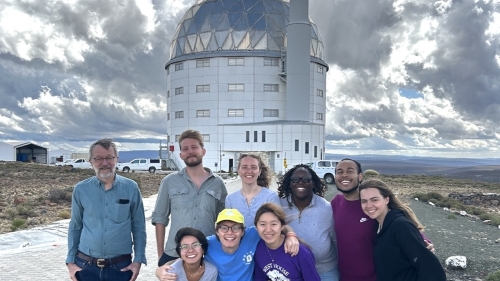
Left: The Southern African Large Telescope (SALT) is being built by an international consortium, including
Dartmouth which owns 10.5%. Scheduled to be completed in 2005, SALT will detect objects one billion times dimmer than the faintest visible to the
unaided eye. As the largest single optical/infrared telescope in the southern hemisphere, it will have the power to tackle fundamental questions about
the Universe, such as what the Universe was like when the first stars and galaxies were forming.
Currently, Dartmouth's observing facilities are located at the MDM Observatory on Kitt Peak, which we operate jointly with the University of Michigan,
Ohio State University, and Columbia University. MDM has 2.4-m and 1.3-m telescopes and a suite of state-of-the-art optical and infrared instruments.
Furthermore, Dartmouth astronomers, faculty and students, regularly make observations with other world-class, ground-based and satellite facilities,
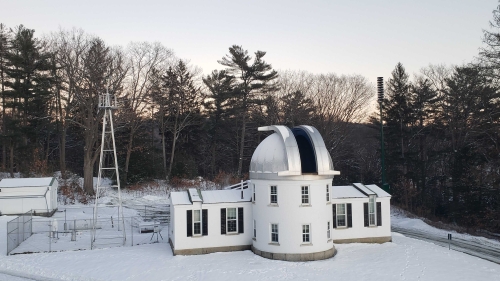
including the Hubble Space Telescope. For teaching purposes, the Department has two LX-200 10'' Meade telescopes. These telescopes are located on the
roof of Wilder Laboratory.
Cosmology
Research in cosmology, including gravitation and field theory, covers the following topics. Theory of the origin and evolution of the large-scale
structure of the Universe; the cosmic microwave background; quintessence dark energy and the accelerating Universe (Caldwell). The physics of the early Universe, at the interface of gravitation,
particle physics and cosmology; gravitational radiation; inflationary cosmology; numerical and analytical studies of nonequilibrium dynamics of quantum
fields and phase transitions (Gleiser).
Left: Images from research in cosmology. Cosmological phase transitions are very likely to have taken place in the early Universe, as a consequence
of symmetry breaking. Such phase transitions, an important clue to the underlying theory of elementary particle physics, have observational
consequences for cosmology, playing a role in the cosmic matter-antimatter asymmetry, and leading to the formation of topological defects such as
monopoles. At left is a slice through a simulation of the dynamics of a phase transition as may occur in the early Universe, by Prof. Marcelo
Gleiser.
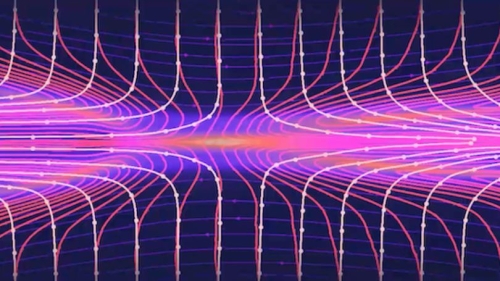
Right: An epoch of primordial inflation in the early Universe may have left a unique imprint on the observed cosmic microwave background
anisotropy, by way of gravitational waves. The polarization pattern on the CMB sky has a distinct pattern which, if detected (and there are several
experiments across the world racing to be the first), would allow us to directly "view" the Universe in the first fraction of a second of the Big
Bang. At right is a depiction of the effect of a gravitational wave on a test mass, which in this case is the Universe at the surface of last
scattering, by Prof. Robert Caldwell. The effect of a wave, here traveling upwards, on a spherical test body, is to induce alternating squeezing
and stretching distortions of the sphere.
Both the Astrophysics and Cosmology groups have their own research labs which house clusters of unix/linux workstations.
Further information is available at the Astrophysics and the
Cosmology research web pages.
Our recent publications (on ADS)
|