Department of Physics and Astronomy, Dartmouth College


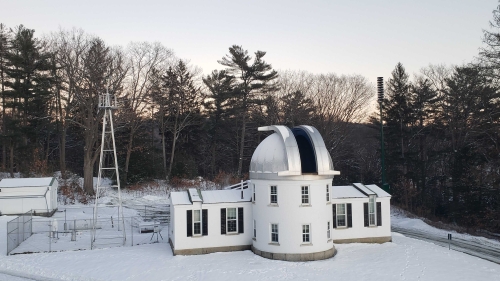
Entrance to Wilder Laboratories

People

Research

Graduate Study

Undergraduate Study

Monthly Calendar

Public Observing

Contact Information

Department News


Home

Site Map


Physics Major

Home > Academics > Physics Major

Physics has been defined as the study of that part of Nature which can be understood in mathematical terms. Physicists use mathematics to help them comprehend the enormous complexity of the world: to them, as to Galileo, "mathematics is the language of Nature." As our knowledge of the physical world becomes deeper, more of it becomes amenable to mathematical formulation, and hence part of physics: for example, atoms used to be regarded as the domain of the chemist alone, while now atomic physics is at the core of the physics curriculum. Mathematics also advances, and becomes able to tackle problems previously thought to be beyond its scope. The great physicist Richard Feynman said in 1963 that he could not conceive of a mathematical description of a cloud, but at that very moment Benoit Mandelbrot was developing the mathematics of "fractals," which turned out to provide just that description. As a result, new branches of physics, such as condensed matter physics and non-linear dynamics, are continually coming into being, as are hybrids with other sciences, for example, chemical physics, geophysics, biophysics and psychophysics

It has been truly said that without chemistry there would be no life: but without physics there would not be anything at all. The first half of this century saw a revolution in physics, in which "classical" physics, which reigned supreme at the turn of the century, was replaced in the domain of the very large by relativity and in that of the very small by quantum theory. This revolution was comparable in its philosophical implications to the great scientific revolution of the 17th Century (also, primarily, the work of physicists and astronomers). However, just as the latter did not significantly affect the consciousness of the general educated public until the following century, so the profound changes in our view of the world that this century's revolution requires, though the subject of much popular writing, have yet to be fully assimilated. Physics is not just a branch of technology but is one of the humanities, in the sense that its study is one road towards an understanding of our place in the Universe. This may be one reason why so many leaders in the struggle for freedom of thought in this century have been physicists: Albert Einstein, Andrei Sakharov, Edward Condon, Yuri Orlov, Irina Ratushinskaya and Fang Lizhi, for example.

Students graduating with a B.A. in physics from Dartmouth go on to careers in business, industry, law, teaching, and medicine, as well as to graduate school in physics, astronomy, history of science, and earth science.

The physics major at Dartmouth is designed to provide students with a solid foundation in analytic thinking, problem solving, and the fundamentals of physics. The introductory courses are offered at a number Student sitting under a tree of levels: you can begin a physics major at Dartmouth even if you've never had any physics before. There are also introductory sequences designed for students with advanced placement in just math, or in math and physics both. A new integrated sequence offers interested students the opportunity to study introductory physics, and calculus together in a unified format. Later on, a wide variety of upper level electives allow each student to tailor the physics and astronomy major to match their own interests.

Students who are interested in both the fundamental aspects of physics and in practical applications may want to consider the Engineering Physics major . This program offers a broad array of courses drawn from both the Physics and Astronomy department and the Thayer School of Engineering.

Physics and Your Career

What do students of physics do when they have obtained the bachelor's degree? About 40% of our graduating majors go on to graduate study in physics or a related discipline, aiming at a career in academia or research. Others go to medical school, to engineering school, or become research technicians or high school science teachers. However, by no means do all our majors pursue technical careers: there are many other possibilities. Many go into business, to law school, to social work and to a host of other careers. Because physics is "the most fundamental and all-inclusive of the sciences" (Feynman), a physics or modified physics degree is a good basis for any career in which scientific and technological considerations play an important role: in the modern world, this includes almost the entire spectrum of human activity. The study of physics provides a training in problem solving by quantitative and logical thinking and by model building, and develops the habit of concentrating on essentials and eliminating irrelevant detail. These are valuable skills in every walk of life. It is significant that many of the analytical techniques (e.g. operational research and game theory) used in business and economics were originally developed by physicists.

For information about career services offered by the American Institute of Physics, see www.aip.org/careersvc.

Courses in the Physics and Astronomy Major

By its very nature, physics requires a strong mathematical background, and the physics major has a minimum mathematical prerequisite of the four-course Introductory Calculus sequence ending with Differential Equations (Math 3, 8, 13, 23, or equivalent). Many students come to Dartmouth with advanced placement in mathematics and place out of one or more of these courses. While some of these courses can be taken in parallel with the four introductory physics courses (numbered 13, 14, 19 and 24) or the two introductory honors courses (15 and 16, the minimum mathematical prerequisite must be satisfied before the core (40's level) physics courses are taken. More mathematics than this minimum is desirable, particularly for those interested in pursuing theoretical research in graduate school: Linear Algebra (Math 22 or 24), Introduction to Applied Math (Math 46), Introduction to Applied Math (Math 46), Functions of a Complex Variable (Math 43), and Chaos (Math 53) are particularly recommended, as is an introductory computer science course.

Professor John Thorstensen teaching Physics 13 students about the physics of 
							strings and musical instruments. Right: Professor John Thorstensen teaching Physics 13 students about the physics of strings and musical instruments.

First year students who achieve the levels of advanced placement in physics described in the First Year, available from the First Year Office, receive credit for Physics 3 and/or Physics 4. If they wish, they can place into the honors sequence on the basis of an examination administered during First Year Orientation Week, so long as their mathematics preparation is adequate, and they are prepared to do the extra work involved in an honors course. In this case, it is possible to complete the introductory sequence Physics 15, 16, 17 in the first year. First year students can also place into Physics 15, and in exceptional cases, Physics 23.

The minimum physics major (including the physics prerequisites) consists of the following courses: Physics 13 and 14 plus Physics 19, 24, 41, 42, 43, 44, and two electives; or the honors sequence 15, 16, 24, 41, 42, 43, 44, plus three electives, one of which must fulfill the culminating experience requirement (see below). The major requires one upper-level laboratory course; Physics 47, Physics 48, Physics 49, Physics 76 or Astronomy 61. Elective courses are Physics 47, Physics 48, Physics 49, Astronomy 15 or 25, and all physics and astronomy courses numbered in the sixties and seventies. Brief descriptions of all undergraduate physics courses mentioned here are given on p. 10 of this guide. Courses in other departments (principally engineering or chemistry) can be substituted for some of these, by permission of the chair. The core sequence (41-44) can be taken in any order. Students are required to complete a culminating activity in the major. For the physics major this requirement may be satisfied by receiving credit for one of the following courses: Physics 68, Physics 72, Physics 73, Physics 74, Physics 76, Physics 82, Astronomy 74, Astronomy 75, Astronomy 81, Physics 87. Students who intend to proceed to graduate work in physics are strongly recommended to take more than the minimum number of electives. They should take Physics 66, 76, and 91 and advanced courses in physics and astronomy. There is also a wide range of graduate courses which are open to qualified undergraduates.

Students who are interested in the philosophical and cultural implications of physics should note that there are many other relevant courses outside the Science Division: for example, History 57 (Scientific Revolutions and Modern Society), Philosophy 27 (Philosophy of Science), and Religion 35 (Religion and Science). The department offers two courses satisfying the interdisciplinary requirement: Physics 1 (Understanding the Universe: Physics through the Ages) and Astronomy 4 (Development of Astronomical Thought).

While it is desirable to begin the physics sequence in the first year, it is possible to begin in the sophomore year and still complete the minimum major within four years. Consult the Chair or a major adviser at once if you are thinking of doing this.

Students with a wide range of interests, or who are particularly interested in cross-disciplinary fields such as biophysics, are encouraged to take a modified major, a double major, or a physics major with a minor in another subject. A modified major requires at least ten courses, of which at least six (excluding the two prerequisites) should be in physics. It is discussed in more detail in the next section. Another option is the Engineering Physics Major, which is described on p. 5.

Students majoring in another subject may modify it with physics, or take a physics minor (see p. 4). All courses numbered Physics 19 and above, or Astronomy 15 and above, are in principle suitable for the modified major, so long as the prerequisites are satisfied. It is often possible to substitute a course from another department for a prerequisite: for example Chemistry 81 can substitute for Physics 42, and EngSci 23 for Physics 41. Other substitutions can be made with the permission of the instructor of the course for which the prerequisite is required.

Click here for the Physics Major brouchure.

Click here for the Astronomy Major brouchure.

Suggested Enrollment Patterns for Physics Majors

The following are suggested course enrollment patterns for 1) P13,14 and 2) P15, 16, 19 students in sophomore through senior years. It is desirable to take P41 and P66 consecutively, but not required and often not compatible with other elective choices. P72 and P68, P73 or P76 make a recommended senior year sampling of graduate school preparatory and research related offerings. Students choosing to do an honors thesis for their culminating experience may need to take relevant research area courses in their junior year, eg. P68 (Plasma Physics), P73 (Condensed Matter) and appropriate Astronomy courses. Students who go quickly through 60's - 70's course offerings may choose to take graduate level courses in their senior year.

P13, 14, 23, 24 pattern: EXAMPLE

Fall Winter Spring Summer
Year 2 Physics 19 Physics 24 Physics 44 Physics 42

Year 3 Physics 43
Physics 47

Physics 41 Physics 66

Year 4 Physics 73 Physics 68
Physics 91
Physics 72
Physics 74
Physics 76

P15, 16, 24 pattern: EXAMPLE

Fall Winter Spring Summer
Year 2 Physics 47

Physics 41 Physics 44 Physics 42

Year 3 Physics 43 Physics 48
Physics 68

Physics 66

Year 4 Physics 73 Physics 68
Physics 91
Physics 72
Physics 74
Physics 76

Research Opportunities

A particularly important aspect of physics education at Dartmouth is the opportunity for students to carry out independent experimental or theoretical research under the supervision of a faculty member. This "hands-on" experience offers the best possible opportunity to learn what physics and astronomy are really all about.

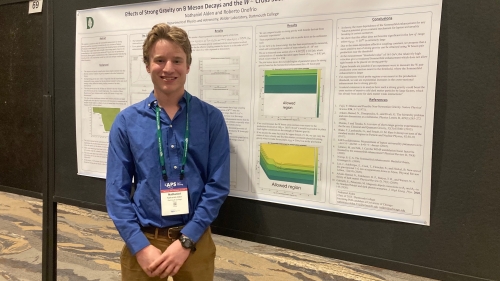
Serguey Polissar ('04) analyzes the far-infrared absorption spectrum of complex molecules with a new
					spectrometer developed by Hayden Brownell (right) and Zachary Keane ('03). Data taken by undergraduate Dinsie Williams on the low
							temperature thermal contraction of materials used in ultra-high
							vacuum scanning tunneling microscopes

LEFT: Serguey Polissar ('04) analyzes the far-infrared absorption spectrum of complex molecules with a new spectrometer developed by Hayden Brownell (right) and Zachary Keane ('03).


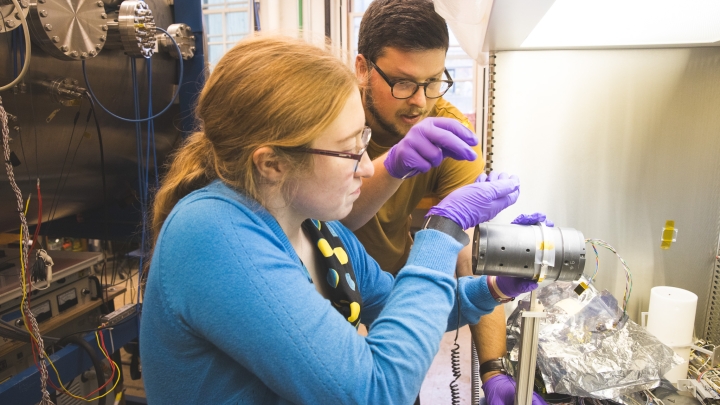
RIGHT: Professor Kristina Lynch and undergraduate Shaunak Mewada examine circuit boards to be used on an upcoming NASA sounding rocket mission to study the aurora.

There are a number of programs on campus designed to help students gain research experience. The Presidential Scholars Program is open to Juniors, and allows them to work closely with a faculty member on a research project. These projects are often used to lay the ground-work for a senior year honors thesis. The Women in Science Project is a program begun at Dartmouth in 1990 to provide additonal support and encouragement to women considering a major or career in science. A central aspect of this program is the opportunity it provides for entering students to carry out a research internship in their first year at Dartmouth. The E. E. Just Program provides research internship opportunities for students of African-American and African heritage. The program features both full-time internships during the summer, and part-time internships during the academic year.

In addition to applying through these programs, many students find research opportunities by talking directly with members of the faculty and setting up their own research internships.


The Honors Program in Physics and Astronomy

Dartmouth provides many unique opportunities for undergraduates to become directly involved in active research. Many students take advantage of these opportunities through the Honors Thesis Program. An honors student carries out a program of independent work in physics or astronomy under the supervision of a member of the faculty. This independent work is usually done in the student's senior year, and it may be either experimental, theoretical, or observational. A written thesis on the completed work is then presented before a faculty committee. All departmental Honors are considered individually and awarded by a vote of the faculty. If the faculty consider a student's work to be truly exceptional, they may vote to award High Honors.

Most students who choose to enter the Honors program begin to get experience in faculty research labs well before their senior year, often through such opportunities as the Women in Science Project, the E. E. Just Program, or the Presidential Scholars Program.

Click here to see a list of recent graduates and their senior thesis topic.

The Modified Physics Major

Students interested in such careers as engineering physics, geophysics, biophysics, chemical physics, medicine, medical imaging, and other health professions can propose a modified major consisting of ten courses (at least six from the Physics and Astronomy Department). It is also possible to modify the physics major with courses outside the science division (for example, with courses in history, government, education or literature). In all cases, the student prepares a written proposal explaining how the courses form a unified and intellectutally coherent program of study, which is then approved by the department chair.

A modified major must be approved by the Registrar and must satisfy the requirements given in the ORC. The most important requirement is that the major be "planned as a unified, coherent whole." To ensure this, the student is required to provide a written rationale of the intellectual coherence of the proposed program, which must be approved by the major advisor (or other representative) of both departments involved.

The Physics and Astronomy Minors

Many students at Dartmouth find that their educational goals at Dartmouth are best met by majoring in one subject while minoring in a second.

Marcello Gleiser Left: Professor Marcelo Gleiser explaining the physics of phase transitions.

A minor in physics has Mathematics 3, 8, 13, and 23 (or the equivalents),; and Physics 13 and 14 (or 3 and 4, or 15 and 16) as prequisites. Four courses are required in addition to the prerequisites. One of these must be Physics 19 except that students taking Physics 15 and 16 may substitute another elective for Physics 19. The other three must be chosen from physics courses numbered 24 and above, and/or astronomy courses numbered 15 and above, at least one of which must be numbered above 40.

A minor in astronomy has Mathematics 3 and 8 (or the equivalents); Physics 13 and 14 (or 3 and 4, or 15 and 16; or Science 13 and 14) as prerequisites. Four courses are required in addition to the prerequisites. One of these must be Astronomy 15. The other three are Astronomy 25, 61, and 81. Any physics or astronomy course numbered 20 or above may be substituted for one of these three. Note that Astronomy 25 has Physics 14 as prerequisite.