|
Previous Sapientia Lectures
Previous Francis W. Gramlich Lectures
Upcoming Sapientia Lectures
Free & Open to the Public
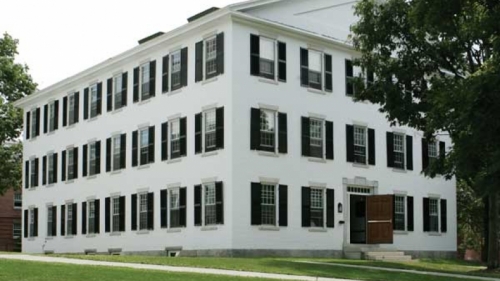
Unless otherwise indicated, events take place at 3:00 p.m. in 103
Thornton Hall
FALL 2007 - Spring 2008
Contact Prof Adina Roskies
for more information.
Friday, November 2
- Jana Sawicki, Williams College
- Title: Foucault and Sexual Freedom: Why Embrace an Ethics of
Pleasure?
Wednesday, December 5, 2007
- Eugene Marshall, Dartmouth College
- Title: A Spinozist Solution to the Problem of Weakness of
Will
Friday, January 11, 2008
- David
Estlund, Brown University -- MOVED to FRIDAY, FEBRUARY 29th,
2008 --
- Title: Democratic Authority: A Philosophical Framework
- ABSTRACT: In this talk, I give an overview of the argument of my new book
of the same title. Democracy is not naturally plausible. Why turn such
important matters over to masses of people who have no special expertise?
Theories of the value of democracy often try to answer this question by appeal
to the intrinsic value of the procedure itself, without relying on any tendency
toward good decisions. In this book I argue that those approaches fail, and I
develop a new approach, "epistemic proceduralism." The authority and legitimacy
of political decisions is partly owed to the fact that they were produced by
procedures that could be generally accepted as having some tendency to make
good decisions. Just as with verdicts in jury trials, the authority and
legitimacy of a decision in a given case does not depend on the decision being
good or correct in that case, but the epistemic value of the procedure is
nevertheless crucial. If epistemic value were what mattered, you might wonder
why those who know best shouldn’t simply rule. Epistocracy, or rule of the
knowers, is avoided on my theory, however. I argue that while some few probably
do know best, this cannot be used in political justification unless their
special expertise is acceptable to all reasonable (or "qualified) points of
view. If we seek the epistemically best arrangement, so far as can be
established to the wide range of qualified points of view, it will be
recognizably democratic, with laws and policies actually authorized by the
people subject to them.
Friday, January 11, 2008
- Bob Fogelin, Emeritus, Dartmouth College
- Title: Hume's Skeptical Crisis
Friday, February 15, 2008 -- NOTE TIME/PLACE: 4pm 007 Kemeny Hall
- Penelope Maddy, Irvine
- Title: How applied mathematics became pure
- Co-Sponsored by the Math Dept
- Abstract: This talk traces the evolution of thinking on how mathematics
relates to the world -- from the ancients, though the beginnings of
mathematized science in Galileo and Newton, to the rise of pure mathematics
during the nineteenth century. The goal is to better understand the role of
mathematics in contemporary science.
- There will be tea at 3:30 in the math department lounge (300 Kemeny Hall);
no reception afterward
Friday, February 22, 2008
- John Kulvicki, Dartmouth College
- Title: The Nature of Noise
- Location: 103 Thornton
- Time: 3pm
Tuesday, January 15, 2008 AT 12noon in 215 Silsby --RE-SCHEDULED for
TUESDAY, MARCH 25, 2008--
- Adam
Kolber, Laurance S. Rockefeller Visiting Fellow (2007-2008), Princeton
University; Associate Professor of Law, University of San Diego
- Co-Sponsored by Legal studies
- Title: The Subjective Experience of Punishment
Monday, March 31, 2008
- Alan
Hajek, Australian National University
- Title: Most Counterfactuals Are False
- Location: 103 Thornton
- 3PM
- ABSTRACT: Counterfactuals are all the rage these days. They figure in
influential philosophical analyses of many important concepts, such as
causation, perception, and rational decision. Science freely traffics in
counterfactuals. They are also earning their keep in the social sciences,
especially in psychology, history, and the law. And we use counterfactuals
nonchalantly in daily conversation. Nevertheless, I argue that most
counterfactuals are false. I focus on two strategies for showing a
counterfactual of the form ‘if X were the case, then Y would be the case’ to be
false: appealing to indeterminism—in particular, chanciness; and to
indeterminacy—in particular, imprecision. Both are strategies for securing the
truth of ‘counterfactuals’ of the form ‘if X were the case, then Y might not be
the case.’ These ‘might not’ counterfactuals, I argue, are incompatible with
the corresponding ‘would’ counterfactuals. I consider, and reject, a number of
fall-back positions: - most counterfactuals are indeterminate; - they have
context-dependent truth values; - the ‘might not’/’would’ clash is merely
pragmatic; and - there is no such clash at all. I concede that some
counterfactuals are true in virtue of necessary connections between antecedents
and consequents. But such counterfactuals are rare, and do little to offset the
preponderance of false counterfactuals. How, then, does our practice of
uttering counterfactuals survive? Close to the ordinary but false
counterfactuals that we utter are counterfactuals that are true but not
ordinary—e.g., ones with probabilistic consequents. They support our practice
when the standards for asserting counterfactuals are forgiving, as they
typically are on the street. However, the street is not always forgiving; even
when it is, falsehood is merely tolerated rather than eradicated; and we
philosophers are not always on the street.
Also Of Interest:
May 9-10, 2008:
Dennett, Churchland, Hauser, in a conference entitled "The Human Algorithm"
A workshop arranged by the Neukom Institute; see: www.neukominstitute.com
Boston Area Colloquium in Ancient Philosophy(BACAP)
Contact Prof
Margaret Graver for more information.
Thursday, October 25, 2007 at 12 noon (done by 2pm) in Thornton
103
- Luncheon Seminar
- David Charles, Oriel College, Oxford
- "Aristotle on Desire and Action"
Thursday, October 25, 2007 at 7:30pm in Rockefeller 2
- David Charles, Oriel College, Oxford
- "How Aristotle Avoided The Mind/ Body Problem"
- Commentary: Victor Caston, University of Michigan
|