|
Harris German-Dartmouth Distinguished Visiting
Professor, Spring 2007
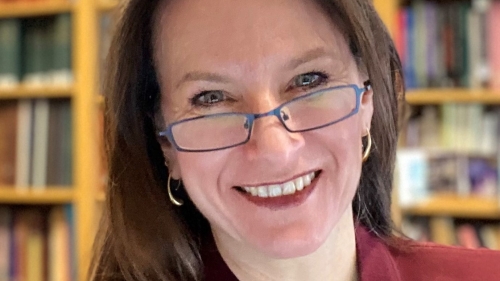
Suraiya Faroqhi, Professor Emerita of Ludwig Maximilian
University of Munich, Germany, and a leading authority on Ottoman history,
taught a course on “The Ottoman Empire and the Mediterranean: The Sultans and
Their European Neighbors, 1400-1774” for the History Department in Spring
2007. In this class, Professor Faroqhi focused on political as well as
commercial and cultural interactions between Ottomans and Venetians. A
highlight of the course was a field trip she and the students took to New York
to view the exhibition “Venice and the Orient” at the Metropolitan
Museum. As background to the luxury crafts shown at the Met, they also
paid visits to the Asia Society to see a Sassanid (pre-Islamic Persian dynasty)
exhibit and to the Cloisters, where they looked at Venetian glass and Spanish
faience that carried Middle Eastern traditions well into the sixteenth
century.
During her stay at Dartmouth, Professor Faroqhi worked on two book
projects: a monograph on Ottoman crafts and craftspeople and a volume
co-edited with Gilles Veinstein of Collège de France on merchants active in
Ottoman territory. She also gave invited lectures at a number of
universities and visited several museums in the United States and Canada with
exhibitions relevant to her research interests, which focus on the interface
between written documents and artifacts. In addition, she joined
Professor Crossley in leading a seminar for Department faculty comparing the
early modern empires of the Ottomans and the Qing.
Shortly before her departure from Dartmouth, Professor Faroqhi sat for an
interview with the editor of this newsletter. Born in Berlin, Professor
Faroqhi attended grade school in Germany, India, and Indonesia before her
father, a medical doctor originally from India, returned to Germany.
After graduating from high school in Bonn, she began studying European medieval
and early modern history at Hamburg University. A turning point in her
life came in 1962-63, when she took the opportunity to go to Istanbul
University on a fellowship as an exchange student. Subsequently she
became a student of Ömer Lüfti Barkan, one of the founding fathers of Ottoman
history and an editor of Annales. When she first read Fernand
Braudel at Barkan’s insistence, she “had the feeling that’s the sort of thing I
wanted to do.” She wrote her doctoral thesis at Hamburg on a set of
documents that a late 16th-century vizier submitted to his sultan
discussing Ottoman politics at the time.
After a detour in the United States, including two years at Indiana
University, where she studied Central Asian languages and earned a master’s
degree in Teaching English as a Second Language, Professor Faroqhi took a
position as an instructor of English and then of general history at the Middle
East Technical University in Ankara, Turkey. While teaching at that
institution, she perfected her Turkish language ability. She also
discovered that urban and regional planning students needed a background in
Ottoman urban history; “for the first time,” she remarked, “I saw that people
outside the field were interested in what Ottoman historians had to offer.”
One of her former teachers was director of the main archive in
Istanbul. At the time it was difficult to gain access to the archive, but
the teacher arranged for her to do research there—“one of the greatest gifts”
she received. At the time only two foreigners had such permission.
Having an “irregular” career had its advantages, Professor Faroqhi noted, for
once she was well established in Ankara she could go to the archive in Istanbul
as often as she liked.
In 1984 Cambridge published a reworked version of her second thesis, for
which she received the highest German academic qualification of
habilitation, as Towns and Townsmen of Ottoman Anatolia: Trade,
Crafts, and Food Production in an Urban Setting, 1520-1650.
Meanwhile, the Technical University had built one of the best mainframe
computers in the Middle East. Professor Faroqhi secured a grant to
computerize data on seventeenth-century houses and their owners from sales
documents. While on a fellowship at Harvard in 1983-84, she continued to
work on this project, which resulted in her third book, Men of Modest
Substance: House Owners and House Property in Seventeenth Century Ankara and
Kayseri (Cambridge, 1987).
In 1987 Professor Faroqhi returned to her home country, thanks to a program
aimed at stemming the German brain drain by creating professorships
specifically for those already abroad, and began teaching in Munich. At
that time she received an offer from a local publisher “to do something in
German”: the result was a book on how the Ottomans ran the Hajj caravan
to Mecca and back, subsequently published in English translation as
Pilgrims and Sultans (I. B. Tauris, 1994). Another Munich
publisher suggested that she write something that would appeal to a broader
audience. This proposal led to her book on the kinds of access Ottoman
townsmen had to cultural offerings of the early modern period, a work that
later appeared in English translation as Subjects of the Sultans (I.
B. Tauris, 2000).
Professor Faroqhi also produced a book of reflections on the history and
state of the discipline, Approaching Ottoman History: An Introduction to
the Sources (Cambridge, 1999), and a brief introduction to Ottoman history
for German high school and undergraduate students, published in 2000.
While on a fellowship in Berlin in 2001-02, she wrote most of The Ottoman
Empire and the World Around It (I. B. Tauris, 2004). More recently
she has edited volumes 3 and 4 of the Cambridge History of Turkey.
Having retired from Ludwig Maximilian University as of April 1, 2007, she
hoped to return to Istanbul with her husband, whom she met in Turkey, and teach
at a private university there for a few years.
Of her Dartmouth experience, Professor Faroqhi observed that students here
are motivated and similar to German students, although students at Ludwig
Maximilian, a national institution and the largest university in Germany, have
a greater range of academic ability. She thought Turkish students tend to
be less shy and more outgoing; however, when she would squeeze in brief
teaching stints in Turkey during the Munich spring break, she would have only
seniors or graduate students, “so maybe that’s why they weren’t shy.” The
students in her Dartmouth course eventually warmed up and actively engaged in
discussions, thanks in part to the camaraderie they had developed on the field
trip to New York.
|