
 |
 |
|
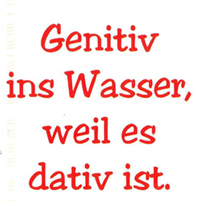
[pun:] Geh nicht tief ins Wasser,
weil es da tief ist. |
|
|
|
 |
|
The care of one tooth is simple.
But you have a couple more of them. |
|
The Genitive Case in English:
When the relationship between two English nouns is defined by one's possession of the other,
the possessing noun is typically placed before the other and marked as genitive with an ending of "-'s"
(or in a plural that already ends in "-s", with just the apostrophe):
"the horse's mouth"; "the books' covers."
In earlier times, a singular noun (usually a name) that ended in "-s" received only an apostrophe ("Bess' house"), but the ending was
nevertheless pronounced as a separate syllable: "-es". Increasingly, writers' manuals call for an "-'s" in those cases as well ("Louis's book"),
with the genitive ending still pronounced as "-es."
A frequent alternative to the genitive case is a prepositional phrase with "of": "the color of the car" (= "the car's color").
Note that in English the so-called "possessive pronouns" ("my", "his", "her", "whose" etc.) are not in the genitive case.
The Genitive in German:
See below for a discussion of when the genitive is used in German, but first we will examine how it is configured.
In German, the genitive case serves several functions beyond indicating possession, and, like the nominative, accusative, and dative cases, it is marked by pronouns, articles and adjective endings. Both masculine and neuter singular nouns also receive endings, but neither feminine singular nouns nor any plural nouns do.
As a rule, multi-syllabic masculine or neuter nouns take an ending of "-s": (des Computers), while one-syllable nouns take an "-es": (des Mannes) — although colloquial speech will sometime add just -s).
In the genitive, there is no distinction between a "der-word" and an "ein-word."1
Here are the the ways in which the three genders and their plurals are indicated as being in the genitive case:
| Masculine | Feminine | Neuter | Plural |
| des roten Stuhles | der neuen Lampe | des alten Buches | der roten Stühle |
| roten Stuhles | neuer Lampe | alten Buches | alter Bücher |
Note that the possessive adjectives (mein, dein, sein, ihr, etc.) are not genitive in and of themselves. Nor is the interrogative wessen (= "whose").
As in the accusative and dative cases, the so-called weak masculine nouns take an "-n" or "-en" in the genitive. For example:
|
nom.
acc. dat. gen. |
der Mensch
den Menschen dem Menschen des Menschen [human] |
der Nachbar
den Nachbarn dem Nachbarn des Nachbarn [neighbor] |
der Herr
den Herrn dem Herrn des Herrn [lord; gentleman] |
der Held
den Helden dem Helden des Helden [hero] |
|
nom.
acc. dat. gen. |
der Bote
den Boten dem Boten des Boten [messenger] |
der Kunde
den Kunden dem Kunden des Kunden [customer] |
der Junge
den Jungen dem Jungen des Jungen [boy] |
der Experte
den Experten dem Experten des Experten [expert] |
|
nom.
acc. dat. gen. |
der Jude
den Juden dem Juden des Juden [Jew] |
der Russe
den Russen dem Russen des Russen [Russian] |
der Kollege
den Kollegen dem Kollegen des Kollegen [colleague] |
der Riese
den Riesen dem Riesen des Riesen [giant] |
Other endings of weak nouns are "-ant," "-arch," "-ege," "-ent," "-ist," "-oge," "-om," "-oph," and "-ot." Some examples:
|
der Buddist
[Buddhist] |
der Katholik
[Catholic] |
der Protestant
[Protestant] |
der Pilot
[pilot] |
|
der Student
[student] |
der Komödiant
[comedian] |
der Astronom
[astronomer] |
der Patriarch
[patriarch] |
|
der Philosoph
[philosopher] |
der Fotograf
[photographer] |
der Enthusiast
[enthusiast] |
der Anthropologe
[anthropologist] |
Again: note that all of these nouns are masculine. Furthermore, their plural forms are the same as their accusative, dative, and genitive singular forms: e.g.,
| Nominative | Accusative | Dative | Genitive |
| Singular: der Student | den Studenten | dem Studenten | des Studenten |
| Plural: die Studenten | die Studenten | den Studenten | der Studenten |
("Herr" is an exception: den Herrn, dem Herrn, des Herrn; [plural:] die Herren, den Herren, der Herren).
Typically, dictionaries identify weak nouns by giving not only the plural but also the weak ending: "der Junge (-n, -n) — boy." The first ending that is cited is that of the genitive case. With weak nouns the accusative and the dative are usually identical with the genitive — but not always. A few weak nouns add "-ns," for example:
|
nom.
acc. dat. gen. |
der Glaube
den Glauben dem Glauben des Glaubens [belief] |
der Wille
den Willen dem Willen des Willens [will] |
der Gedanke
den Gedanken dem Gedanken des Gedankens [thought] |
der Name
den Namen dem Namen des Namens [name] |
One neuter noun is also weak in the dative and takes an "-ens" in the genitive:
|
nom.
acc. dat. gen. |
das Herz
das Herz dem Herzen des Herzens [heart] |
While the Latin accusative and dative forms of Jesus Christus (Jesum Christum, Jeso Christo) are not used in modern German, the genitive is: Jesu Christi.
The genitive personal pronouns are rare nowadays, but they do exist (some further examples of their use can be found below) Note that, despite their appearance here, these are not the same as "possessive pronouns":
| meiner = (of) me | unser = (of) us |
| deiner = (of) you | eurer = (of) y'all |
| Ihrer = (of) you | |
|
seiner = (of) him
ihrer = (of) her seiner = (of) it |
ihrer = (of) them |
The third-person demonstrative pronouns — which can be possessive pronouns — are commonly employed:
|
(masculine) dessen = (of) him/it/whose
(feminine) derer = (of) her/it/whose (neuter) dessen = (of) it/whose |
(plural) derer = (of) them/those |
| Wir danken im Namen derer, die in Nöte geraten sind. | We give thanks in the name of those who have come into hardship. |
| Meine Brüder und deren Kinder sind schon angekommen. | My brothers and their children have already arrived. |
In ambiguous situations, the demonstrative possessive pronoun points to the nearest preceding (i.e. the latter) noun:
| Pauls Sohn und dessen Freunde haben Hunger. | Paul's son and (Paul's) son's friends are hungry. |
| [not: Paul's son and his (Paul's) friends are hungry]. |
When such a pronoun depends on a preceding noun, desselben or derselben can be employed:
| Das Mikroskop, Theorie und Anwendung desselben. | The Microscope: its Theory and Use [book title] |
| Die meisten Glaubenslehrer verteidigen ihre Sätze nicht, weil sie von der Wahrheit derselben überzeugt sind, sondern weil sie diese Wahrheit einmal behauptet haben. | Most doctrinal theologians defend their propositions, not because they are convinced of the truth of them, but because they have at one point asserted that truth. [aphorism by G. C. Lichtenberg] |
Further pronoun examples can be found below.
|
|
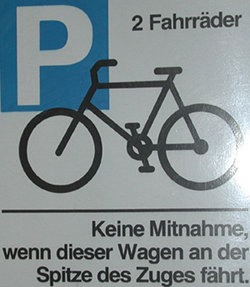 |
| [There is room in this subway car for] 2 bicycles. No bringing [a bike] along when this car is traveling at the front of the train. | |
Using the Genitive Case in German:
Germans will often assert that the genitive is disappearing from the language. It is certainly used less than one or two centuries ago, but it still occupies an important position. Primarily, the genitive designates a relationship between two nouns in which one of them belongs to the other. The former can be in any case, but the latter is in the genitive:
| Was ist die Telefonnummer deiner schönen Kusine? | What is your beautiful cousin's phone number? |
| Sie hat den Brief ihres Vaters gar nicht gesehen. |
She never saw her father's letter. |
| Das Bild deiner Frau ist besonders gut. |
Your wife's picture is particularly good. |
| Der Motor dieses Autos ist viel zu klein. |
This car's engine is much too small. |
| Die größte Liebe aller deutschen Männer ist Fußball. |
The greatest love of all German men is soccer. |
| Das Dach des Hauses war unbeschädigt. |
The roof of the house was undamaged. |
|
|
 |
| Success is the sum of correct decisions | |
Note that the genitive noun comes second. The placing it first, as in English, makes it sound either archaic or poetic:
| "Das also war des Pudels Kern!" [quotation from Goethe's Faust] | So that was the poodle's core! |
Proper names in the genitive do precede the noun, however. If the name already ends in "-s" or "-z," then an apostrophe is added:2
| Was hast du mit Roberts altem Computer gemacht? | What did you do with Robert's old computer? |
| Veronikas neuer Freund ist schön. | Veronika's new boyfriend is handsome. |
| Heinz' Hut ist wirklich hässlich. | Heinz's hat is really ugly. |
In colloquial speech, Germans often use the preposition von (with the dative, of course) instead of the genitive:
| Ist das der Freund von deinem Bruder? | Is that your brother's friend? |
| Wir suchen das Haus von seiner Mutter. | We're looking for his mother's house. |
This construction with "von" is always used if there is no article to mark the genitive:
Uneducated Germans sometimes use the dative and a possessive adjective to create a genitive effect: "Bist du dem Mann seine Frau?" Are you the man's wife? The genitive is used to indicate an indefinite day or part of the day:
Although Nacht is feminine, it here — and only here — assumes an analogous structure: "Sie ist eines Nachts weggelaufen." She ran away one night.
Prepositions that take the genitive: A number of prepositions take a genitive object. The most common are statt and anstatt [instead of], trotz [in spite of], wegen [because of] and während [during]. In normal speech, German often use the dative after trotz and wegen. The grammar-police find that appalling, but in fact the dative is actually the older form.
When just a masculine or neuter noun follows the preposition (i.e., when there is no article), there is no genitive "-s":
Note also:
Less frequently used are außerhalb [outside of], innerhalb [inside of], oberhalb [above], unterhalb [beneath], diesseits [on this side of], and jenseits [on the other side of]:
George O. Curme's Grammar of the German Language (New York: Macmillan, 1922) lists a total of 123 prepositions that take the genitive (p. 357), but most are very rare or confined to legal language. They include anlässlich [on the occasion of], angesichts [in the face of; in view of], infolge [as a result of; owing to], ungeachtet [despite; notwithstanding], etc. Genitive prepositions do not form "da-" compounds.
Instead we use genitive demonstrative pronouns, getting structures like während dessen [in the meantime],
statt dessen [instead of that], and trotz dessen [despite that] — written as one or two words.
Verbs that take the genitive: Quite a few verbs once took a genitive object, but over time they have switched to the accusative. One example is vergessen, although the name of the flower Vergissmeinnicht (forget-me-not) remains. Some verbs officially still take the genitive, although many native speakers will use the accusative instead. It is with such formal — some would say stilted — German that you might encounter genitive pronouns:
Other genitive constructions: Some predicate adjectives are also associated with the genitive:
Certain noun phrases in the genitive act like prepositional phrases:
1
The "ein-words" are ein, kein, and the possessive pronouns: mein, dein, sein, ihr, unser, euer, Ihr, ihr.
2 Increasingly, Germans are putting apostrophes onto all names, especially in commercial enterprises. This option is unavailable to non-native speakers.
| ||||||||||||||||||||||||||||||||||||||||||||||||||||||||||||||||||||||||||||||||||||||||||||||||||||||||||||||||||||||||||