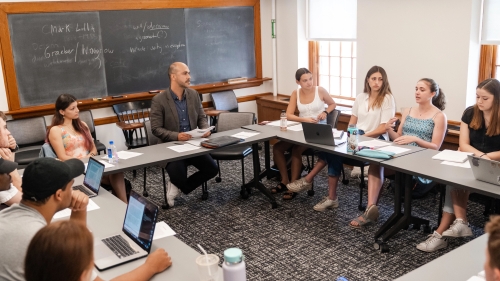
ALI helps faculty develop and refine skills for learner-centered teaching in their courses. This year's insitute will be held on August 31st and September 1st
Additional topics include theories of learning, course and syllabus design, collaborative learning, peer assessments and information technology for active learning.
Deadline for applications is Monday May 16
The sixth annual Active Learning Institute (ALI) will be held Wednesday and Thursday, August 31th and September 1st, 2011. ALI helps faculty members develop and refine their skills as learner-centered course designers and teachers. The ALI faculty designs this two-day workshop around the challenges identified by each year’s group of participants. These challenges may include (but are not limited to) the following:
Every ALI focuses on designing courses that take full account of how people actually learn and we set aside plenty of time for participants to workshop each other’s new designs and strategies.
Participants in the 2011 ALI will receive a $500 stipend for full participation in the two-day institute. Anyone holding a faculty teaching appointment at Dartmouth at any rank (Arts and Sciences, Engineering, Tuck and DMS) is eligible to apply. To apply for the institute, please submit the following as e-mail file attachments to DCAL@Dartmouth.Edu by May 16, 2011:
The ALI faculty will read every application and select participants based on:
We strive for a group diverse in disciplines, schools and departments or programs.
Here is what your colleagues have said about previous ALIs:
“ALI is a phenomenal asset to this college. I not only learned valuable practical content, but I also find myself sharing these ideas with my colleagues in informal discussions. It's rare to have a two-day workshop have such a strong positive impact.”
“All in all, the Institute ranks among my most productive professional education experiences.”
“I do not think I could overstate how much the experience, authority, authenticity, intelligence, commitment, and enthusiasm of the facilitators and other participants defined my ALI experience. They helped me see how these techniques could be used and gave me the sense that it would be OK to try using them.”
“The ALI was a transformative experience for me. With no formal training in teaching methodology, the most useful component was overall, big picture, course design. ”
“Great program! I wish it had been available when I started teaching.”
Anthropology—Lourdes Gutierrez Najera (also LALACS)
Art History—Marlene Heck
Biological Sciences—Kathryn Cottingham
Business Administration—Ye Luan, Richard McNulty, Paul Gardent, Katy Milligan
Chemistry—Richard Stolzberg, Jon Kull
Community and Family Medicine—Carolyn Murray, Scottie Eliassen, Cathleen Morrow
The Dartmouth Institute for Health Policy and Clinical Practice—Honor Passow, Alice Andrews
Earth Sciences—Xiahong Feng
Economics—Parama Chaudhury
Education—Donna Coch
Engineering—Mary Kay Brown
English—Colleen Boggs, Michael Chaney, Mishuana Goeman (also NAS), Ivy Schweitzer (also WGST), Soyica Colbert
Epidemiology—Don Likosky
French & Italian—Michael Fodor, Nancy Canepa
Geography-Jonathan Chipman
Government—Lisa Baldez, James Murphy
History—Cecilia Gaposchkin, Leslie Butler, Robert Bonner
Japanese—James Dorsey
Linguistics and Cognitive Science—David Peterson
Mathematics—Stephanie Treneer, Paige Rinker, Patricia Cahn, Katie Kinnaird, Lola Thompson
Microbiology-Charles Sentman
Philosophy—Carey Heckman, Ann Bumpus
Physics & Astronomy—Robyn Millan, Chandrasekhar Ramanathan
Psychological and Brain Sciences—Thalia Wheatley, Mark Detzer, David Bucci, Ann Clark, Jon Pfister, Catherine Norris, Siobhan Robinson, Ming Meng
Public Health—Sharon McDonnell
Religion—Reiko Ohnuma, Susan Ackerman, Christopher MacEvitt
Spanish & Portuguese—Ana Merino
Writing and Rhetoric—Sara Chaney, Joshua Compton, Carl Thum, Jonna Mackin, Claudia Anguiano, Ellen Rockmore