Here are just a few notes about upcoming events and projects at DCAL and other items of interest to teachers. Navigate the site's resources at the right. For more news, see DCAL News.
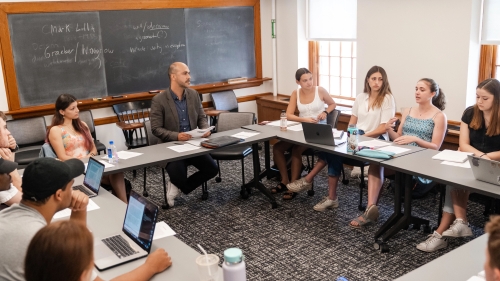
The fourth annual Active Learning Institute (ALI) will be held on Wednesday and Thursday, September 2nd and 3rd. ALI helps faculty develop and refine skills for learner-centered teaching in their courses. Once again this year Professor Chris Jernstedt (PBS) will address the institute with a presentation on how people learn and how learning changes brains.
* "ALI is a phenomenal asset to this college. I not only learned valuable practical content, but I also find myself sharing these ideas with my colleagues in informal discussions. It's rare to have a two-day workshop have such a strong positive impact."
* "All in all, the Institute ranks among my most productive professional education experiences."
* "I do not think I could overstate how much the experience, authority, authenticity, intelligence, commitment, and enthusiasm of the facilitators and other participants defined my ALI experience. They helped me see how these techniques could be used and gave me the sense that it would be OK to try using them."
* "I was pleasantly surprised with just how incredibly useful it was."
Art History-Marlene Heck
Business Administration-Ye Luan, Richard McNulty
Chemistry-Richard Stolzberg
Community and Family Medicine-Carolyn Murray
Economics-Parama Chaudhury
Education-Donna Coch
English-Colleen Boggs, Michael Chaney, Mishuana Goeman (also NAS), Ivy Schweitzer (also WGST)
Epidemiology-Don Likosky
French & Italian-Michael Fodor, Nancy Canepa
Government-Lisa Baldez, James Murphy
History-Cecilia Gaposchkin, Leslie Butler
Japanese-James Dorsey
Mathematics-Stephanie Treneer
Philosophy-Carey Heckman
Physics & Astronomy-Robyn Millan
Psychological and Brain Sciences-Thalia Wheatley, Mark Detzer, David Bucci
Public Health-Sharon McDonnell
Religion-Reiko Ohnuma
Spanish & Portuguese-Ana Merino
Writing and Rhetoric-Sara Chaney, Joshua Compton, Carl Thum, Jonna Mackin
DCAL will make grants of up to $1000 to support attendance at conferences and programs devoted to teaching and learning. These may be special panels organized by your professional organizations at their annual meeting, or by the Educause Learning Initiative or Tomorrow's Professor, or similar events. If you want to attend such a meeting or present on such a panel, DCAL will help you pay for it; we may be able to cover the entire expense! These funds are for travel, lodging, registration and other costs of participation. Direct your inquiries to Elaine Livingston.
We have a diversely talented teaching faculty at Dartmouth and we can learn a great deal from each other. DCAL started this informal network by setting up a system for visiting colleagues' classes, not for evaluation of course, but for sharing and learning from each other. Comments and suggestions are shared only with each other, not with the larger group and certainly not with any chairs, supervisors or deans. This is often referred to as formative, rather than summative, evaluation. DCAL helps the process by hosting the initial meeting of those interested in joining the network, supplying guidelines and helpful forms, and finally by hosting a de-briefing at the end of term. For more details see the Class Visits page of this website. Please sign up on our workshops and events sign-up page or with Elaine Livingston.
The Dartmouth Centers Forum is pleased to announce that the theme for 2008-2009 will be Conflict and Reconciliation. Conflict is seemingly endemic to society and rightly deserves our attention. Yet often efforts to resolve conflict focus on causes, the mitigation of conflict impact upon its victims and place great emphasis on the prevention of future conflicts through structural or policy change. The focus of the Dartmouth Center's Forum theme is to emphasize the role of reconciliation as a method to resolve conflicts no matter what their causes. Conflicts permeate our personal and social relations, and may be internal, local, national or international. Reconciliation, viewed as a process of coming to terms with what is, accepting, forgiving and compromising, and encompasses all the fields of human endeavor. As such it is fertile ground for discussions such as, what makes reconciliation a successful conclusion to conflict? Are there universal processes of reconciliation? Is there a distinction between disputes and conflicts? Are there conflicts within which parties cannot be reconciled? What methods might be employed in the promotion of reconciliation for conflicts, be they personal, societal and global?
A syllabus template is now available on the DCAL website. We hope that this template will give you some ideas and make developing a syllabus for your course a bit easier. Please modify the template as needed to make your own personal syllabus and let us know if you have comments/additions.
This new DCAL seminar formed on October 25th 2007 as an ongoing forum for informed discussion of teaching and learning languages and cultural competencies. Anyone at Dartmouth interested in these topics is welcome to join us; simply e-mail Tom Luxon, Doug Moody or Nancy Canepa. Our inaugural discussion focused on the May 2007 MLA report entitled "Foreign Languages and Higher Education: New Structures for a Changed World." Future plans include invited speakers, discussion of literature on the subject of language learning and cultural competency and discussion of possible innovations at Dartmouth.
Please e-mail Doug Moody and Nancy Canepa with suggestions for future meetings!
Reducingstereotypethreat.org was created by two social psychologists and professors who sought to offer a resource for faculty, staff, and students regarding stereotype threat. This website offers summaries of research on this topic and discusses unresolved issues and controversies in the research literature on the phenomenon. Included are some research-based suggestions for ameliorating negative consequences of stereotyping, particularly in academic settings.
An excerpt from "Using the 'Beauties of Physics' to Conquer Science Illiteracy": A Conversation with Professor Eric Mazur of Harvard University (New York Times July 17).
Q. When you teach Physics 1b, do you give "fantastic performances?"
A. You know I've come to think of professional charisma as dangerous. I used to get fantastic evaluations because of charisma, not understanding. I'd have students give me high marks, but then say, "physics sucks." Today, by having the students work out the physics problems with each other, the learning gets done. I've moved from being "the sage on the stage" to "the guide on the side."