|
Daily Updates Week Eight: 8 November
8 November. Briar Teron Reporting
The Forum of Augustus was dedicated in 2 B.C. by Augustus. The forum has a long rectangular form, dominated by a large temple that stands directly against the back wall (see Figure 9). To either side of the temple, the side walls open up into parallel exedrae. The forum was built adjacent to and perpendicularly to the Forum of Julius Ceasar, after which it was modeled.
During the dedicatory ceremonies, the Senate dedicated a large bronze statue of Augustus in a quadriga that was placed in the centre of the forum. The inscription on this statue read "pater patriae", or "Father of His Country."
Augustus was very conservative and interested in emulating Greek Classical architecture. Although the medium of concrete was available at the time, Augustus used very little of this modern construction in his forum. Rather, the forum is dominated by orthogonal and trabeated forms, with many references to Greek Classical architecture. This includes numerous references to the Athenian Acropolis. Since Augustus was such a revolutionary leader, completely changing the Roman system of government, it was in his best interest to downplay this effect by promoting Italic traditions and conservative forms.
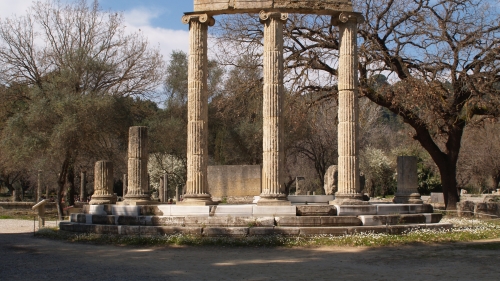
The Temple of Mars Ultor, Mars 'the Avenger', was built to commemorate both the defeat of Julius Caesar's assassins at the Battle of Philippi in 42 B.C. and the return of the Roman legionary standards by the Parthians in 20 B.C. (see Figure 1.) This large octastyle Corinthian temple has pycnostyle column spacing and peripteros sine postico column distribution (see Figure 2.) The podium is high, with a frontal staircase and an altar embedded in the steps. The walls of the cella are lined with freestanding columns and pilasters, leading to the terminal apse. The three cult statues within the apse were of Venus, Mars, and Divus Julius (see Figure 3.) These three deities allude to Augustus' divine ancestry, with Venus and Mars as ancestors of the Romans and the Julian line, and with Divus Julius as his own adopted father.
A large tufa wall, 30m high, encloses the entire complex (see Figure 5.) This wall was designed to block off the view and noise from the crowded residential complex behind the forum, the Subura, and also as a protective barrier against the spread of fire.
Corithian porticoes run along the sides and exedrae of the forum (see Figure 6.) The walls themselves are lined with statue niches which once held sculptures of the great men of Rome's history, the summi viri. Under each niche, a marble plaque called an elogium described the deeds of the particular man. In the central niches of the two exedrae, Aeneas and Romulus were representedÑthe two legendary founders of Rome. They were flanked by their descendants, the Julian line and the Great Men of the Republic, respectively.
The porticoes had a second storey that was lined with caryatids, in between which were sculpted shields bearing the heads of defeated nations and of Jupiter Amon.
At the north-west corner of the forum, there was a separate room, the Room of the Colossus, in which a colossal statue was placed (see Figure 8.) This statue was originally of Divus Julius but was replaced after AugustusÕ death and deification with a statue of Augustus himself.
REFERENCES
Claridge, Amanda. Oxford Archaeological Guides: Rome. New York: Oxford University Press, 1998.
Favro, Diane. The Urban Image of Augustan Rome. Cambridge: Cambridge University Press, 1996.
Galinsky, Karl. Augustan Culture. Princeton [NJ]: Princeton University Press, 1996.
Macadam, Alta. Blue Guide: Rome. London: A & C Black, 2003.
Sear, Frank. Roman Architecture. Ithaca [NY]: Cornell University Press, 1982.
Temple of Mars Ultor from the north side. View of enclosing tufa wall (at the back). View of high temple podium, frontal staircase, and some of the white marble Corinthian columns.
Solid white marble Corinthian column from the south side of the Temple of Mars Ultor. View of the flat-edged flutes. View of the column base modeled after those of the Propylaea, the entrance gate to the Acropolis at Athens. Kyle and Brian act as human scales.
Cella of the Temple of Mars Ultor. The area where the cult statues were placed was accessed by a set of five steps. Briar, Dave, and Dan pose as the cult statues of Venus, Mars, and Divus Julius, respectively.
View of the south side of the Temple of Mars Ultor; notice the four columns on the high podium. View of the cross-hatched polychrome marble pavement of the porticoes (foreground). View of an original entrance archway (to the right of the columns) framed in white travertine
View of the large tufa wall (the background) which enclosed the Forum. Notice the bands of white travertine that run horizontally through the wall and tie the Forum together in a neat package. The jaggedness of the wall indicates that Augustus was unable to purchase all of the property needed for his forum, and therefore compromised the symmetry of his forum in order to avoid kicking Romans out of their homes. Also, view of the statue niches in the wall, the colourful marble pavement of the porticoes (foreground), and the south side Corinthian columns of the Temple of Mars Ultor.
The north exedra. View of the Corinthian colonnade, the statue niches, and the floor paved in a checkerboard design of giallo antico (yellow) marble and africano (reddish) marble.
The pavement in the porticoes, but not in the exedrae. A cross-hatched design of grey Italian marble, with a central square of reddish africano marble and an inner rectangular border of giallo antico yellow marble.
Room of the Colossus, where the colossal statue of Augustus once stood. View of statue base on right side. View of pavement with checkerboard pattern of pavonazzetto purple marble and giallo antico yellow marble.
Figure 9:
Plan of the Forum of Augustus, adapted from the plan from:
Diane Favro, The Urban Image of Augustan Rome, (Cambridge: Cambridge University Press, 1996), 97.
Legend:
A Temple of Mars Ultor
B Sculpture of Aeneas
C Sculpture of Romulus
D Altar in frontal staircase of temple
E Summi viriÑstatues of great men of Rome
F Room of the Colossus
G Apsidal cella of temple with 3 cult statues: Venus, Mars, Divus Julius (left to right)
H Wall of tufa enclosing forum
I Bronze statue of Augustus in a quadriga. Inscription: pater patriae
↑
Give Us Feedback
9 Nov. »
|
 |