The
Roman city of Pollentia is located on the north coast of the Mediterranean
island of Mallorca 53 klm. north-northeast from Palma. It occupies a slight
rise covered with a series of almond groves immediately south of the modern
town of Alcudia, Mallorca. Like the modern town Pollentia was strategically
placed on an isthmus between
two expansive bays, the Bahía de Alcudia and the Bahía de
Pollensa. Both bays are protected by mountainous Cape Formentor from prevailing
northwest winds and provide excellent shelter for shipping.
Pollentia was founded along with Palma,
according to Strabo 3.5.1, by Q. Caecilius Metellus Balearicus following
a campaign against Mediterranean pirates operating from the Balearic Islands
of Mallorca and Menorca. Livy, Ep. 60, says that Metellus undertook the
campaign as consul in 123 B.C. In recognition of his victory over the pirates
and for adding the Baleares to the Empire he celebrated a triumph in Rome
in 121 B.C. Thus the historical record implies that the two cities were
established after the pacification of Mallorca probably in 122 B.C.
The archaeological evidence, on the
other hand, indicates that the organization of a structured Roman community
at Pollentia and perhaps at Palma as well
occurred no earlier than the second quarter of the first century B.C. and
was not completed until the time of Augustus. It seems likely that Metellus
Balearicus merely removed 3,000 Italian settlers from the mainland of Spain
and located them at Palma and Pollentia on the island. They lived, 1500
at each site, either along with native inhabitants or in a military camp
attached to the native community. Their primary mission was to keep the
peace on the island. Balearicus' grand-nephew, Q. Caecilius Metellus Pius, may have been responsible for founding the city of Pollentia when he
introduced additional settlers, Italian veterans, after his victory in
the war against Sertorius (80-71 B.C.). At that time he may have organized
the community as a Latin colony. Finally the Emperor Augustus seems to
have sent another group of colonists to the island and elevated the status
of Pollentia along with Palma to that of a colonia civium Romanorum
or Roman colony. But from its founding Pollentia, not Palma, was the main
Roman city on Mallorca and the administrative center for the island.
Discovery and Excavation of Pollentia
At
the end of the sixteenth century (1593) a local antiquarian and historian,
J. B. Binimelis, proposed that the ancient city of Pollentia lay beneath
the fields surrounding the chapel of Santa Ana south of Alcudia. But in
spite of the discovery of a fine bust of the Emperor Augustus, numerous
Latin inscriptions, and many Roman coins in those fields throughout the
17th, 18th, and 19th centuries Mallorcan scholars debated whether Pollentia
was located at Alcudia or Puerto de Pollensa twelve kilometers west
of Alcudia where Roman artifacts were also being found. The issue was not
finally settled until two enthusiasts, Gabriel Llabrés, professor
of history at the Instituto Balear in Palma, and Rafael Isasi Ransome,
an artillery colonel, excavated from 1923 to 1935 a series of trenches
between rows of almond trees in the fields at Alcudia. Their spectacular
finds made it indisputable that a major Roman city lay south of Alcudia.
A fragment of an inscription found on the site in 1887 seems to identify
the city as Pollentia.
William L. Bryant Foundation
In
1952 William J. Bryant, founder and president of the William L. Bryant
Foundation, on the recommendation of Spanish scholars turned his attention
to Alcudia. Through the Foundation from 1948 to 1957 he had funded the
excavation of the Roman amphitheater in Tarragona and was searching for
a new site for exploration. In the summer of 1952 he purchased the property
on which the Roman theater was located in Alcudia.
During the winter of 1952 the theater was excavated under the direction
of Dr. Martin Almagro, then Professor of Prehistory in the University of
Barcelona, Director of the Archaeological Museum in Barcelona, and Director
of Excavations in Ampurias, with the assistance of Antonio Arribas, one
of Almagro's students. Enticed by the prospect of excavating an entire
city, Mr. Bryant bought in 1953 a grand manor house in Alcudia to serve
as the town museum and excavation headquarters for further exploration
of Pollentia. In 1957 he created a center for archaeological studies, the
Centro Arqueológico Hispano-Americano de las Islas Baleares, located
in the Bryant house in Alcudia and incorporating the leading archaeologists
in Spain and American scholars Professor Walter Cook, Director of the School
of Fine Arts of New York University, Professor Sterling Dow of Harvard
University, and Professor Daniel Woods of Manhattanville College. In the
summer of 1957 the first systematic excavations on the site of Pollentia
began under the guidance of the new Centro with the support of the Bryant
Foundation. Excavation of the city continued under the auspices of the
Bryant Foundation until 1997.
The Size of Pollentia
Careful
survey of the site indicates that the Roman city extended no further north
than the bypass road along the south side of modern Alcudia. Its eastern
limit is marked by the road from Alcudia to the Roman theater. On the south
the ancient city extended no further than the property of Caín Fanals south
of the theater and the chapel of Santa Ana where the ground level falls
off and a series of Roman graves was found. Its western limit lies along
the modern highway past Santa Ana to Puerto de Alcudia and Arta with the
possibility now that it may have spilled
over west of the roadway. At a minimum the area of the Roman city measures
300 m. west to east x 600 m. north to south or 180,000 m. sq. (= 18 hectares).
These figures indicate that Pollentia was a substantial community occupying
an intermediate position among Roman settlements in Spain. By comparison
Barcinum (Barcelona) was 13 ha. in area, Dertosa (Tortosa) 12 ha., Ilici
(Elche) 12 ha., Lucentum (Alicante) 10-14 ha., Emporion (Ampurias) 21 ha.,
Tarraco (Tarragona) 70 ha., Emerita (Merida) 100 ha., Corduba 70 ha., and
Caesar Augusta (Zaragosa) 50 ha.
Pollentia was unwalled. It relied on
its location on an island and its distance from the sea, 1.5 klm. from
the Bahía de Alcudia and 2.5 klm. from the Bahía de Pollensa,
for defense. Only at the end of the third century was a defensive wall
built around the northwest corner of the city. During the crisis of the
third century the population of the city retreated to that small enclave.
Similar contractions occurred in many cities along the east coast of Spain
and elsewhere in the Roman Empire during that same period.
In 1963 the Spanish government declared
the entire area of the ancient city from Sa Portella in the north to the
fields south of the chapel of Santa Ana a protected archaeological site.
No construction may now take place in the fields over the Roman city. In
1973 the state began the process of expropriating and buying individual
fields. Thus far eighteen properties have been purchased by the state.
Only six still remain in private hands.
The Roman Theater
The
Roman theater of Pollentia is located at the southeast corner
of the city. It was constructed in the early first century A.D. perhaps
under Augustus. Only a series of square holes for the insertion of wooden
posts to support a platform identify the proscenium and scaena
. The semi-circular orchestra is 9.50 m. in diameter. Three rows of
backed seats comprising the proedria are separated from the cavea
by a 1.20 m. wide praecinctio or ambulatory. Eleven rows of
seats of the cavea divided into four cunei have been preserved.
The excavators estimate that the theater may have seated as many as two
thousand persons. The town of Alcudia still uses the theater for musical
and dramatic presentations.
The Sa Portella Excavations
In
1957 the Centro with the support of the Bryant Foundation began excavations
on the property Sa Portella owned by the Museo de Mallorca and made available
for exploration by the museum. The directors were Dr. Miguel Tarradell
then of the Universidad de Valencia and Daniel Woods. Antonio Arribas joined
the team in 1958. Excavations were conducted every summer from 1957 to
1962.
In Sa Portella the remains of four houses
were uncovered. Of the
southernmost house, the House of the Bronze Head, only eight rooms
around a peristyle courtyard were sufficiently intact to be studied. The
entire south end of the house was destroyed by a deep trench excavated
by the government in 1936. The house takes its name from a bronze head
of a young girl discovered in a trash heap in one of the northern rooms.
The excavators date the construction of the house to the middle of the
first century B.C. It continued to be occupied until the beginning of the
fifth century A.D.
Across a broad street, 3.75 m. wide,
north of the House of the Bronze Head is the House of the Two Treasures,
so named because of the discovery of two coin hoards in the house, one
dating to the mid-third century and the other to the end of the fourth
century. This house is the best preserved of the Pollentia houses. It is
an atrium style house with ten rooms, the largest of which is a spacious
triclinium at its northwest corner. The impluvium at the
center of the atrium is colonnaded. There was a colonnaded portico along
the south front of the house. The house dates to the Augustan period. It
suffered damage in the third quarter of the third century and was then
occupied by squatters until the end of the fourth or beginning of the fifth
century.
North of the House of the Two Treasures
in the same insula is a third house. Only seven rooms at the rear of the
house have been excavated. They make up two shop or taberna complexes,
one facing the North-South Street and the other the street along the east
side of the insula.
Opposite the House of the Two Treasures
across the North-South Street is the Northwest House. It is an atrium
style house with six rooms north of the atrium. At the center of the atrium
is a colonnaded impluvium. North of the house are two small shops
facing the North-South Street. The curious feature of this house is the
fact that in the last quarter of the third century a defensive wall,
5.00 m. wide, was constructed, cutting the house in half along the line
of the west side of the impluvium and rear wall of the two shops.
Attempts to trace the wall in the fields south of Sa Portella have been
unsuccessful. That fact and the evidence that the wall cuts the Northwest
House in two suggests that it was built to enclose a small enclave at the
northwest corner of the city to which the declining population of the city
retreated during the crisis of the third century.
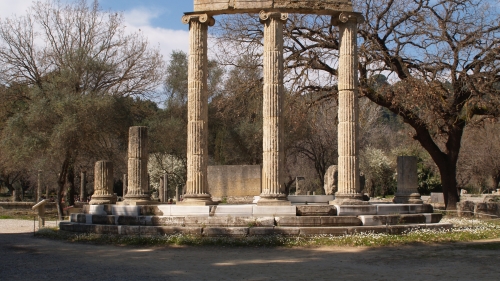
In recent years the town of Alcudia
has consolidated house walls, re-erected the columns of the impluvium
of the House of the Two Treasures, and added plantings to make the
Sa Portella site a major attraction for tourists visiting the island each
summer.
The Forum Excavations
In
1980 excavation of the Forum of Pollentia began under the direction of
Miguel Tarradell, Daniel Woods, and Antonio Arribas, who was by then Professor
of Prehistory at the Universitat de les Illes Balears, on the property
Ca'n Reynés which had been purchased by the government. A team from
Dartmouth College under the direction of Prof. Norman A. Doenges joined
the project in 1983. It excavated a Dartmouth sector at the northwest quadrant
of the insula at the west side of the forum from 1986 to 1997. Excavation
of the Pollentia Forum continues each summer during the months of July
and August under the direction of Dra. Margarita Orfila Pons of the Universidad
de Granada.
The main structure in the Pollentia
Forum is the Capitolium which stands at the north side of the square.
Because building blocks from the temple have been robbed over the centuries
for use elsewhere, only the north wall and small sections of the east and
west walls of the podium of the temple remain intact. The leveling stones
for the cella walls and the footings for three columns in the pronaos are
also still in place. But enough evidence remains on the ground to reconstruct
the general plan of the building. Todd W. Parment, a member of the Dartmouth
College team, made a special study of the Capitolium in 1995 and 1996.
The temple podium measures 23.30 x 17.80
m. The temple itself was tetrastyle prostyle in design with four columns
across the front and two columns in antis behind. The temple building
was divided into three cellae. The central cella is slightly larger than
the two side rooms. The walls were made of mud brick above a high sand
stone socle. The architrave and roof were of wood. Soundings made in 1996
by Todd Parment indicate that the Capitolium was constructed under Augustus
over the site of a pre-Roman Talayotic sanctuary. By the end of the third
century the building began to fall into disrepair, but the cella section
may have remained in use into the fourth century. It is of interest that
no early Christian graves were dug in the area of the temple although they
line the south, east and north sides of the structure.
Flanking the Capitolium at its northeast
corner is a large rectangular platform. The excavators have identified
it as a temple, but the lack of an approach makes that identification suspect.
The structure may be a base for a large monument, perhaps an equestrian
statue. Isasi in 1927 found a life-size bronze head of a horse and a bronze
hand which may belong to a rider or a charioteer. On the pavement in front
of the platform fragments of a dedicatory inscription were found along
with fragments of a crowning member or balustrade in a leaf or flower design.
At the southeast corner of the Capitolium
are the remains of a small temple, 10.10 x 6.40 m. Only the lowest foundation
coarse remains in place. It stands just 4.00 m. east of the temple and
may have faced east rather than west toward the Capitolium.
At the southwest corner of the Capitolium
are two statue bases and a rectangular platform, 5.40 x 3.50 m. The platform
is of interest in that it is the only structure on the site whose sides
are oriented to the points of the compass. The city grid is oriented SSE
to NNW. The excavators propose that the platform was the ancient altar
of the city established at its founding. If so, the altar would be the
oldest structure in the forum.
Along the west side of the forum opposite
the Capitolium are four shops or tabernae. Along the front of the
shops was a colonnaded portico facing the temple. Each of the shops has
two rooms. A stairway between the two northern shops and the two southern
shops indicates that they were two stories high. Each shop has a wide entrance
opening onto the portico. Except for that of the second shop from the north
the thresholds of the shops are channeled to receive a wooden door. In
the rear room of the third shop there is a deep trapezoidal stone-lined
cesspool or latrine from which a large number of ceramic canteens dating
to the end of the second century were recovered. In the front room of the
shop the excavators found a complete set of stone balance weights.
South of the shops is a large opus
sectile pavement measuring 8.30 x 7.45 m. The walls surrounding the
pavement have all been robbed. At the center of the west side of the pavement
is the rectangular imprint of a statue base. The base itself was at some
point moved to the east side of the steps of the Capitolium. Near the southwest
corner the pavement collapsed into a circular rubbish pit which was filled
with pottery dating to the middle of the first century B.C. The excavators
propose that the pavement is the floor of either a large cult building
or the curia of Pollentia. Directly in front of the room stood the
ancient altar of the city.
At some point toward the end of the
third century or the beginning of the fourth century the portico in front
of the shops was walled up. South of the portico a series of four small
rooms was constructed in the open area of the forum. The coarse walls of
the rooms were built with stones taken from earlier structures.
North of the Capitolium was a broad
street, and on the north side of the street was another series of shops.
Only one of the shops together with part of another has been excavated.
Between these shops and the temple there is a massive rectangular tower
constructed from reused blocks, many of which may have come from the Capitolium.
The tower was part of a fortification system which was started
but perhaps never completed and which the excavators have tentatively dated to
the late fifth century.
More than 200 late Roman or early
Christian graves have been excavated in the forum area south, east,
and north of the Capitolium. The graves are either simple fossa or cist
graves with the body laid out facing east in a supine position. Many of
them cut into earlier walls and monuments, an indication that when the
burials took place the forum area had been abandoned and except for the
Capitolium was already beneath a mound of earth. In only a few graves were
there simple offerings of a single jar or a coin. The graves seem to date
to the fourth and early fifth centuries.
Bryant Foundation/Dartmouth College Sector
Excavation
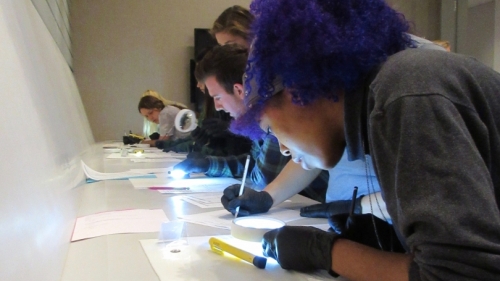
of a Dartmouth College sector in the Forum area began in 1986 and continued
until 1997. Each summer during that period teams of three or four Dartmouth
College undergraduates participated in the excavations under the direction
of Prof. Norman A. Doenges as field director. In all fifty four students
took part in the program. Of
them at least eighteen have gone on to further study of archaeology, architecture, or the
classics in graduate doctoral programs.
The Dartmouth sector is located at the
northwest quadrant of the taberna insula along the west side of the forum.
It is made up of two independent blocks of eight rooms, three facing west
along the west side of the insula and five rooms facing north along the
street at the rear of the Capitolium. The rooms occupy parts of fifteen
5.00 x 5.00 m. squares of the excavation grid. They cover an area of 16.35
x 12.00 m. or 196 m. sq. The Dartmouth excavations established a definitive
date for the earliest structures in the forum area, dated successive building
periods, and defined through the discovery of the West Street the street
plan of the city.
The West Unit
The
three western rooms (Rooms V, Y, and X) are at a lower depth than the five
eastern rooms. They also constitute a separate unit with no access to the
eastern unit. Room V at the northwest corner of the insula is the
largest room in the complex, measuring 8.10 x 5.85 m. Its entrance on the
West Street is a wide doorway with a grooved threshold for holding a wooden
closure. At the south end of the doorway there was a low rectangular counter.
Such counters are a regular feature at the entrances to Pollentia shops.
In Room V the counter stands at the south side of a rectangular sunken
area, 2.70 x 2.20 m., with a finely prepared beaten earth floor at the
entrance to the room. The sunken area and the counter seem to have been
part of the entrance system. At a late date perhaps shortly before the
collapse of the room a mud brick wall was constructed 2.00 m. west from
the rear wall of the room. Not enough of the wall remains to determine
its function, but the rear of the shop seems to have been used for storage.
In the destruction fill over the latest floor of the room several large
fragments of a pink concrete floor were found, indicating that the room
had a second story or a loft at its east end.
Stratigraphic soundings date the construction
of the room to the first half of the first century B.C. At the end of that
century a new floor was laid at a higher level, and finally a third beaten
earth floor at a still higher level was put down probably in the early
first century A.D. It was on the third floor that the room collapsed as
the result of a major fire late in the third quarter of the third century.
More than 190 objects of interest were
found on the latest floor of the room. They suggest that Room V was an
industrial shop in which glass blowing and metal working took place. Near
the center of the room was a round iron frame holding a ceramic bowl full
of glass slag. Fragments of slag were scattered throughout the center of
the room. A pile of washed sand lay against the south wall near the entrance.
In the sunken area in front of the entrance many iron and bronze tools,
chisels, sickles, pruning forks, rakes, scoops, and shovels, were found
along with lumps of scrap iron and bronze. At the rear of the shop
among many small objects there were parts of two iron spoked wheels, an
iron saw, four large bronze fry pans, a complete mill for grinding grain,
an amphora filled with 58 iron nails, and a hoard of 42 bronze coins. The
latest coin in the hoard is one of Valerian (253-260 A.D.), the earliest
of Marcus Aurelius. Just under the threshold of the shop there was a small
bronze statuette of the god Mercury, very well preserved.
South of Room V is a second shop facing
the West Street. It is made up of two rooms, Rooms Y and X. Originally,
however, it like Room V was a single large shop. It was split in two with
the construction of Room X at the beginning of the first century A.D. The
front room, Room Y, is entered through a wide doorway. The threshold
of the doorway was originally channeled to hold a wooden closure. But at
some point the channel was chiseled away to provide a wide open entrance
to the shop, and a porch or portico was added to the front of the shop
to protect the entry way. Typically there is a low counter just inside
the entrance at its north end.
This shop like the one to the north
was built in the first half of the first century B.C. A new beaten earth
floor was then put down at the end of that century or the beginning of
the next. It was on this floor that the structure collapsed in a raging
fire in the second half of the third century. Over the floor was a deep
layer of burnt mud brick and rubble. At the time of its destruction the
shop may have been an eatery or tavern. Fragments of more than twenty
amphoras
were found at the counter and along the north wall of Room Y. There were
other amphoras along the south wall at the entrance to the room. Two fish
hooks and the horn of a goat were found near the center of the room. In
the destruction rubble east of the counter there was a well preserved iron
grate which may have come from a window over the entrance or may have served
as a barbecue grilling surface over the counter. A similar grate was found
at the northeast corner of the shops along the west side of the forum.
The rear room of the shop, Room X,
was used for storage. It was constructed at the turn of the millennium.
Subsequently two new floors were laid at higher levels. At a late date
probably in the third century the rear wall was rebuilt with large reused
blocks taken from elsewhere in the forum. A buttress had to be added at
the center of the wall to make it stable. Scattered on the latest floor
of the room were twenty-four amphoras dating to the third century. Two
of the them contained a mass of minuscule fish bones, the residue of the
fish sauces garum or salsamentum. The inside of one of the
amphoras was coated with pitch. Another held unidentifiable organic matter,
and still another contained fine white sand. Two cylindrical iron bars,
1.00 m. in length, lay along the west and south walls of the room. Stacked
against the south wall were five unused roof tiles, and leaning against
one of them a large spouted ceramic basin. At the northeast corner of the
room was a collection of metal objects, among them the handle of a bronze
jug, a bronze balance arm with chain, a bronze funnel, a low iron stand
with wheels, several iron rings to hold pots over a fire, two iron fire
tongs, a knife with the handle ending in a ram's head, two bronze fry pans,
and iron bucket handles.
South of Rooms Y and X there is a narrow
walkway or alley separating the rooms from another shop unit to the south.
Access to the walkway was through a door at the southeast corner of Room
Y. At some point near the end of the second or the beginning of the third
century the walkway was blocked up at its west end with the result that
a deep layer of fine silt from runoff accumulated over the pavement in
the period before the firing and collapse of the buildings on either side.
The East Unit
The
east unit of the complex made up of five rooms, U1, U2, Q, T, and R, is
an independent set of rooms unconnected to the shops along the west side
of the forum and to the west unit. It faces north with its entrance along
the street running east to west at the rear of the Capitolium. All evidence
of the street unfortunately may have been destroyed by the action of earlier
excavators. The use to which the unit was put is not clear. It was not
a shop complex, and it does not seem suitable for residential purposes.
One possibility is that the rooms served at least initially as office space
for town officials.
Stratigraphic evidence indicates that
Room U was originally undivided. It was constructed in the first
half of the first century B.C. at the same depth as Room V to the west.
The main feature of this early room was the well with its arch at the center
of the south wall. The location of the well suggests the possibility that
the room was inÝ
its
initial stage open along its north side and unroofed. There is only a single
footing block in place at the end of the west wall of the room to indicate
that there may have been a north wall. On the other hand a well in an interior
wall of a room is not an uncommon feature of Roman buildings. The floor
level of this early room was then raised some 20 cm. in the late first
or early second century A.D. Finally in the early third century a new floor
was laid at a still higher level, and the room was divided in two.
After the division the eastern room,
U1, became a long entrance corridor to the entire unit. Along its
north side is a wide threshold. There were two doorways into the western
room, U2, one just inside the entrance and the other at the well. By this
time the arch of the well had been walled up, and well itself had ceased
to be functional and had been filled in. There may have been a third doorway
into Room R at the southeast corner of the room. The latest floor on which
the room collapsed was of beaten earth. Beneath it was a mosaic floor with
the tesserae set in clay. Both floors date to the third century. The tessera
floor ran through the south doorway into Room U2. On the latest beaten
earth floor among other items was a distinctive hand-made ceramic bowl
decorated with a vine motif in relief. The bowl may have contained nine
circular blue glass-paste disks, seven with figures of fish done in yellow
and black inlay. The disks seem to have been cut from a glass-paste plaque
on which the fish were portrayed swimming in a blue sea. The disks may
have served as counters for some sort of game.
The western room, U2, seems to
have been a storeroom. On the latest floor of the room there were the charred
remains of what may have been a wooden box holding folded cloth which had
been partially carbonized. Near the wooden box among other items were two
disk lamps, a bronze balance arm with chain, a bronze balsamarium in
the shape of a female head, a bronze seal stamp ring in the shape of an
eagle with the word ACTIACI embossed from right to left and in a lower
register a legionary standard on its side, and finally a large lead strongbox
with a circular hole in its top and the figures of a bull and a horned
deity in relief on its front. The seal stamp may have belonged to a veteran
of the battle of Actium. In the third century the stamp would have been
an heirloom or an official seal.
Rooms Q and T were also originally
a single large room. The west and south walls of the larger room date to
the first half of the first century B.C. At first this large room may have
been open to the north and unroofed. Around the turn of the millennium
the floor level of the room was raised some 20 cm. In the early first century
A.D. the level was again raised. On this floor at the southwest corner
of the room a roof tile was embedded in plaster at an angle to the corner,
and north of it two dolia were set into the floor. One of the dolia held
a collection of small pots. Finally in the late second or early third century
the floor level was raised for a third time. At this point a the large
room was divided into Rooms Q and T, and new walls were built over the
earlier west and south walls at the higher level.
There is a doorway from Room Q to Room
T at the southwest corner of Room Q. There may also have been an entrance
from the street in the north wall. The typical third century destruction
fill over the floor of Room Q was disturbed by a deep pit dug in the Islamic
period into which hundreds of broken water jugs had been thrown. A trench
of the early excavators may have further damaged the room along its north
side. Room T has a door at its northwest corner and another at the center of the
south wall into Room R. On the latest floor of the room there were found
among other items the base of a candelabra, a bronze statuette of a seated
draped figure, two iron keys, and a bronze coiled snake, perhaps a furniture
attachment.
Room R south of the well was
constructed at the end of the first century B.C. or the beginning of the
first century A.D. when the floor level in Rooms U, Q, and T was first
raised and when Room X was built at the rear of Room Y. The earliest floor
of the new room is at roughly the same depth as the second floor in
Room U. At the end of the second century at new floor was laid at a higher
level. The surface of this floor was compact white clay.Ý
At
some point in the third century the room seems to have suffered a major
disturbance. There was a mass of broken pottery over much of the clay floor.
The floor level was then again raised. So also were the south and east
walls of the room with the superposition of large building blocks taken
from other structures on top of the early walls of the room. Probably at
the same time the west wall of the room was rebuilt also with the use of
large building blocks taken from elsewhere. Finally toward the end of the
third century the floor level in the room was again raised. The surface
of this floor was sauló or decomposed sandstone which hardens on
exposure to air. It was on this third floor that the room collapsed. Room
R is the only one in the Dartmouth sector which was not destroyed by fire.
It is also the only room in which terra sigillata Africana D fragments
were found. There is thus the possibility that it survived the catastrophe
which engulfed the rest of the insula and remained occupied into the fourth
century. But when it was in its final stage, all of the other structures
in the forum area with the possible exception of the Capitolium must have
been in ruin, and most of the population had abandoned the center of the
city to subsist within the confines of the late wall built around the Sa
Portella enclave. The cause of this sharp decline is unclear. But its roots
lie in economic depression, political insecurity, and perhaps disease which
not only Pollentia but also other major cities in eastern Spain suffered
toward the end of the third century.
Bibliography:
L. R. Amorós, M. Almagro, and A. Arribas, Excavación
del Teatro romano de Pollentia 1953 (Palma 1954)
A. Arribas, M. Tarradell, and D. Woods, Pollentia I. Excavaciones
en Sa Portella, Alcudia (Mallorca) Memoria no. 75 (Madrid 1973)
A. Arribas, M. Tarradell, and D. Woods, Pollentia II. Excavaciones
en Sa Portella, Alcudia (Mallorca) Memoria no. 98 (Madrid 1978)
A. Arribas, Pollentia 3. Estudio de los materiales, I. Sa Portella
Excavaciones 1957-1963 (Palma de Mallorca 1983)
A. Arribas, "La Arqueología de Pollentia," Historia de Alcudia
I, (Alcudia, Mallorca 1978) 111-291
A. Arribas and M. Tarradell, "El Foro de Pollentia. Noticias de las
primeras investigaciones," Los Foros Romanos de las Provincias Occidentales,
C. Aranegui Cascó, ed. (Madrid 1987) 121-136
R. C. Knapp, Aspects of the Roman experience in Iberia, 206-100 B.C.
(Valladolid 1977)
M. Tarradell, "Pollentia: esquema de aproximación histórica,"
Historia de Alcudia I, (Alcudia, Mallorca 1978) 293-357
© Copyright 1998, Trustees of Dartmouth College
Norman A. Doenges, September 1, 1998