Department of Physics and Astronomy, Dartmouth College


Entrance to Wilder Laboratories

People

Research

Graduate Study

Undergraduate Study

Monthly Calendar

Public Observing

Contact Information

Department News


Home

Site Map


Research Overview - Plasma, Fluids, & Beams

Home > Research > Overview > Plasma, Fluids, & Beams


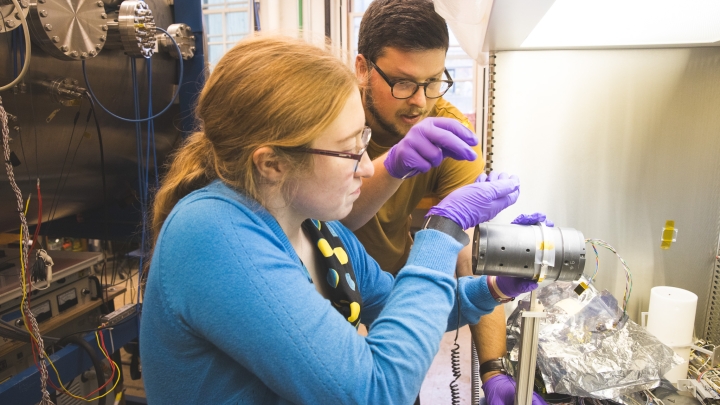
Research in the physics of plasmas and fluids is carried out by Professors David Montgomery and Barrett Rogers, and includes studies of nonlinear magnetohydrodynamics and turbulence in plasmas and fluids, investigations of magnetic reconnection, the physics of fusion devices, analytical dynamics, computational physics, plasma simulation, and plasma theory. The department also has a large vacuum calibration and test system for quantifying the response of particle detectors flown on auroral sounding rockets to the space environment, including a plasma source. Further details are described under Professor Kristina Lynch's rocket lab.

Through the efforts of an an international fusion research program, dramatic progress has been made in recent years toward the goal of confining a fusion-grade plasma in the laboratory using intense magnetic fields. The performance of these fusion devices is typically limited by a host of instabilities, which produce turbulence and degrade the confinement of particles and thermal energy. Research on this topic at Dartmouth (Rogers and Montgomery) is focused on understanding the physics of these instabilities as well as the turbulence and transport that they produce. This work relies heavily on both analytic methods as well as state-of-the-art massively parallel numerical simulations.

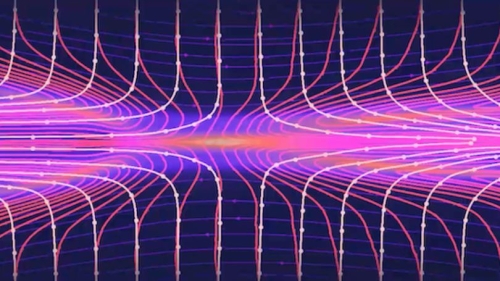
Professor Montgomery's recent activities have included studies of (1) the effect of an externally-imposed dc magnetic field's partial or total suppression of turbulent magnetohydrodynamic (MHD) dynamo action (see, e.g., D.C. Montgomery et al, Phys. Plasmas 9, 1221 (2002) and 6, 2727 (1999)); and (2) the mass flows which necessarily arise in steady-state toroidal confinement devices for magnetic fusion plasmas (see, e.g., L.P. Kamp and D.C. Montgomery, Phys. Plasmas 10, 157 (2003)). The two figures below are taken from the 2003 Kamp/Montgomery paper, and show sample values of magnetohydrodynamic flow variables in the top half of an axisymmetric toroid's rectangular cross section, as determined by numerical solution of the non-ideal MHD equations using viscous and resistive boundary conditions. In the top figure is shown the toroidal velocity component (the long way round the doughnut), while in the lower figure, the toroidal vorticity and poloidal (short way round the doughnut) stream function are displayed. Mirror images of this "double smoke ring" pattern are present in the lower half of the toroidal cross-section (not shown). Such flows are absent if only the ideal (non-resistive, non-viscous) MHD description is employed in the calculation and are highly sensitive to the values of the transport coefficients used.

Toroidal velocity graph

Stream function graph

For more information, visit Prof. Montgomery's and Prof. Roger's home page.

Recent Publications

L.P.J. Kamp and D.C. Montgomery, "Toroidal Steady States in Visco-resistive magnetohydrodynamics," Journal of Plasma Physics 70, 113 (2004).
Z. Yin, D.C. Montgomery, and H.J.H. Clercx, "Alternative statistical-mechanical descriptions of decaying two-dimensional turbulence in terms of 'patches' and 'points'," Physics of Fluids 15, 1937 (2003).
B.N. Rogers, R.E. Denton, and J.F. Drake, "Signatures of collisionless magnetic reconnection," B. N. Rogers, R. E. Denton and J. F. Drake, Journal Geophysical Research, 108 A3, 10.1029/2002JA009699 (2003).
B.D. Jemella, M.A. Shay, J.F. Drake, B.N. Rogers, "Impact of frustrated singularities on magnetic-island evolution," Physical Review Letters 91, 125002 (2003).