Information resources are central to the mission of the Library. Rapid developments in information technology, publishing, and scholarly communication have transformed information management from a process of local collection building into an increasingly complex set of tasks involving discussion and planning for resource selection, bibliographic and physical access, fiscal management, storage, and options for resource sharing. In particular, rapid development of the Internet and related information technologies, the changing scene in scholarly and commercial publishing, and growth in the scope and availability of digital information have made resource management the nexus for the interaction of the library's major programs. The operational and financial aspects of the information resources management program are reported in the Library’s annual Statistical Report. 5.
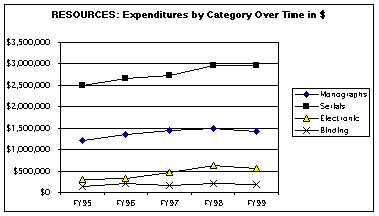
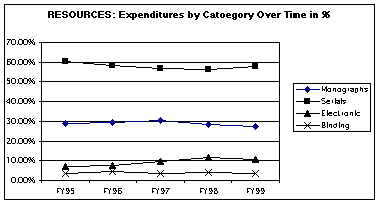
The Library collection supports research and instruction in undergraduate, graduate and professional programs in the Arts and Sciences and the three professionals schools. In raw numbers, print materials represent the vast majority of the Library’s resources. Described in terms of expenditures in FY99, the Library spent approximately 27% of its budget on print monographs, 57% on print serials, 11% on digital resources, 4% on binding, and 1% on other resources (including audio-visuals).
While print materials comprise the majority of the collection (and are likely to do so for the foreseeable future), spending and collecting trends over the past five years are beginning to shift to digital formats, with a much stronger emphasis on access, both in terms of actual dollars and percentages of budget spent.
Collection strengths include:
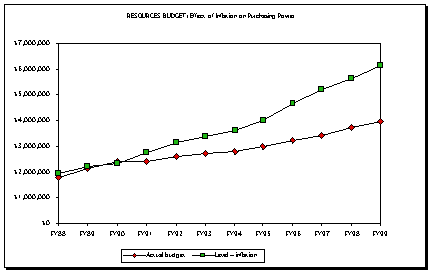
The Library depends upon the information resources budget to provide the funding to purchase those resources needed on site, to preserve those materials which are part of the permanent collection, and to make available those tools which facilitate access to information resources located elsewhere. Two major factors affecting resources are the rising cost of these resources which is increasing annually at a rate more than double the annual inflation rate, and increased need to invest in access to a growing body of digital resources. During the past decade, rising prices for information have seriously eroded this budget. A rapidly growing need to provide access to information in digital formats is placing additional pressure on a severely strained resource. Since 1987 the cost of Library materials has risen nearly 275%, while during the same period the resources budget increased approximately 140%. The chart below provides a graphic representation of the increasing discrepancy between the library budget (actual budget) and the dollars needed in order to merely keep pace with inflation (level + inflation). During the previous decade substantial progress was made toward maintaining the purchasing power of the resources budget. That goal was achieved in 1990. Since that time the discrepancy between the annual inflation rate for information resources and the yearly budget increments has increased markedly to the point that in FY99 the budget had lost over 35% in purchasing power. In terms of dollars available, over the ten-year period since 1987, the resources budget has lost in the aggregate over $4 million. In FY99 alone, the 35% reduction in purchasing power represented approximately $2 million.
The Library's response to the problem of declining budgets at a time of growing demand for information, increased publisher output, and the need to invest in new formats and technologies for information access, has been a combination of purchase, interlibrary cooperation, and improved public service. The question of "access or ownership" informs every major collection management decision the Library makes. Over the last five years, the Library has reduced its journal subscriptions by over 1000 titles and decreased the number of individual monographs purchased by nearly 20%. At the same time the Library has more than doubled the percentage of its resources budget spent on electronic information resources. As the number of items purchased has decreased, borrowing has increased substantially and lending has decreased. However, the use of interlibrary loan shifts costs; it does not necessarily reduce them.
Over the last decade, the College has added or expanded in a number of areas not traditionally supported by the Library at the level required by these new initiatives. In most cases the Library was not consulted as part of the planning process for such expansions; thus, there was no opportunity to assess collection strength or determine the needs of the initiative. Such new programs include Arabic, Hebrew, Japanese, Latin American and Caribbean Studies, and Cognitive Neuroscience. The Library has employed a variety of means to provide support for these programs, including grant funding and interlibrary loan. However, these are not adequate long-term solutions. Until Library costs associated with new initiatives are evaluated in the same way as salary, office, laboratory, equipment, etc., this serious problem will continue to grow, preventing the Library from providing the information resources and services these programs require.
The challenge of providing adequate information resources must be addressed on several fronts: a re-examination of collecting strategies (access or ownership), increased resource sharing, and the exploration of the use of new and emerging technologies for access to information resources. The Library is doing all of these things. At the same time, however, steps must be taken to prevent further erosion of the existing resources budget. If this is not done, the ability of the Library to meet the information needs of the constituencies it serves will be increasingly reduced. This decade is a critical one for information creators and providers. Formats, locations, and methods of accessing information are undergoing major changes and these changes are occurring in different ways at different rates of speed from discipline to discipline. This places the Library in the position of needing to continue to acquire resources in all the traditional formats, as well as acquire new formats and explore ways to provide access to information not acquired.
Collection development activities are managed by thirty subject bibliographers working directly with faculty and academic departments to build and maintain collections that support the curricular and research needs of constituencies. 6. Guided by written policies developed for each academic area, bibliographers assess and select information resources in all formats, evaluate user requests, monitor interlibrary loan and document delivery activity, maintain awareness of developments in the fields they represent, and communicate with their constituencies through a variety of mechanisms, including newsletters and current awareness/selective dissemination of information services. In addition to collection building, collection management and development includes activities, such as weeding, transferring materials to storage, and acquiring older materials to strengthen existing collections. Collection management and development is a distributed activity coordinated by the Director of Collection Services through the Collection Management and Development Committee, a group composed of bibliographers, technical services librarians, and systems staff. The committee serves as a forum to discuss collection development activities, to define and solve problems, and to develop strategies.
Bibliographers, working individually or in subject-related groups, are also responsible for digital information selection decisions. A high degree of cooperation and coordination across subject areas and functional departments in the library is required to handle the complexities of much of this material. Centralized funds have been established to cover the many large, multidisciplinary products chosen for the Dartmouth community. Librarians work actively with publishers and vendors on issues such as pricing, acceptable contracts and licenses, and modes of access. Bibliographers are assisted in their digital resources collections activities by the Electronic Information Group, a sub-group of the Collection Management and Development Committee.
Interlibrary loan extends the scope of the Library's collection by providing access to information the Library does not own, license, or lease. 7 Bibliographers use ILL and fee-based document delivery services as an adjunct to local resources for a variety of reasons: material may be out of scope for local collections, too costly to purchase, or very specialized (technical reports or patents, for example). In some areas, especially in disciplines and subjects that have become active research fronts at Dartmouth, the viability of this option has decreased as users expect in-house collections. In areas not fully supported by local collections, such as chemistry, biotechnology, patents, and environmental sciences, the Library provides access to specialized databases through librarian-mediated online search services.
Bibliographers are supported in their collection management and development work by the centralized departments of Acquisitions Services, Bibliographic Control Services, Bibliographic Records Management Services, and Preservation Services, which together comprise the Collections Services division.
D. Preservation of Library Materials
Preservation activities began at the Library with the completion of an ARL, Office of Management Studies, Pilot Preservation Program Self Study in 1981. 8 The recommendations resulted in the appointment of a Preservation Committee which formulated policy and coordinated a number of initiatives, including the creation of a binding manual for bibliographers, and the development of a basic book repair workshop. Concurrently, a Disaster Committee was appointed to write a disaster manual, assist the libraries in developing emergency response procedures, and coordinate recovery of damaged library materials. By the mid-1990s "preservation by committee" was no longer viable, and in 1995 the Library's first Preservation Services Librarian was appointed to oversee the preservation program and the newly formed Preservation Services department. Three years later the Collections Conservator position was created and filled. Books and flat paper are the specialty of the preservation staff, but the department is a resource for preservation information and coordinates preservation of all formats. This includes commercial binding; in-house binding; conservation of books, flat paper, and manuscripts; disaster recovery; reformatting of brittle books; and staff training. The Preservation Committee advises the Preservation Services Librarian on program needs; currently the committee is evaluating mass deacidification technology and plans to review digitization as a preservation tool. Both the Preservation Services Librarian and the Collections Conservator work closely with the Disaster Committee to coordinate training, emergency preparedness, and recovery.
The operation of information management systems involves two components. The first is the provision of the intellectual content of these systems, or the creation and acquisition of databases that optimize access to the content of the library collections. The second is the support structure that underlies this content, that is the design, acquisition, and maintenance of the hardware and software on which these systems run. These components are linked in a complex way, and decisions in one area have a direct effect on the other. The goal of development in both areas is the same, however, to provide the best access to the content of the collections, including licensed remote resources. Computing systems touch nearly every aspect of Library operations; staff and users rely on them continuously.
Next section:
"The Dartmouth College Library in the Year 2000"