WGST 07/First Year Seminar: Representations of African-American Women in
American Cinema
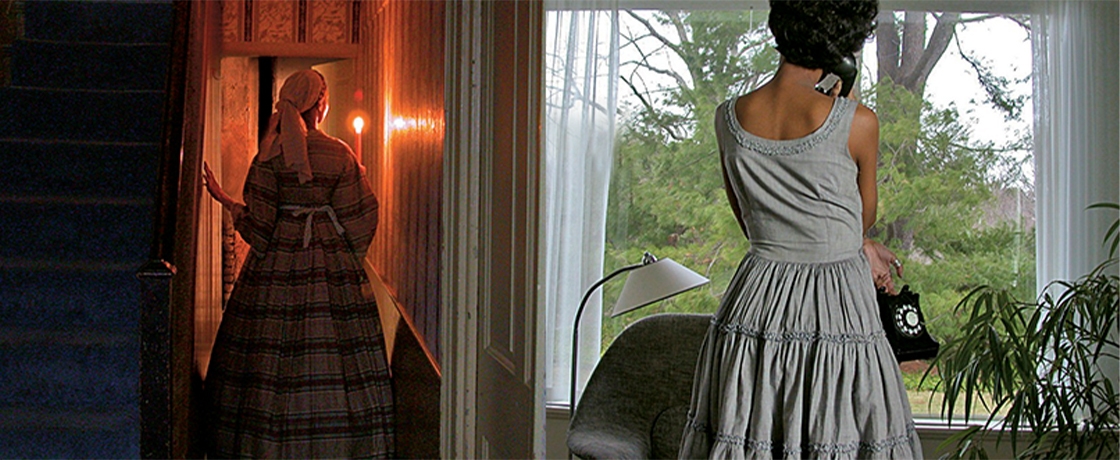
This course examines the representation of black women in American cinema —
or lack thereof — as evidence of the dominant cultures’ historical insistence
on the invisibility and powerlessness of African American femininity. Why is
the black female voice inherently missing in Hollywood? What are the
stereotypes? Who profits from their absence, powerlessness and silence? Films
screened include works by directors Oscar Micheaux, Gordon Parks, Spike Lee,
Julie Dash, Kasi Lemmons, Steven Spielberg, John Singleton, and Cheryl Dunye.
Students will also be introduced to independent black women filmmakers who
articulate an empowering, active black female voice through their progressive,
substantive and universally-compelling representations of black femininity — in
spite of the dominance of western imperialist culture and the formidable
commercial constraints of the industry. Dist: ART.
Professor Nottage
10A-hour
WGST 10.1/ Sex, Gender and Society
This course will investigate the roles of women and men in society from an
interdisciplinary point of view. We will analyze both the theoretical and
practical aspects of gender attribution — how it shapes social roles within
diverse cultures, and defines women’s and men’s personal sense of identity. We
will discuss the following questions: What are the actual differences between
the sexes in the areas of biology, psychology, and moral development? What is
the effect of gender on participation in the work force and politics, on
language, and on artistic expression? We will also explore the changing
patterns of relationships between the sexes and possibilities for the
future.
Open to all students. Dist: SOC. Class of 2008 and later: WCult:
CI. The staff.
Professor Katz
10-hour
WGST 10.2/ Sex, Gender and Society
See course description for WGST 10.1
Professor Fluri
12-hour
WGST 18 Introduction to Gay, Lesbian, Bisexual and Transgender Studies
This course will examine the ways in which “deviant” sexual and gender
behavior and identities, and the political movements that emerge from them,
have been conceptualized in U.S. culture. We will cover basic g/l/b/t cultural
and political history and the interplay between sexuality, gender, race, class,
ethnicity, and economics. Classes will be a mix of lecture and discussion.
Students will be expected to work with primary documents (including novels and
film), recent work in queer theory and historical analysis.
Open to all students. Dist: SOC. Class of 2008 and later: WCult:
CI. Bronski.
Professor Bronski
2A-hour
WGST 23.2/HIST 28 American Women's History Since 1920
This course traces the history of American women from 1920 to the 1980s.
Topics to be discussed include: the breakup of the suffrage alliance during the
1920s; women in the radical social movements of the 1930s; women and war work
in the 1940s; women in the Civil Rights movement of the 1950s and 60s; the
‘second wave’ of American feminism; institutionalization of feminism in the
1970s; and the rise of an anti-feminist women’s movement in the 1980s. The
course will also examine the ways gender definitions have changed in the U.S.
during this century, and the ways that race and class have shaped American
ideas about gender.
Open to all students. Dist: SOC. Class of 2007 and earlier: WCult:
NA. Class of 2008 and later: WCult: W.
Professor Orleck
10-hour
WGST 37.2/GEOG 41 Gender, Islam and Space
This course will address various aspects of Feminism, Islam and Space. This
course will seek to answer various questions about space, gender and Islam such
as: What constitutes a Muslim Space and the “Muslim World”? Who decides and
defines these spaces? How are theses spaces gendered and influenced by Islam or
Islamic practices? How do such gendering of spaces differ by place?
Additionally, we will explore the readings of several Islamic feminist scholars
that address several gender related topics such as women’s rights, gender
roles, honor and Sharia (Islamic law).
Open to all students. Dist: SOC. Class of 2007 and earlier: WCult:
NW. Class of 2008 and later: WCult: CI.
Professor Fluri
10-hour
WGST 40.1/NAS 42 Gender Issues in Native American Life
We will address issues of gender in indigenous communities as it relates to
culture, policy, history, and social life. Indigenous, in the context of this
class, will focus on the diversity of Native people within/across
settler-colonial nation-states. The project-based assignments will tackle
common misperceptions, the complexity of changing gender patterns, the methods
Native communities develop to balance out gender inequities, and various
organizing of Native women’s activism. The aim of this class is to create an
understanding of how gender issues are a vital component in the process of
decolonization,
Open to all students. Dist: SOC. Class of 2008 and later: WCult:
CI. Goeman.
Professor Goeman
11-hour
WGST 46.1/PHIL 22 Feminism and Philosophy
This course examines the relationship between feminism and philosophy. The
focus is on such questions as: Is the Western philosophical canon inherently
sexist? How should feminist philosophers read the canon? Are Western
philosophical concepts such as objectivity, reason, and impartiality inherently
masculinist concepts? The course may focus on either the ways in which
feminists have interpreted great figures in the history of philosophy (e.g.,
Plato, Aristotle, Descartes, Hume, Kant, Nietzsche), or on the ways in which
feminists have rethought basic concepts in core areas of philosophy (e.g.,
epistemology, ethics, metaphysics, political philosophy, philosophy of
science), or both.
Open to all students. Class of 2007 and earlier: Dist: PHR. Class of
2008 and later: Dist: TMV; WCult: CI.
Professor Brison
2-hour
WGST 52.1/COLT 67 Colonial and Post Colonial Masculinities
In this course, we will develop an understanding of masculinity as a
construct which varies in time and space, and is constantly (re)shaped by such
factors as race, class, and sexuality. The contexts of the colonial encounter
and its postcolonial aftermath will set the stage for our examination of the
ways in which social, political, economic, and cultural factors foster the
production of specific masculinities. Texts include Achebe's Things Fall
Apart, Conrad's Heart of Darkness, Lafferiere's How
to Make Love to a Negro, and additional writings by Irish, Indian, and
Australian authors. Our study will be organized around the questions of the
production of hegemonic and subaltern masculinities, the representation of the
colonial and postcolonial male body, the militarization of masculinity, and the
relation between masculinity and nationalism. Theoretical material on
masculinities will frame our readings.
Professor Coly
3B-hour
WGST 80/Feminist Theory and Methodology
The seminar in Women's and Gender Studies is designed to be both a
culminating experience for Women's and Gender Studies students and an intensive
preparation for future work (such as independent study, honors theses, graduate
work, or any kind of advanced feminist scholarship). Consequently, this course
will address such questions as what is a feminist approach? What kinds of
questions do feminists ask? What is the relation between feminist theory and
feminist activism? The focus will be on feminist methodology, examining through
reading, exercises in class, written assignments, and research projects, how
feminist scholarship is done within a given area.
In 06F, Transnational Feminism. Possible texts will include close readings of
Chandra Mohanty's Feminism without Borders and Ketu Katrak's
Politics of the Female Body: Postcolonial Women Writers of the Third
World. Dist: SOC. Class of 2008 and later: WCult: CI.
Schweitzer
Professor Schweitzer
10A-hour
Associated WGST Courses
EDUC 54/Moral Development, Moral Education
Professor Garrod
2-hour
ENGL 67.5/Black Women Writers
Professor Vasquez
2A-hour
|