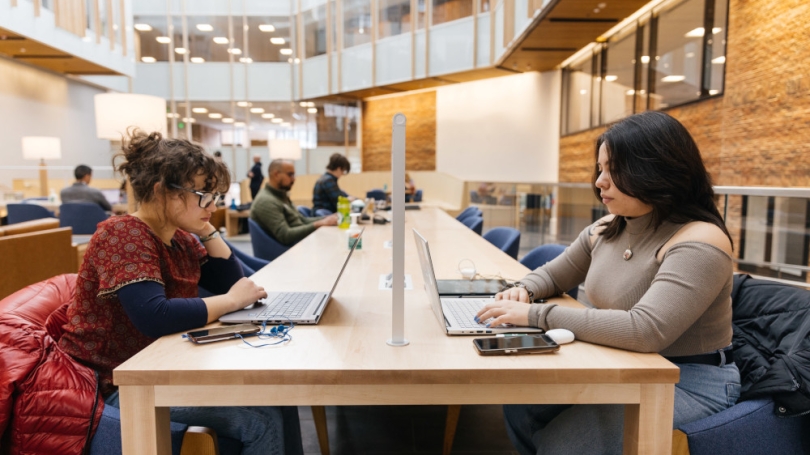
For the past three decades, educators have recognized the value of learning collaboratively. Educators widely recognize that students do not learn well when they are isolated "receivers" of knowledge. Indeed, students must overcome isolation in order to learn to write. Collaborative learning exercises—such as peer review workshops, collaborative research assignments, group presentations, collaborative papers, discussion groups, and so on—are important components of our writing classrooms because they encourage active learning, giving students the opportunity to become more deeply engaged with their writing, and with one another.
Consider:
Our discussion so far has pointed to why collaboration is useful in our writing classrooms. The question that remains is how collaboration is most effectively used. Can collaborative exercises be whole-class events? Or do they work better when the groups are smaller? Should groups have three members? Two? Four? Should collaborative work be done in class, or might it be done outside of class? Should an instructor supply guidelines for collaborating? Should she develop criteria for evaluating peer work, or should she encourage students to develop their own?
The beauty of collaborative learning is that it might be practiced in a number of ways. Collaborative exercises can be whole-class events; they might also be done in small groups. Some collaborative exercises work best with pairs—in particular, those exercises that require close attention (such as sharing whole essays). Other collaborative exercises work best when student writers receive multiple points of view (for example, when the aim of the exercise is to narrow a topic, sharpen a thesis, and so on).
Whatever you decide, it's important to remember that peer exercises should be carefully designed so that they reflect your goals and meet your students' needs. You don't, necessarily, have to design the exercises on your own—sometimes (as in collaborative assessment exercises) you may want to design the exercise with your students. What follows are some ideas for designing collaborative enterprises for your class.
One very effective use of collaborative learning in the Writing Classroom involves asking students to diagnose and then respond to their peers' written work. To insure that our students are able to comment productively and effectively on their peers' papers, we must first teach them methods of diagnosis and response. We can begin by modeling the reading process for our students, illustrating that there are several ways to read a paper. (For a discussion of how you can use these same methods to sharpen your diagnostic skills, see Diagnosing and Responding to Student Writing.)
Too often when diagnosing their peers' writing, students either 1) try to emulate their instructors, or 2) respond as editors. Neither response is particularly effective: in the first case, students appropriate authority over their classmates' work; in the second, they correct errors rather than facilitate good writing. Accordingly, we offer some ways of reading that will help students avoid these pitfalls:
Download Ways of Reading instructions for your students here.
Once students have been taught how to read their classmates' papers, they will require some instruction in how to respond. Students must be taught to respond facilitatively, a method that is more fully outlined in Diagnosing and Responding to Student Papers. In brief, a facilitative response requires a reader to respond in a way that facilitates the writer's goals. This approach asks readers to ask questions rather than to offer directions for improvement, so that the writer can herself determine which revision strategy to take. For instance, instead of saying, "Omit this," ask, "Why is this relevant? What's the connection?" The first comment assumes that a portion of the text needs to be cut when, in fact, the idea may be keenly relevant. In this case, the writer would find a way to make more explicit the relevance of the idea. The paper will then meet the student's original aim rather than meet the reader's (mistaken) assumptions.
The facilitative approach also encourages a writer to understand that good writing is a matter of making good choices. If you respond to a student with a list of directions, she won't think her options through. If you ask questions, the student will have to determine how best to answer them. She will discover that there are several ways to express an idea or develop an argument, and that she must choose the one that best meets her aims. In this way, authority remains with the student author.
When interacting with their peers, students will require strategies for crafting good responses to their classmates' work. They might try the following strategies:
Though peer group work is the most commonly used method for collaborative learning, many instructors employ collaborative assignments in order to reap the benefits of peer learning. Consider, for example:
Collaborative Research Assignments
The collaborative research assignment allows students to work together to explore a topic relevant to the course, but not necessarily covered in class. Working together, students can cover more ground than they can on their own. They can also try out different research strategies and then discuss among themselves which strategies are most useful, and why. Sometimes collaborative research leads to some other collaborative assignment—a group paper or presentation, for example.
Not all collaborative research assignments involve "big" tasks. In the first-year classroom in particular, instructors look for creative ways to introduce their students to the research process through small assignments. For example, some instructors assign students to research groups, give them a set of questions to answer, and then send them to the library or to the Internet to find the answers together. One instructor sends groups of students on a scholarly scavenger hunt, requiring them to explore different databases and to use different search engines in order to accomplish their research tasks. Others provide students with a topic and ask them to create an annotated bibliography together. The point is to get students working and talking together about what it means to do academic research.
Group Presentations
Group presentations are common in many Dartmouth classrooms. In these instances, instructors prepare topics or questions for the groups to consider, and then require the groups to prepare a presentation for the class. Sometimes the groups are asked to lead discussion of one of the course's primary texts; sometimes they are asked to come to class with historical or cultural information that can put a particular work in context. Sometimes groups are encouraged to be creative and to use several media when presenting to the class.
Some instructors express concern that group presentations allow weaker students to depend on stronger ones for their success in the course. In fact, this concern can be understood as one of the "positives" of group work, in that the stronger students can model the academic process for their less-prepared peers. If you remain concerned about your students' individual performances, you might begin by having groups prepare the first round of class presentations. The next round of presentations might be managed by pairs, and the final round by individuals. Students learn with each round to become more independent in the research and presentation processes.
Collaborative Papers
Like collaborative research assignments or group presentations, collaborative papers permit instructors to ask students to tackle an idea associated with the course that has not been covered in class. Students are assigned to produce the paper together: they may be asked to write the entire paper together, or they may be permitted to write the paper in sections and then to edit the paper together so that it seems to come from a single author, employing a consistent voice. One instructor allows students to divvy up the bulk of the work but insists that they write the introduction and conclusion together, attending to transitions between sections so that the paper reads seamlessly.
One benefit of the group paper is that it requires students to consider the stages of the writing process as they determine how to divide the labor among the group. For example, will the collaborative writing be most efficiently done if the group does its brainstorming together? Should the paper be divided into sections, with each member responsible for a single part? Can one student write effectively about something that has been researched by another student? As the group considers these questions, they are brought to think carefully and critically about the writing process.
Finally, collaborative writing makes students more conscious of their own writing processes and styles. As they debate strategies and sentences, students must defend their choices. They also come to see other possible ways of expressing their ideas. For this reason, the group papers will likely not be the best papers that students produce, but they may be the most educational.
Discussion Groups
Some instructors ask students to meet formally or informally in discussion groups, where they can work together to improve their understanding of difficult texts. Whole-class discussions are greatly improved when students have met in smaller groups to discuss the course materials among themselves. Instructors can direct these groups by furnishing them with questions to consider, or they might simply ask the group to meet and to return to class with the questions and observations that have arisen.
Evaluating collaborative work can be problematic—particularly if this work constitutes a considerable part of the course grade. Instructors might simply grade the project and give the same grade to all students. Or they might ask the students to submit a paper that documents their contributions to the presentation. Or they might ask each member of the group to evaluate the work of their group mates. Any strategy is equally good, as long as the standards and processes of evaluation are made clear to students long before collaboration begins.
In terms of peer critique: instructors who require peer critiques want some way of insuring that students are giving these exercises their best efforts. One way to evaluate peer critiques is to ask students to do their critiques in writing. Instructors can collect these critiques in class or on Blackboard and evaluate them. Another idea is to ask students to write a brief summary of how the peer review process did (or did not) help them to rethink and rewrite their papers. Whatever the method, the instructor should make sure that students understand that their work in the peer groups is an important element of the course, and in what way it will count towards their final grades.
Many instructors have found that Blackboard is a very useful tool in engaging students in collaborative learning exercises. Especially useful are the Discussion Board and the Wiki tool.
The Discussion Board allows instructors to create "threads," where students can post drafts of their papers and receive comments from their peers. The Discussion Board conveniently provides instructors and students with an archive of student work, in its various stages. It also provides instructors with a way to oversee the written critiques that students are doing of their classmates' work.
The Wiki tool is designed so that students can write and revise collaboratively. The Wiki keeps track of every draft, noting the changes made and who made them. Instructors use the Wiki in a variety of ways, sometimes asking students to write short Wikipedia-style entries on related course topics, other times asking them to create and maintain a glossary of key terms.
If you want to talk more about how to use Blackboard in your writing classroom, contact Karen Gocsik, Executive Director of the Writing and Rhetoric Program, or Barbara Knauff, of Curricular Computing.