Carol B. Muller and Mary L. Pavone Abstract This paper describes the retention strategies incorporated into
the Women in Science Project at Dartmouth, presents data on increases
in the numbers of undergraduate women graduating with majors in
science, math, and engineering since the project's inception,
and evaluation findings of specific interventions, suggests key
elements contributing to the project's success, and describes
how other universities have designed programs modeled after the
Women in Science Project. Introduction In 1990, a comprehensive program to address retention among undergraduate
women in science, including math and engineering, was launched
at Dartmouth College in Hanover, New Hampshire. Its strategies
include paid research internships for first year students (45-100/year),
an electronic newsletter distributed widely across campus every
two weeks, opportunities for informal conversation with practicing
women scientists and engineers, a peer mentoring program, special
speakers and programs, and a pilot industrial electronic mentoring
program. Coupled with these activities is an effort to inform
the campus concerning women's underrepresentation in these areas
of study and employment, suspected causes of and remedies for
underrepresentation, and Project work to encourage more women
to pursue their interests in these areas. Together these activities
create a stronger community of support and communication for women
in science. A 1993 grant from the Sloan Foundation provided support for Women
in Science Project activities including new initiatives to reach
out more systematically to faculty, encouraging them to consider
more effective approaches to teaching. Six faculty seminars are
offered each year, showcasing teaching methods, presenting information
on teaching and learning, offering student perspectives, and addressing
issues of gender and ethnicity in teaching and learning. The Dartmouth
Institute for Science Teaching provides a group of 15-25 faculty
members an intensive two-day program at a retreat center during
the summer, to focus more deeply on new ways of thinking about
teaching and learning. A curriculum development fund has allowed
the development of new material for teaching introductory physics
by women students working under the direction of a faculty member. Between 1990 and 1995, the percentage of women in Dartmouth's
graduating class who were science majors rose from 12% to 25%.
The proportion of women represented among engineering majors rose
to 25%. Evaluation shows first year research interns experience
increased confidence, positively influenced perceptions of science,
and increased interest in further research experience. Pennsylvania
State University and Trinity College, among others, have modeled
new programs on the Women in Science Project. The Women in Science Project at Dartmouth began with a commitment
to increase the number of women pursuing their interests in science[1].
A study of factors leading to attrition from the sciences at four
universities, including Dartmouth, which was completed 1989, had
shown, even when all usual factors of prediction of retention
in science were considered, including test scores, high school
courses taken, grades received, that women who entered the College
interested in the sciences were leaving those fields of study,
including engineering, at higher rates than their male counterparts
[2]. This finding was consistent with other literature concerning
women's participation in science, which has also identified the
most likely causes of women's underrepresentation in these fields:
early socialization, lower self-confidence, lower expectations
from parents, teachers, and others, less "tinkering" experience,
teaching practices in introductory college science and math courses,
and a lack of critical mass [3]. Both research and experience
at Dartmouth suggested that a series of intervention strategies
could ameliorate the attrition. Program Development When the late Karen E. Wetterhahn, Professor of Chemistry and
then Associate Dean of the Faculty for the Science Division, and
Carol B. Muller, then Assistant Dean at Thayer School of Engineering
designed the program, science and engineering faculty and student
services staff from across the university were encouraged to offer
suggestions. The process of involving a broad cross-section of
the campus was useful in more ways than one: in addition to tapping
additional experience and expertise, those who were not yet aware
of the issues related to women's underrepresentation became more
knowledgeable and we could encourage them to take action in their
respective spheres of influence to help support our efforts. We
identified five categories of need: information, role models,
mentoring, encouragement and support, community. Skill and knowledge
development requiring remedial work was not an issue within our
population; lack of ability or preparation did not characterize
the population. We decided to focus particularly on the first year students because
it appeared that attrition from the sciences was most prevalent
during that year. This focus made a campuswide initiative all
the more pragmatic, because students at Dartmouth don't select
a major until the end of their sophomore year; separating history
and English majors from math and engineering majors, or even chemistry
majors from biology majors, is not feasible on our campus in the
students' first year, so we needed to target the population of
students as a whole. We wrote to all the women entering their
first year in the fall of 1990, inviting them to participate in
our project. In subsequent years, this strategy has remained in
place, but the Project's reach has extended well beyond first
year students, while still paying special attention to the first
year. Retention Strategies Recognizing that reasons for leaving science vary from one individual
to another, we conceived a program which would offer a number
of different strategies which addressed the various categories
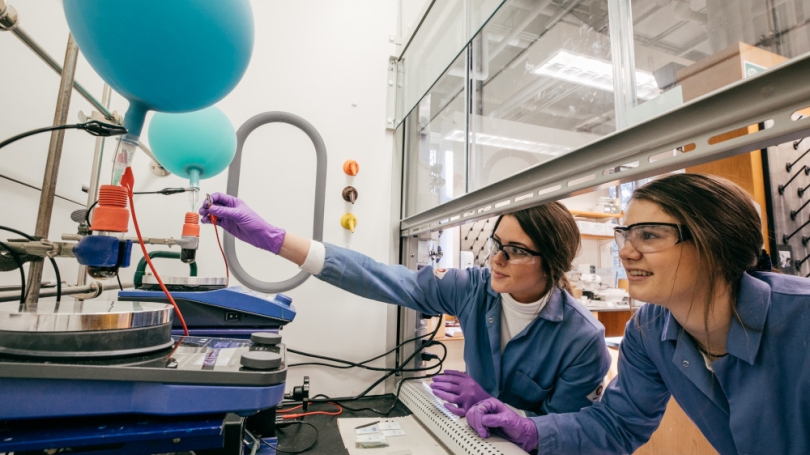
of need, from which students could choose. We worked with the faculty to develop a program of paid first
year research internships, which offer students an opportunity
to work in scientific research during the first year, one-on-one
work with a faculty member or researcher, who can serve as a present
and future mentor and role model, "hands-on" laboratory work and
firsthand experience with scientific inquiry, an important scientific
experience complementary to introductory science classes, experience
with the social construction and teamwork involved in science,
and stipends to ensure the full participation of economically
disadvantaged students. This is an innovative approach to undergraduate
instruction in scientific research, which is usually reserved
for upper division science majors, most often seniors, and tends
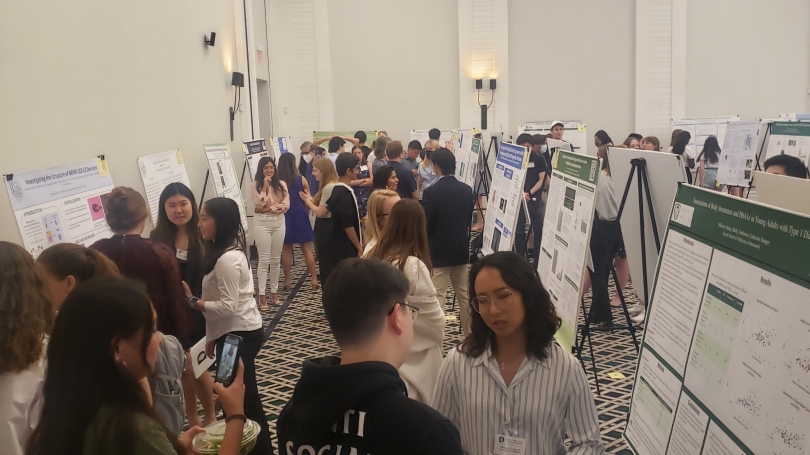
to be focused on preparation for graduate study. As a culminating
experience, interns participate in a Science Poster Symposium
at the conclusion of their internship, developing a poster representing
their work, and informally addressing questions from interested
students, faculty, and others attending the symposium. Faculty
involvement at an intensive level also had the benefit to faculty
of increased understanding of the decision points influencing
first year students' persistence in the sciences. To address the need for a sense of community, as well as needs
for encouragement, support, and information, we developed a twice-monthly
newsletter for students, which is also sent to faculty and staff.
The newsletter, edited by a student intern, is distributed every
two weeks via electronic mail. Offering encouragement and insights
from the project director and students, featuring profiles of
women in science, often but not exclusively some of those on campus,
recapitulation of talks with women in science, notices of colloquia,
campus activities and programs related to science, opportunities
for internships and scholarships, the newsletter also serves to
reminding the campus at large of the project's existence and goals. A peer mentoring program links first year students with more experienced
students, who are trained to provide information about campus
resources, as well as friendly support, advice, and encouragement.
Usually a pair or small group of first year students are matched
with a pair or even trio of mentors, so that students can benefit
from varying perspectives and experiences of the mentors, and
share experiences with other first year students. A recently-developed
electronic industrial mentoring program pairs students with mentors
in industry via e-mail, contributing to their understanding of
postgraduate career opportunities, as well as a source of support,
encouragement, and validation from outside the university. Time-intensive
extracurricular activities, such as industrial site visits and
other field trips, and special colloquia and seminars, featuring
distinguished women scientists and engineers as role models, are
offered occasionally, although for the most part, we have found
that demands on student time are great, and expectations for frequent
meetings of large groups are unrealistic. Faculty Development During the early 1990s, individuals working on the recruitment
and retention of women in science and engineering at various universities
began to meet and discuss their common issues and strategies.
Through meetings and discussion, it became apparent that offering
programs designed to help women negotiate and navigate the institutions
and practices which often resulted in discouraging them from pursuing
study or careers in science, was offering a "band-aid" solution
which did not address directly the problem. In the long run, to
avoid having to offer an extensive and expensive set of programs,
it appeared that working on "systemic change" would benefit women
and institutions alike. In contemplating institutional change
in an institution of higher education, it is essential to involve
the faculty, as well as others. The faculty has both the opportunity
to create change, both in policy and in the actual delivery of
education, and also the ability to thwart and actively resist
change. By enlisting faculty members directly in the provision
of retention efforts, through their supervision of students involved
in research internships and involvement in other activities, they
are likely to learn more about and appreciate more fully the experiences
of women students. Like most sensible professionals, faculty members
"do not replace strongly-held views and behavior patterns in response
to fiat or the latest vogue; instead, they respond to developing
sentiment among respected colleagues, to incentives that reward
serious efforts to explore new possibilities, and to the positive
feedback that may come from trying out new ideas from time to
time"[4]. We had already found that some science faculty members who were
initially skeptical that first year students could be involved
in any meaningful way in research projects had, through talking
with their own colleagues and observing their behavior, found
ways to involve first year students in research. A few others
confessed to us their surprise in finding the Women in Science
Project's success in encouraging women students in science corroborated
in direct conversation with students. In 1993, with the particular
support of a grant from the Alfred P. Sloan Foundation, the Women
in Science Project began to develop programs specifically for
faculty, including a summer institute and monthly faculty seminars
during the academic year. These programs have focused on best practices and theory in teaching
science at the college level, including, but not focusing exclusively,
on issues of gender. We have generally relied upon faculty, either
from Dartmouth or other institutions, to teach their colleagues. Results The Women in Science Project has grown from 115 students signed
up to participate in the project's activities and 45 research
internships in its first year to more than 1,000 participating
students and as many as 100 internships offered each year. The
numbers and percentages of women selecting science majors have
both grown, even as the total number of students majoring in science
has increased in the last five years. Students affiliated with
the Project are more likely to declare a major in the sciences
and the total number and percentage of women declaring majors
in science and engineering increased from a low of 12% in 1990
to a projected 24% for the class graduating in June 1997. In 1997, 42% of the students graduating with science majors were
women. In engineering, 24% of senior majors are women, in advance
of the national average of 18%, and an increase from the 15% of
engineering majors in 1990. Formative evaluations were conducted through surveys of participating
students and focus groups with faculty during the first two years
of the Project. External evaluations, including summative findings,
of various aspects of the project were completed in 1993 and 1996,
by Horizons Research and by Christine M. Cunningham of Cornell
University. It appears that the strategy of linking a series of
programs under a major, visible "umbrella" has been successful.
Even students who do not actively participate in many programs
report that they feel a strong sense of institutional support
just because of the project's presence on campus. Some participants
have noted that project activities were clearly instrumental in
affecting student choice of a major. Although the project was
designed to address retention of women in science, some women
select Dartmouth as the college of their choice because of its
Women in Science Project. External evaluations show that mentoring provided through the
research internships was often the most valuable aspect of an
intern's experience. Interns particularly appreciate their role
as a part of the team within a lab, and feeling their work is
important. Although most students find their internship experience
stressful at first, their confidence grows as their work becomes
more familiar. Quantitative analysis conducted in 1995 showed
that a student's decision to major in science is directly associated
with high math SAT scores, being male, and being work-study eligible
(a measure of financial need), and that the effect of gender on
majoring in sciences had changed over the period analyzed, so
that the gender effect had been reduced in 1993 and 1994, compared
to 1992. This analysis also showed that although math SAT scores,
gender, and work-study eligibility are statistically significant
predictors of major choice, they cumulatively account for less
than 10% of the variance. Qualitative analysis suggested six major themes for other factors
contributing to choice of major: confidence, personal contact
and teamwork, the "bigger picture," career plans, understandings
about scientific research, and the issue of women in science,
and help us understand how and why the Women in Science Project
has contributed to increased retention of women in science. The aspect of Women in Science Project programs most valued by
students is the personal contact they foster, through the support,
networking, mentoring, and camaraderie gained, especially but
not only, through research internship experiences. Women's lack
of confidence in their scientific abilities discourages them and
causes them to leave science; internships increase confidence
and comfort with science and scientific research. The feeling
of success stemming from working on their own research projects
prompts some interns to continue in science, often serving as
an antidote to their discouraging classroom experiences and grades.
The evaluation also spoke to the important role that the Women
in Science Project plays in promoting more accurate understanding
of the practice of science, and underscored women's needs for
more information about the career possibilities available, finding
that women's science study is largely motivated by aspirations
to future professions. Evaluation of the newer faculty development initiatives is currently
in process. Early indicators of their success and usefulness to
some extent are evidenced by the willingness of faculty to take
the time to participate and attend both the university seminars
and the summer institute. Faculty have said they appreciate the
opportunity to discuss teaching, which is not often presented
to them. For the most part, any discussion of teaching is usually
limited to a colleague in the same department, and faculty rarely
attend professional meetings where teaching or curriculum are
discussed. Those attending the summer institute have also expressed
appreciation for the opportunity to think and discuss more deeply
the assumptions and theory underlying the construction of a course,
including styles of teaching and learning. Dissemination & Replication Many involved with efforts to recruit and retain women in science
have hoped that the development of effective strategies as demonstrated
by "model" projects would lead to the adoption of such practices
by many other institutions. The Women in Science Project has been
characterized as a "model" project in various ways, and particularly
through competitive awards, such as NSF grants in 1991, 1992,
and 1993, a first place award for leadership in modeling recruitment
and retention by the American Association of University Administrators
in 1993, and one of five Presidential Awards for Excellence in
Science, Mathematics, and Engineering Mentoring granted to organizations
nationally in the first round of such awards in 1996. Adaptation
of "model" projects, however, is not simple. Many institutions
have not yet perceived the underrepresentation of women in science
as a problem which they can or should address. Dissemination can
also be hard to measure. When various good models of intervention
programs are highlighted at a conference or in published material,
it is often difficult to trace the impact on the development of
new programs. And, adaptations need to be appropriate for a given
institution's organization, mission, target population, and resources. In addition to the possible effects of dissemination about the
Women in Science Project at conferences, through published articles
and reports, and through invited presentations at other institutions,
we know of at least two institutions where it is clear that the
Project has had a significant effect on the development of similar
programs. At Trinity College in Hartford, Connecticut, there was
interest in spurring retention in science, and a presentation
there about the organizational strategies used in developing and
implementing the Women in Science Project is credited with having
provided a substantive model for the subsequent development of
the Trinity College Science Alliance, a program to attract and
retain students in science, which employs research internships
among its strategies. Faculty at Pennsylvania State University
had independently come up with the idea of creating a program
of research internships for first year students as a means of
recruitment and retention for women in science. Their coordinator,
Karin Wynn, heard about Dartmouth's Women in Science Project at
a national conference, and then turned to Dartmouth for specific
organizational and procedural models; she estimates that having
the materials developed and the experience of the Dartmouth program
saved two years' of start-up effort on their campus. These experiences suggest that adaptation of model projects is
possible, but will occur under certain conditions. First, the
project has to have proven its effectiveness and have communicated
that evidence to an audience. Second, the audience, in addition
to being receptive to learning from other institutions' experience,
has to have an expressed need which leads them to want to take
action. Third, potential adapters need to have similarities in
institutional characteristics and populations. Other factors are
also necessary, including in-house "change agents," usually faculty,
who serve as champions within their own institution, and other
resources. Conclusions The Women in Science Project at Dartmouth has been successful
in developing retention strategies to increase the number of women
majoring in science, math, and engineering, and has been able
to demonstrate that success. From evaluation, we know that comprehensive
programs employing multiple strategies can be useful insofar as
they address women's needs for personal contact, confidence-building,
understanding of the practice of science, and career information.
We also know that research experiences targeted at first year
students are particularly effective, for a variety of reasons,
and that the presence of a visible, well-supported retention program
has positive spillover effects in addition to the substantive
effects of the various intervention strategies. The results of
faculty development initiatives are not yet available, and in
any case, are expected to lead to longer term, though extremely
important, effects. Model projects, such as the Women in Science Project, have much
to offer those interested in achieving similar goals, but probably
only under the right set of conditions, including similarities
in institutional mission, organization, and resources, and in
any case, will have to be adapted to the specific institution. Acknowledgements The authors acknowledge gratefully the support of the National
Science Foundation (Grants HRD-9353764, HRD-9253440, and HRD-9153478),
and the Alfred P. Sloan Foundation.
Retaining Undergraduate Women in Science, Math, and Engineering:
A Model Program
Dartmouth College Hanover,
NH 03755-8000
References
[1] Science departments at Dartmouth include biology, chemistry,
computer science, earth sciences, engineering sciences, mathematics,
and physics. The engineering sciences department offers an interdisciplinary
major; there are no separate departments or majors by engineering
fields.
[2] C. A. Strenta et al., "Choosing and Leaving Science in Highly
Selective Institutions: General Factors and the Question of Gender," final report to the Alfred P. Sloan Foundation, March 15, 1993.
[3] For example, see: "Achieving Full Participation of Women in Science
and Engineering," A Report of the National Science Foundation's
Task Force on Women in Science and Engineering (National Science
Foundation, Washington, October 25, 1989); Mary Field Belenky,
Blythe McVicker Clinchy, Nancy Rule Goldberger, Jill Mattuck Tarule,
Women's Ways of Knowing: The Development of Self, Voice, and Mind
(New York: Basic Books, 1986); Stephen G. Brush. "Women in Science
and Engineering." American Scientist 79 (1991): 404-419; M. L.
Matyas and S. M. Malcom (Eds.), Investing in Human Potential:
Science and Engineering at the Crossroads. (AAAS, Washington,
1991); S. Tobias, They're Not Dumb, They're Different: Stalking
the Second Tier. (Research Corporation, Tucson, 1990); Sheila
E. Widnall. "AAAS Presidential Lecture: Voices from the Pipeline." Science 241 (1988): 1740-1745.
[4] Chapter 14, "Reforming Education," in Science for All Americans
(AAAS, Washington, 1989), p. 154.