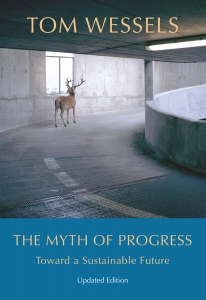
The Myth of Progress
Toward a Sustainable Future
Tom Wessels


University of Vermont Press
University Press of New England

2006 • 164 pp. 5 1/2 x 8”
Ecology & Environmental Studies


$20.95 Cloth, 978-1-58465-495-7


Bookmark and Share


"Wessels writes that people with a richness of life created through their connections with community, place and themselves have no need to compulsively consume the "frivolous accoutrements that we tend to think of as making us happy, but which really don't."
Wessels wisdom in The Myth of Progress provides much more than just a warning about the damage we are doing to our biosphere. It also helps us to see the damage we may be doing to our very souls."
People's Voice Magazine

A provocative critique of Western progress from a scientific perspective.

In this compelling and cogently argued book, Tom Wessels demonstrates how our current path toward progress, based on continual economic expansion and inefficient use of resources, runs absolutely contrary to three foundational scientific laws that govern all complex natural systems. It is a myth, he contends, that progress depends on a growing economy.

Wessels explains his theory with his three Laws of Sustainability: (1) the law of limits to growth, (2) the second law of thermodynamics, which exposes the dangers of increased energy consumption, and (3) the law of self-organization, which results in the marvelous diversity of such highly evolved systems as the human body and complex ecosystems. These laws, scientifically proven to sustain life in its myriad forms, have been cast aside since the eighteenth century, first by western economists, political pragmatists, and governments attracted by the idea of unlimited growth, and more recently by a global economy dominated by large corporations, in which consolidation and oversimplification create large-scale inefficiencies in material and energy usage.

Wessels makes scientific theory readily accessible by offering examples of how the Laws of Sustainability function in the complex systems we can observe in the natural world around us. He shows how systems such as forests can be templates for developing sustainable economic practices that will allow true progress. Demonstrating that all environmental problems have their source in the Myth of Progress’s disregard for the Laws of Sustainability, he concludes with an impassioned argument for cultural change.

Reviews:

"This is a short, often pithy book, and you can easily read it in a evening. In this way, it serves multiple purposes. It is a fine refresher or overview for people who are either new to this material or who haven't thought about it in a long time. It's perfect for folks who lack a science background and wish to better understand the relationship between ecological and economic systems. It is a valuable teaching tool that covers these basic principles in a simple, no-nonsense way. Most importantly, it retains all of Wessel's charm as a writer and educator. Indeed, the book's most riveting passages are his anecdotes and examples . . . This is an impassioned, critical, and bold book. Wessels is guided by his overwhelming sense that the laws of sustainability demand respect, understanding, and interpretation, and unless we educate ourselves about their full complexity and truth, we will do irreparable damage to the landscapes we love."—Northern Woodlands

“[A]n impassioned, critical, and bold book. Tom Wessels is guided by his overwhelming sense that the laws of sustainability demand respect, understanding, and interpretation, and unless we educate ourselves as to their full complexity and truth, we will do irreparable damage to the landscapes we love,”Antioch New England Notes

"Demonstrating how our current path toward progress, based on continual economic expansion and inefficient use of resources, runs absolutely counter to three
foundational scientific laws that govern all complex natural systems: the law of limits to growth, the second law of thermodynamics, and the law of self-organization."

Natural Resources Journal

Endorsements:

“Tom Wessels critiques the politicians' dream of ‘growth' through an eloquent discussion of the principles that govern biological sustainability. He links science and civic responsibility with a forcefulness that recalls his New England predecessor George Perkins Marsh.”—John Elder, Stewart Professor of English and Environmental Studies at Middlebury College and author of Reading the Mountains of Home and The Frog Run

Click here for TABLE OF CONTENTS


TOM WESSELS is a professor of ecology and the founding director of the Master’s degree program in Conservation Biology at Antioch New England Graduate School. His books include Untamed Vermont (Thistle Hill Publications, distributed by UPNE, 2003), The Granite Landscape: A Natural History of America’s Mountain Domes from Acadia to Yosemite (2001), and Reading the Forested Landscape: A Natural History of New England (1997).


Secure on-line ordering!

Fri, 16 Oct 2009 15:03:56 -0500