Frequently Asked Questions
What is the James O. Freedman Presidential Scholar
program?
The program enlists faculty and researchers to mentor juniors through
part-time, paid research assistantships. The program provides
opportunities for students to experience research first-hand and is intended to
prepare students for undertaking senior honors theses.
How many James O. Freedman Presidential Scholars can I
have?
In the past, we have limited the program to one Scholar per faculty member,
but this year we have sufficient funds so that faculty members can select
either ONE or TWO Scholars. Funds for the program do remain limited,
however, so we are not able to fund more than two Scholars per faculty
member. Faculty who are willing to pay the $700 stipend from their own
accounts for each of the two terms of the assistantship can choose to select
additional Scholars.
Can any student be a James O. Freedman Presidential
Scholar?
Only students who have attained a GPA in the top 40% of the class at the end
of fall term of sophomore year are eligible for the program. Eligible
students are notified winter term of sophomore year. Students apply for
the program during sophomore year (winter and spring), and the assistantships
take place during junior year. Questions about student eligibility should
be directed to the Undergraduate Advising and Research office.
How many hours can I expect my James O. Freedman Presidential
Scholar to work?
Scholars are expected to work 7-12 hours per week for two terms.
What kind of work can I assign to my James O. Freedman Presidential
Scholar?
It is expected that Scholars will assist faculty in their research.
Students participating in this program are not expected to generate their own
independent research projects. Many students become independent during
the course of their Scholarship, but independence should not be expected at the
outset of the assistantship. The faculty advisor and student should set up a
work schedule at the beginning of the term, and this schedule should include
weekly or biweekly meetings between the student and advisor. This will
help to ensure that projects remain on track and that students are receiving
adequate supervision.
How are James O. Freedman Presidential Scholars paid?
Scholars are paid through the Dean of Faculty office from an endowment made
by John (Launny) L. Steffens, Dartmouth Class of 1963. Students receive a
stipend of $700 for each term of the assistantship. The stipend is
paid at the end of each term and is contingent upon a satisfactory evaluation
by the faculty mentor. Students do not need to turn in time-sheets.
Are there funds available for research expenses incurred by
Presidential Scholars?
No. Since Presidential Scholars are working as research assistants for
faculty, it is assumed that the faculty mentor will cover any research-related
expenses (e.g. photocopying, books, travel, etc.).
Can James O. Freedman Presidential Scholars receive academic credit
for their work?
In the second term of the assistantship, students may receive independent
study course credit instead of a stipend if it is deemed appropriate by the
faculty advisor (subject to departmental criteria). Assistantships for
which independent study credit is to be granted will involve a greater
commitment of time than non-credit assistantships. The faculty mentor
ultimately makes the decision as to whether independent study credit is an
option, and the student is responsible for registering for the independent
study through the faculty mentor’s department. The Office of Advising and
Research is not involved in the course registration process, but the student
must notify the office if they will receive academic credit for the second term
so that they are not mistakenly issued a check for that term. Students may not
receive both honorarium and course credit for the same work.
How do I get a James O. Freedman Presidential Scholar?
Faculty are invited to submit project descriptions to the Undergraduate
Advising and Research office. A database of these faculty projects is
made available to eligible students on the web. Students then contact
faculty and arrange for interviews. Interviews should take place during
the last 2 weeks of winter term and the first 2 weeks of spring term so that
all students have the opportunity to interview for an assistantship regardless
of their D-plan. Once you have selected a student, sign that student’s
application form and the student then submits the signed application form to
the Undergraduate Advising and Research office. Be sure to only sign no
more than TWO students' application forms. PLEASE NOTE: a signed
application form does not guarantee acceptance into the program. If we
have more applications than stipends, selection will be based on factors such
as academic standing and the relevance of the project to the student’s
major.
How do I write a project description for the James O. Freedman
Presidential Scholar program?
Project descriptions should not be overly technical or use jargon or
acronyms without explanations. The description should identify some
responsibilities of the intern, the skills and knowledge to be developed, and
the qualifications (or lack of) needed for the assistantship. While specific
responsibilities may be redefined later, this type of description allows a
student to get an idea as to what the assistantship entails. James O. Freedman
Presidential Scholar projects need not be self-contained in the two terms or be
an independent project. Many projects are "works in progress" as part of
the larger research effort, depending upon the sponsor and upon the inclination
and abilities of the student. It is beneficial to identify in your
description if a graduate student or others on your research team will have the
day-to-day contact with your Scholar in addition to you.
Are there guidelines for interviewing potential James O. Freedman
Presidential Scholars?
The interview is the appropriate time to clearly state for students the
basic requirements that you feel are important, e.g., needing a 4-hour block of
time to set up and complete a procedure, or attending a weekly research group
meeting at a set time. It is beneficial to have students think and talk
realistically about how a James O. Freedman Presidential Scholar commitment
fits in with their academic and extra-curricular commitments and to express
where their priorities lie. For example, students often underestimate
study time (including study groups), x-hours, office hours and sport time
commitments (including practice plus games). You also may want to suggest
that students contact your past Presidential Scholars to hear what the
experience was like from a peer. We ask that you wait to select your
Scholar(s) until spring term. This will allow students who are on leave
or away on FSP’s or LSA’s in the winter to have an equal opportunity to
interview for assistantships.
If I list a project in the on-line database, am I guaranteed a James
O. Freedman Presidential Scholar?
No, there is no guarantee that every interested faculty member will find a
Scholar or that every interested student will find a faculty mentor.
Are there opportunities for James O. Freedman Presidential Scholars
to present their research?
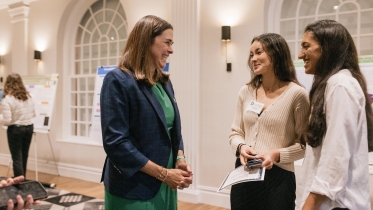
Scholars are invited to present their work at a number of events throughout
the year (e.g. at the Undergraduate Research Poster Session during Homecoming
Weekend and at the annual Karen E. Wetterhahn Science Symposium in the
spring). There are also other opportunities during the year, and faculty
mentors may be asked to recommend their Scholars for these events.
How can I get more information about the James O. Freedman
Presidential Scholars program?
The program is administered by the Dean of Faculty’s Office of Undergraduate
Advising and Research, located 110 Wentworth. The contact information is
as follows:
- Blitzmail: “Undergraduate Research”
- HB: 6201
- Phone: 646-1632
|