E.E. Just Program

Program Description

The purpose of the E. E. Just Program is to increase the number of minority students majoring in the sciences; participation in the program is open to all students interested in this issue. The program includes a quarterly Science Forum focused on research in the sciences, opportunities for undergraduate involvement in science research, as well as issues related to minority participation in the sciences. The program is named in honor of Ernest Everett Just, a distinguished black scientist who graduated from Dartmouth College in 1907.

Science Forum

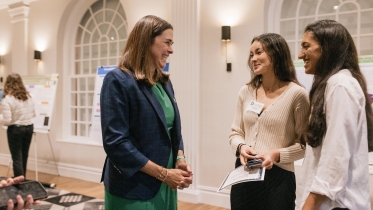
  • The Science Forum is an opportunity for undergraduates to meet other students in the sciences, learn about faculty research, and find out about on- and off-campus research opportunities.
  • The Science Forum is held each term (except summer) and includes dinner.
  • Interested students should contact the Office of Undergraduate Advising and Research (UGAR) in the Dean of Faculty office (blitz: Undergraduate Research).

Research Opportunities

  • Interested in getting involved in science research at the college or at DHMC but not sure how to get started? Blitz "Undergraduate Research" to make an appointment.
  • Funding is available for full-time (leave term) and part-time (residence term) research.
    • Full-time research: information and applications are available on the Research Programs section of the UGAR website.
    • Part-time research: blitz "Undergraduate Research" for information.

Conferences, Meetings & Special Events

(Travel funds are available for these opportunities. Blitz "Undergraduate Research" for information.)

  • Biomedical Science Careers Student Conference:
    • The primary objective is to provide African-American, Hispanic, and American Indian/Alaska Native students with an opportunity to network with advisors/role models from the basic and clinical sciences, medicine, public health, academic administration, and the private sector.
  • New England Science Symposium:
    • The aim of the symposium is to encourage post-doctoral fellows, medical/dental/graduate and college students, particularly underrepresented minority individuals involved in biomedical or health-related research, to present their research projects through oral or poster presentations, and to exchange ideas to further their career development.

Dartmouth Student Organizations

  • Minority Association of Pre-Health Professionals (MAPS)
    • The purpose of MAPS is to provide under-represented pre-health students with knowledge, skills and experiences that are both prerequisite to and affiliated with becoming a professional in health care fields. MAPS is affiliated with the Student National Medical Association (SNMA), which is a medical school organization dedicated to people of color and underserved communities, to offer guidance and support to undergraduate students in pursuing a career in medicine. SNMA members work with MAPS members to advise them about the medical school application process, the medical school admissions test (MCAT), and to serve as mentors to help them successfully matriculate to medical school. Blitz "MAPS" for more information or to join.
  • National Society of Black Engineers (NSBE)
    • The aim is to recruit and retain minority students in science at Dartmouth College with a long-term goal of increasing the number of culturally responsible Black engineers who excel academically, succeed professionally and positively impact the community. Blitz "NSBE" for more information or to join.
  • American Indian Science and Engineering Society (AISES)
    • The AISES mission is to substantially increase the representation of American Indian and Alaskan Natives in engineering, science and other related technology disciplines. Blitz "AISES" for more information or to join.
  • Nathan Smith Premedical Society (NSS)
    • The NSS serves all students interested in the health professions. As there is no "pre-health" major at Dartmouth, NSS serves as the central organizing locus for all extracurricular activities related to health and for advice concerning the Dartmouth curriculum. Their website provides information for pre-medical students, including news on Society activities, the physician shadowing program, volunteer, research, and internship opportunities, curricular planning and medical school applications, the MCAT exam, and links to other medicine-related Web sites. For information and to join, see the NSS website.

On-line Information & Resources

  • Association of American Medical Colleges (AAMC): AspiringDocs.org
    • The AAMC represents all 125 accredited medical schools that grant the M.D. degree and more than 400 major teaching hospitals in the United States. They also administer the MCAT® exam and manage the application process for medical school. What does that mean to you? It means they can offer the reliable tools, information, and support you need to explore whether a career in medicine is right for you and to help you prepare an application to medical school that presents you at your best. The United States needs more doctors, and our nation's medical schools are looking for talented, committed, and caring individuals who want to make a difference. The need for more African American, Latino/a, and Native American doctors is especially important. Today, while these groups make up 25 percent of the population, they account for only 12 percent of U.S. medical school graduates. The AAMC is strongly committed to changing the face of medicine to address the needs of diverse communities, and they invite you to use this free resource to help make it happen.
  • Web Guide to Research for Undergraduates
    • A web-based tool intended to assist undergraduates as they navigate the hurdles of undergraduate research experiences in the sciences.
  • JOBNET
    • A database used by Dartmouth's Student Employment Office that lists current on-campus and local off-campus positions (science-related jobs are generally listed in the categories of "health care" or "research").
  • MentorNet
    • An award-winning nonprofit e-mentoring network aimed at increasing retention and success of students in the sciences, engineering and math. The program is particularly but not exclusively designed for those in groups traditionally underrepresented in these disciplines.
  • JustGarciaHill
    • The program is committed to increasing the number of minorities entering science careers and to celebrating contributions to science by minority scientists.
  • Society for Advancement of Chicanos and Native Americans in Science
    • The goal of SACNAS is to encourage Chicano/Latino and Native American students to pursue graduate education and obtain the advanced degrees necessary for science research, leadership, and teaching careers at all levels.

Summer Research Opportunities

OTHER RESEARCH AND INTERNSHIP OPPORTUNITIES

List of research and internship opportunities at Dartmouth AND at other institutions.

Post-Graduation Opportunities

  • Wellstone Fellowship for Social Justice
    • The aim of the fellowship is to advance social justice through health care advocacy by focusing particularly on the unique challenges facing communities of color. This fellowship, established to honor the memory of the late Senator Paul D. Wellstone, intends to expand the pool of talented social justice advocates from underrepresented racial and ethnic minority groups. The ideal candidate must demonstrate an interest in health care policy and racial/ethnic health disparities, as well as displaying the potential to contribute to social justice work after their year of hands-on experience as a fellow.
  • Villers Fellowship for Health Care Justice
    • The Fellowship was created in 2005 by Philippe Villers, Founder and President of Families USA. Villers Fellows work in the health policy department and assist the organization's efforts to improve access to health coverage for all Americans, especially for low-income and other vulnerable communities. Specifically, Villers Fellows will conduct research on a range of health care policy issues, and write and contribute to publications that are relevant to current health policy debates. In creating the fellowship, Mr. Villers aspired to develop a network of young leaders who share a passion for health care justice. The ideal candidate will demonstrate a commitment to health care justice work following their year as a fellow. Additionally, in order to encourage the development of future leaders, Villers Fellows must commit to mentoring at least one person over the course of their careers.


Last Updated: 1/27/09