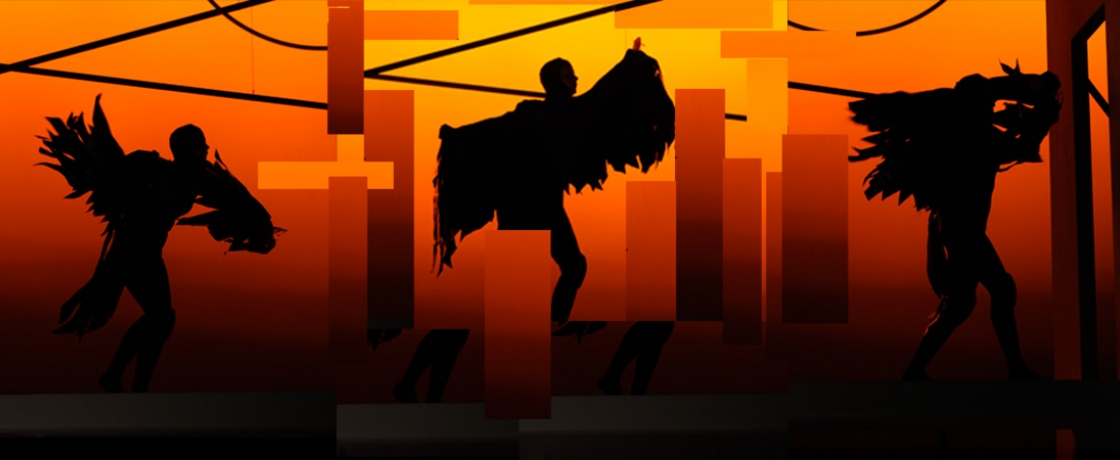
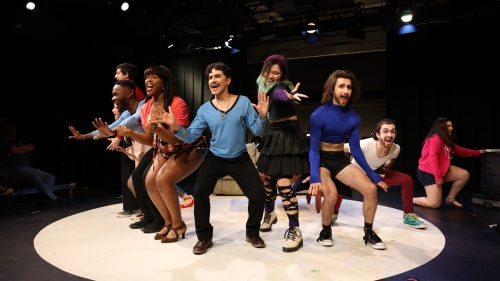
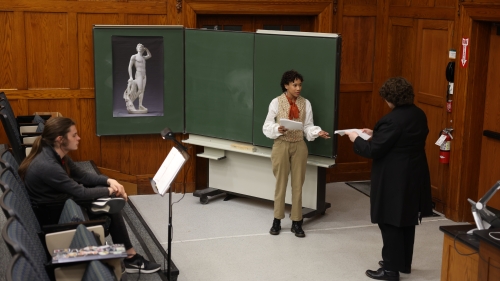
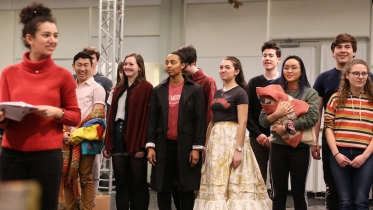
A festival for the development of innovative new projects initiated by Dartmouth alumni. Vox Theater (www.voxtheater.org) will be in residence at Dartmouth from June 29-July 7, collaborating on seven new works with Dartmouth students, alumni and faculty.
THEATER 1: Introduction to Theater
As a set of staged practices rich with social context, theater has sought to document, engage, and affect communities. This course introduces and explores theater from page to stage as a live performing art. Topics include the relationship between theater and society (historical and contemporary), dramatic structure, theatrical representation, and the crafts of theater artists such as directors, designers, playwrights, and actors. We will also engage with live performances and video archives of past performances. Dist: ART. Mayorga.
THEATER 10.1: Dramatic Storytelling
This course is designed to expose students to two main forms of dramatic storytelling, play and screenplay, and explore the ways they are different and the ways they are the same. By the end of the course, the student will better understand which form best suits a given story, to adapt stories told originally in one form into the other, and develop an appreciation of the history and traditions of both forms. Dist: ART. Sutton.
THEATER 15: Theatre and Society I: Classical and Medieval Performance
This course explores selected examples of world performance during the classical and medieval periods in Western Europe and eastern Asia. Plays to be discussed might include those by Aeschylus, Sophocles, Euripides, Aristophanes, Seneca, Plautus, Terence, and Zeami. Through the reading and discussion of primary and secondary texts, we seek to situate selected performance texts within their sociopolitical and artistic contexts. Open to all classes.
THEATER 30: Acting I
Basic introduction to acting technique for the stage. Designed to develop ability to play dramatic action honestly and believably, using realistic/naturalistic material as well as self-scripted autobiographical writing. Course work includes exercises and improvisations exploring awareness, relaxation, observation, the senses, voice, and physical and emotional life. Work in preparation of the monologue will be introduced. Scene work, in the second half of the term, will focus on breaking down the play, analysis, identity, motivation and action. Out-of-class assignments include required readings from acting texts and plays. Attendance at, as well as responses to, a number of stage productions scheduled during the term is required. A commitment to regular journal writing in the form of an Observation Notebook will be expected. Open to all classes, with instructor's permission. Do not pre-register for this course: registration is invalid without permission from the instructor. To enroll in this course you must first interview with the instructor. Interviews are conducted on the first day of classes. A sign-up sheet for interviews will be posted in Shakespeare Alley the day before classes begin. Dist: ART. Rice and Guest to be announced.
There are 3 sections offered this fall, 2 with Professor Rice, one at 10A and another at 2A. We are also hiring a visitor and will be posting their information soon. To receive Instructor Permission, you must be interviewed by the Professor. After all interviews are conducted, the class roster will be chosen. These are not auditions. Interview sign up sheets will appear in Shakespeare Alley at 8:30 am on the first day of class, Monday, September 16th. Slots fill up quickly. Interviews will be conducted on Tuesday, September 17th. Please only sign up with one professor. You cannot interview with both professors. Please arrive prior to your interview and go to the Green Room. There will be questionnaires for you to fill out there. You cannot sign up via email. You must come in person to sign up. Shakespeare Alley is located in the Hopkins Center. Enter the lobby, go left around the Moore Theater, go through Glass Door, marked Shakespeare Alley. The sign up sheets will be posted in that hallway. One section of Acting I, will be offered again in the winter and spring terms. It is recommended that you sign up for an alternative course, in case you don't make it into Acting I. You can always drop/ add at the beginning of the quarter.
THEATER 10.1/WGST 59.3/AMES 25: Unveiling the Harem Dancer
The historical legacy of Orientalism continues to perpetuate a stereotypical image of the exotic female dancing body. We will consider the Oriental dancer as an entry point to examine contexts of the colonial encounter, global circulation, and postcolonial conditions. We will also explore issues of gender and sexuality in Arab Islamic culture and address questions about the social agency of the female dancer. Materials include theoretical texts, travel accounts, films, and performances. Dist: INT; WCult: NW. Yessayan.
THEATER 10.2: Textual Analysis (CANCELLED FOR SPRING 2013 BUT WILL OFFERED AGAIN IN 2014)
An introduction to the techniques for analyzing a theatrical text from the point of view of a practicing theater artist. Methods for exploring the elements of a script will be applied to Clifford Odets' 1935 social protest play, Waiting for Lefty, with the purpose of successfully transforming a one-dimensional script into a three-dimensional performance. Particular attention will be given to the social, cultural and artistic context that gave rise to this Depression-era play. The class will culminate in a workshop production of Waiting for Lefty presented for an invited audience. Dist: ART. Hackett.
THEATER 10.3: Voice II: Speaking Shakespeare
Utilizing the progression of exercises developed by Kristen Linklater (known as Freeing the Natural Voice) the course will extensively utilize the language of Shakespeare in sonnets, monologues and scenes to free and strengthen the speaking voice of the stage actor. An essential course for the serious actor, it is also a course for anyone eager to explore the ideal medium Shakespeare provides for deepening in one's speaking capabilities, development of confidence, poise,and fearlessness. Students will be responsible for preparing material for spoken presentation, maintaining an observational journal, and attending scheduled tutorials or rehearsals with the instructor. Enrollment by permission of instructor. Dist: ART. Rice.
THEATER 10.4/CLST 2: The Tragedy and Comedy of Greece and Rome
The course studies in translation selected works of Aeschylus, Sophocles, Euripides, Seneca (tragedy), Aristophanes and Plautus (comedy), and some of their central themes and questions: law, community, revenge, passion, and justice. We will approach them both as texts and as scripts/librettos, considering their relationship to other types of performance (ritual, rhetoric, music, dance) and genres (history, philosophy) as well as to theatrical space. There will be practical workshop opportunities for those interested. Open to all classes. Dist: ART; WCult: W. Tell.
THEATER 10.5: Acting for Musical Theater
This course will introduce student to the techniques used by actors/singers to play musical theater scenes believably, honestly and dynamically. Basic acting techniques will be taught as well as work in singing, text analysis, movement and speech. Students will begin with individual songs, then prepare, rehearse and present two-person musical scenes from Company, West Side Story, Side Show, Jane Eyre, Into the Woods, Passion, She Loves Me, The Secret Garden, Follies and others. Permission of the instructor is required. Dist: ART. Dunne.
Interview sign up sheets will appear on Monday, March 25th at 8:30 am in Shakespeare Alley in the Hopkins Center. Interviews will take place Tuesday, March 26th. Please prepare 32 measures of an up tempo song and 32 measures of a ballad to be sung a cappella.
THEATER 10.6: Avant-garde Theater in Paris, 1887-1925
Avant-garde Theater in Paris explores the completely unique theatrical scene of fin-de-siècle Paris when Paris was the epicenter of the theater universe. We begin with the Symboliste movement – including Madame Rachilde, "man of letters," and the trickster Alfred Jarry – continue with the Dadas – Marcel Duchamp, Tristan Tzara, and Francis Picabia – and finish with the Surrealism of André Breton and Antonin Artaud. The course will also examine Le Chat Noir and the Parisian cabaret. Dist: ART; WCult: W. Thomas.
THEATER 17: Theater and Society III: 19th and 20th Century Performance
This course explores drama and performance during the classical and medieval periods. The Japanese performance tradition of nõ will also be addressed. Through the reading and discussion of primary and secondary texts, we seek to situate selected performance texts within their sociopolitical and artistic contexts. The course also includes explorations of dramaturgy (how the theatrical past comes alive on contemporary stages), historiography (current debates and concerns in the writing of theatre history), and dramatic and performance theory. Dist: ART. Thomas.
THEATER 24/AMES 24: Asian Performance Traditions
This course studies the performance traditions of Asia, focusing on China, Japan, Indonesia and India. Classical forms studied include Noh, Bunraku, Beijing opera, Sanskrit drama, Balinese dance and Javanese puppet theater. Attention is paid to social, religious and aesthetic influences on these traditions, theories on which they are based, the history behind the theatrical practices, and training and dramatic techniques. Students gain an appreciation of the rich variety and scope of theatrical conventions of Asia. Dist: ART; WCult: NW. Chin.
THEATER 27: Movement Fundamentals II
A continuation of THEA 26, this class will explore further the relationship between efficient and expressive movement and body connectivity. Contact improvisation, conditioning, kinesiology and movement repertoire form the foundation from which class will explore individual performance. Assignments include readings, written work, class presentations and a final paper. Dist: ART. Evans.
THEATER 30: Acting I
You must be interviewed by the Professor. After all interviews are conducted, they will set the class roster and determine who gets in. Interviews typically last 6-7 minutes. These are not auditions. Acting I is one of the most popular courses on campus. We traditionally get twice as many students interviewing as we have slots for. For example, normally an Acting I class consists of 16 students. We often have 35-40 students interviewing to get into that class. Interview sign up sheets will appear in Shakespeare Alley the day before classes start. You must come in person to sign up. Shakespeare Alley is located in the Hopkins Center. Enter the lobby, go left around the Moore Theater, go through Glass Door, marked Shakespeare Alley. The sign up sheets will be posted in that hallway. Dist. ART. C. Kohn.
To enroll in this course you must first interview with the instructor. A sign-up sheet for interviews will be posted in Shakespeare Alley, Monday, March 25th at 8:30 am.
THEATER 32: Acting III
An advanced scene study class that focuses on developing a process for performing non-realistic acting texts. Students will encounter plays that present unique challenges for actors in terms of language, physicality, characterization, style, content, and text analysis Dist. ART. Hackett.
THEATER 43: Scene Design II
An introduction to the basics of scenic design through weekly projects in scale models, drawings, research, lighting and storyboards. Students will also study the collaborative process between scene designers, directors, costume and lighting designers. Suitable for students interested in theater, visual and video art, installation, film, architecture, and sculpture. Students will have the opportunity to assist student and faculty scene designers on Department of Theater productions. Open to all classes. Dist. ART. Alexi-Meskhishvili.
THEATER 44: Lighting Design
An introduction to the practical and artistic elements of theatrical lighting design. The course will include topics in color theory, form, movement, composition, and the creative process. Through analyzing the script and studying light in nature, film, and art, students will prepare projects that explore the possibilities of light in the theater. Students will have the opportunity to work on Theater Department productions with faculty and student lighting designers. Lectures, discussions, design projects, and critiques. Open to all classes. Dist: ART.
THEATER 50: Playwriting I
The aim of the course is for each student to write the best one-act play he or she is capable of writing. It is open to students both with a Theater background and those without. This class will involve a number of preliminary exercises, the preparation of a scenario, the development of the material through individual conferences, and finally the reading and discussion of the student's work in seminar sessions. Open to all classes. Limited enrollment. Dist: ART
THEATER 51: Playwriting II
Permission of the instructor is required. Dist. ART. Sutton.