|
Edinburgh, Scotland
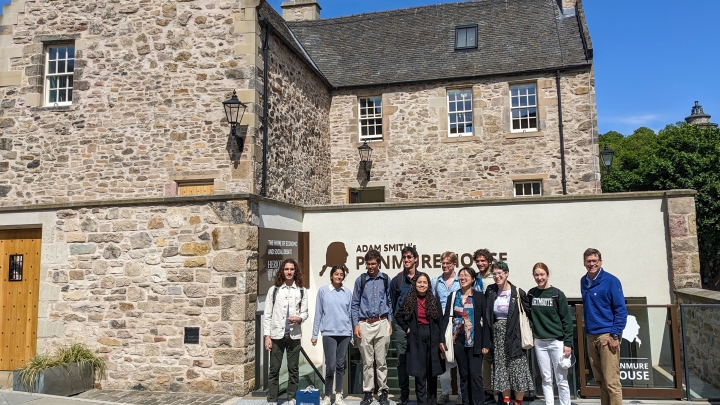
The Philosophy program offers the opportunity to spend a fall term at the University of Edinburgh, Scotland. Students take a course in philosophy taught by a Dartmouth faculty member (Philosophy 50). In addition, each student will take two courses (Philosophy 60, 61) from faculty of the Philosophy Department at the University of Edinburgh. Students participating in the program must have completed at least two courses in philosophy prior to their participation but not necessarily prior to their application for admission to the program. However, preference will be given to those students who have completed more philosophy courses. A member of the University of Edinburgh philosophy faculty will offer a course at Dartmouth in the summer term. Students going to Edinburgh should consider taking this course. There will be an opportunity to participate in the junior year Honors program while in Edinburgh. The program provides students with the opportunity to study at one of Great Britain's oldest and finest universities, which has a large and diverse philosophy staff. This staff represents a wide spectrum of approaches to philosophy including both the analytic tradition and the continental tradition. Dartmouth undergraduates should benefit from contact with students doing graduate studies in philosophy. Great Britain has an excellent system of public transportation, so trips to many fascinating sites can conveniently be arranged. Curriculum
Depending on the subject, these courses may satisfy distributive requirements for the major (e.g., the history of philosophy requirement). Any student who wants such credit should petition the Chair of the Philosophy Department at Dartmouth. 12F FSP Professor Timothy Rosenkoetter This course is an introduction to the Enlightenment projects of Hume (1711-1776) and Kant (1724-1804). Though their models of the mind’s basic workings and their resulting epistemologies will occupy the greatest share of our time, the guiding thread throughout will be a comparison of the ways in which these great philosophers try to free us from the shackles of dogmatism and mystification, to assist us in using our own reason. Accordingly, we will also examine their views on the relation of theoretical and practical reason, the foundations of morality, the significance of feelings and passions, and the rationality of religion. The course will begin with a brief look at Christian Wolff (1679-1754), whose ambitious Enlightenment project was, along with Hume’s, the most important influence on Kant. The largest share of the readings will be taken from Hume’s Enquiry concerning Human Understanding and Kant’s Critique of Pure Reason, though there will also be readings from Hume’s Treatise and Kant’s Critique of Practical Reason and Metaphysics of Morals. This course is an opportunity to study two giants of the Enlightenment while living in the wellspring of its Scottish version. 13F FSP Professor Jim Moor Both free will and responsibility are crucial concepts in how we understand ethics, law, and human behavior. In recent decades these two familiar notions have come under pressure from advances in science and technology. Results from brain science and cognitive science raise questions about free will – whether, for example, we are as free in and aware of our decision-making as we usually believe. Results from technology raise questions about responsibility. Given that only computers can process huge amounts of data rapidly, are we becoming less responsible or even irresponsible in letting computers make decisions, especially those that must be made quickly such as those in the stock market or on the field of battle? Prerequisites: At least two courses in Philosophy Enrollment: Limited to 15 students Applications available on-line through the Off Campus Programs office. Application Deadline: February 1, 2013 Living Accomodations: Students live in University of Edinburgh owned flats. |