|

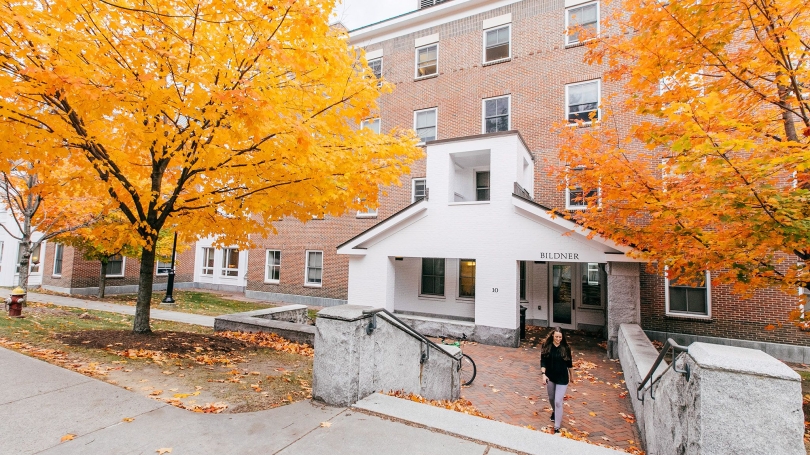
The Housing Office offers on-campus housing within communities that are
designed to enhance students’ opportunities to learn from each other, while
also supporting the goals they have established for their academic careers at
Dartmouth. Residence halls are the foundation upon which community and
friendships are built, and are home to most Dartmouth undergraduates. We
consider the residential experience to be integral to life at Dartmouth, and
therefore require that all first-year students live on campus in our residence
halls. The exceptions to this rule are those first-year students who are
parents, married or part of a College-recognized domestic partnership.
While juniors and seniors are not guaranteed on-campus housing,
approximately 85% of the students live on campus in our residence halls,
academic affinity programs, and co-ed/fraternity/sorority housing. The
remaining 15% live in either college-owned off-campus apartments or other local
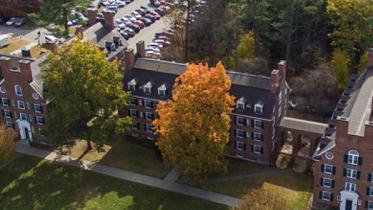
rental housing options. Our residence halls are grouped into nine communities,
composed of one to three “clusters.” Every community has clusters with
distinctive identities, and as a result, you will often hear students refer to
their cluster, rather than his/her individual building. In all, Dartmouth
houses over 3,300 students on campus.
Rarely are two rooms on campus alike! We have traditional one room singles
and one room doubles. We also have some two and three room doubles that provide
the opportunity for residents to have a common “hang out” space in their rooms.
There are two and three room triples, a few quads on campus, suite style living
and three and four bedroom apartments. Some of our halls are modern in design,
while others are of traditional brick and ivy Georgian architecture.
In addition to the residence halls, Dartmouth offers two other housing
options for upperclass students: affinity
housing and social
organization housing. Affinity programs are dynamic alternatives to
traditional residence hall life. Each program has a distinct theme, and most
are culturally based. We have the Max Kade German Center, Native American
House, and the International House just to name a few! Students who are
interested in participating in one of the affinity programs go through a
selection process with the Program Advisor. These communities sponsor programs
both for their own residents and for the larger residential community. Located
in a variety of spaces on-campus — converted houses, apartments, and
traditional residence halls — affinity programs range in size from eight to
twenty-six students.
Upperclass students who are members of a fraternity, sorority, co-ed
organization or undergraduate society have the option of living in their
organization’s house. These arrangements are made within the organization, and
many members live at least one term of their time at Dartmouth in their
houses.
|