Latin American, Latino, and Caribbean Studies
Dartmouth College
122 Silsby Hall
Hanover, New Hampshire 03755-18042
Tel: 603 646-1640
Fax: 603 646-3050
Contact Us
Home >

Courses

Macaws from Copan, Honduras.

Please visit the department office in 304B Silsby Hall or visit the Registrar's Web site for course descriptions.

Courses in Latin American and Caribbean Studies

1. Introduction to Latin America and The Caribbean

 11F: 10, 13S: 10

This interdisciplinary course introduces students to the geographical conditions, historical roots, and enduring cultural diversity of Latin America and the Caribbean. After a brief survey of the physical and cultural geography of the region, the course examines the history of selected countries to highlight the way European conquest and colonialism have molded Latin American institutions and attitudes. The course then turns to particular case studies of contemporary life and society to analyze the ongoing problems of ethnicity, inequality, and political repression engendered by the region's colonial past. Finally, the course draws on these historical and anthropological understandings to assess recent economic, social, and political developments in Latin America. By juxtaposing historical realities with their living consequences, the course presents a multi-disciplinary perspective on the nature, dynamics -- and future prospects -- of the many peoples who inhabit this vast and diverse continent. Dist: SOC; WCult: NW.  Baldez.

4. History, Culture and Society: The Many Faces of Latin America

12W: 10A, 13W: 10A

The Spanish discovery and conquest of this continent created Latin America and the Caribbean out of the diverse and complex realities of the pre-Columbian world. Since colonial times Latin American and Caribbean cultures have developed against a background of cultural repression, racial conflict, political domination, colonial exploitation, and gender inequality. And yet, in the midst of all this turmoil, Latin America and the Caribbean has produced an extraordinary variety and wealth of artistic creations, ranging from literature to the visual arts, from music to film. In this course we will turn to some of the works by Latin American and Caribbean artists and writers in an attempt to illuminate and explore some of the wonders of the cultural dynamics that shape the many faces of what we call Latin America. Dist: LIT; WCult: NW.  Bueno, Walker, 12W, Franconi, Pastor, 13W.

7. First-Year Seminars in Latin American, Latino and Caribbean Studies

Consult special listings

30. In 13S at 11, Race and Ethnicity in Brazilian Cinema.

This course will explore aspects of race and representation in Brazilian film from its earliest beginnings in the silent film era through the present day. Students will gain insight into issues of cultural identity in Brazil as well as learn about the major aesthetic movements in the country’s cinema.  Pending faculty approval. Smolin.

30.3. In 12S: 10, Gringos in Mexico: English speaking writers and their love of Mexico.

This course is focused on half a dozen writers who made Mexico part of their writing life and their subject matter. It deals not only with their novels and journalism, but also with writers’ personal lives during their travels or long stays in Mexico. Although this is a literature course, it is also a cultural studies course in that it deals with sociology, anthropology and esthetics. Dist.: Lit; WCult: NW. Palou.

30.4. In 12F: 2, Religion and Music in Cuba (Identical to Religion 52)

This course tells the story of Cuba's religious formations through their musical genres. Readings draw from several disciplines to illuminate the role that music plays in celebrating deities, ancestors, and community, in such traditions as the all-male secret society Abakuá; French-Haitian Tumba Francesa; the "drums of affliction" Lucumí and Palo Monte; and Havana-based hip-hop. We examine the relationship between dance, spirit possession, and mythology, and how nation, race, and gender have been constructed through music. Open to all classes. Dist: TMV; WCult: CI. Perez.

42. The Aztecs (Identical to Anthropology 21)

13W:12

Mexico City once the capital of New Spain overlies the remains of Tenochtitlan, capital of the Aztec empire. This course examines the development of the Aztec empire, the organization of Aztec society and religion, and the Spanish conquest of the Aztec. It ends with an introduction to Nahua society in the first century after conquest. We will also consider the varied perspectives of Aztec history offered by Nahua texts, archaeology, history, and art history. (ARCH) Dist: SOC; WCult: NW. Nichols.

43. Olmecs, Maya, and Toltecs: Ancient Civilizations of Mesoamerica (Identical to Anthropology 22)

 12W: 10

Mesoamerica, the area encompassing Mexico and northern Central America, provided the setting for two major transformations in human history: the development of maize agriculture and the emergence of cities and states. The legacy of those achievements is still evident today among contemporary Latin American societies. We begin with an examination of how people first occupied Mesoamerica during the Ice Age and discuss the development of agriculture and early villages that laid the foundations for the evolution of Mesoamerica's earliest complex societies, including the Olmecs. We then the explore the Classic civilizations of Teotihuacan, Monte Albán, and the Maya. The course ends with an overview of the Postclassic city-states and kingdoms of the Toltecs, Mixtecs, and Maya and the Aztec empire at the time of the Spanish Conquest. Dist: SOC; WCult: NW. Nichols.

44. The Incas (Identical to Anthropology 23)

12W: 11, 13S: 12

When Francisco Pizarro led an expeditionary force into the Andean highlands in 1532, the Incas ruled the largest native empire to develop anywhere in the Americas. The Incas ruled millions of subjects living across one of the most diverse regions of the planet, and they left behind impressive material remains that speak to their organizational and technological abilities. This course will explore how Inca civilization developed, and how the Incas grew from a small highland state into a mighty empire, and how a small number of Spaniards and their allies were able to bring the Inca dynasty to an end. We will read accounts of the Incas written in the first years of Spanish colonial rule, and will also review the latest archaeological discoveries. Covey.

48. Mexican Muralism( Identical to Art History 16)

12S: 12

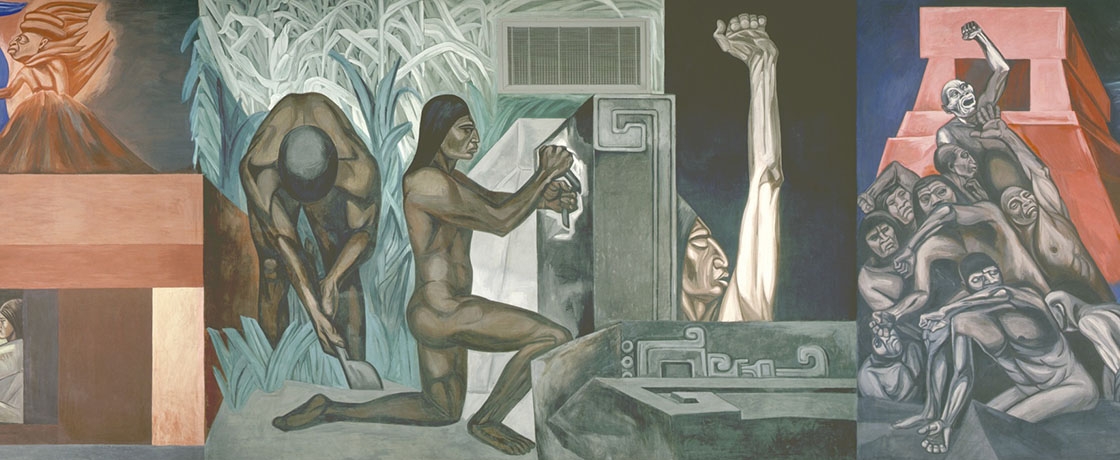
This survey course introduces students to Mexican muralism. Students will learn about the fresco technique and how to visually analyze a mural. We will consider the following themes: cultural nationalism; art and class politics; the legacy of muralism in the U.S.; the ethics of aesthetic indigenism; and the gender politics of public art. Student projects will concentrate on Jose Clemente Orozco's mural at Dartmouth College. Dist: ART. Coffey.

52. Gender Politics in Latin America (Identical to Government 49.4 and Women and Gender Studies 32)

12S, 14S: 2A

This course examines women's movements in Latin America. Women in Latin America are perhaps the most highly mobilized population in the world. Throughout the region women have organized around myriad issues, including the right to vote, human rights, poverty, legal rights, anticommunism, the workplace, race, ethnicity and war. Women's efforts to challenge fiercely repressive regimes, deeply entrenched norms of machismo and extreme poverty defy conventional stereotypes about women and provide us with inspiring examples of how to sustain hope during difficult times. The seminar will introduce students to recent scholarship on women's movements in Latin America in the 20th century and seek to understand the emergence, evolution and outcomes of women's movements in particular countries and crossnationally. Dist: SOC; WCult: NW. Baldez.

53. Protests and Parties (Identical to Government 49.5)

13S: 2

For many people, Che Guevara remains the key symbol of protest in Latin America. His passionate belief in social justice, his refusal to compromise and the extraordinary personal sacrifices he made on behalf of the poor all contribute to his enduring legacy. While this legacy continues to inspire people to engage in protest and revolutionary movements, it does little to help us understand the conditions under which organized movements will succeed in their goals-or even form in the first place. Under what conditions do people organize on behalf of their collective interests? We compare revolutionary movements, social movements, political parties and other forms at political action in various countries throughout the region. Dist: SOC or INT; WCult:NW. Baldez.

54. Nationalism and Revolution in the Caribbean (Identical to AAAS 86 )

12S:10A

The islands of the Caribbean have served as the site for two of the most significant revolutionary upheavals of the modern era—the Haitian Revolution and the Cuban Revolution—and have produced anti-colonial luminaries such as José Marti, Frantz Fanon, Marcus Garvey, and Claudia Jones. This course will explore the origin, trajectory, and outcome of nationalist struggles in the Caribbean from the eighteenth-century to the present through primary and secondary materials, memoirs, fiction, and film. Dist: SOC or INT: WCult: NW. Goldthree.

56. Latin American Women Writers: Negotiating Realities (Identical to WGST 47.4)

 Not offered in 11F through 12X

This course focuses on narrative by Latin American women, primarily fiction, and how that fiction has been a force for social change. The course will introduce students to Feminist theories which have been applied to and by Latin American scholars to give account of diverse literary forms produced across cultural differences. The core articulating idea of the course is women’s impact on literature and on the world. Students will: 1. Become familiar with important authors and common themes in contemporary Latin American literature by women. 2. Be familiar with different literary periods and movements in Latin American literature. 3. Demonstrate an understanding of the different literary terminology employed in the analysis of different types of narratives, such as poetry, short stories, and plays. 4. Use literary terminology in their own analysis of contemporary Latin American literature. 5. Articulate a basic understanding of Latin American history, politics, human rights, social activism, and gender roles, as seen through the lens of fictional and non-fictional characters. 6. Discuss the social and political impact of Latin American writers in the struggle for social change. Dist: LIT; WCult: NW. Lirot.

57. From Coca to Cocaine: Drug Economies in Latin America( Identical to History 81)

13S: 12

Padilla

58. Slavery and Emancipation in Latin America and the Caribbean (Identical to AAAS 83.3 & History 86)

12W: 10, 13S: 2

This course explores the history of African slavery in Latin America and the Caribbean from the beginning of the transatlantic slave trade in the sixteenth century to Brazilian emancipation in 1888. The lectures and assigned readings will focus on the lived experiences of enslaved Africans, while also examining the broader social, political, legal, and cultural context.We will trace the origins of chattel slavery in colonial Latin America and the Caribbean, and analyze the development of the transatlantic slave trade, which brought over nine million Africans to the region. Then, in the second unit of the course, we will explore the complex social and cultural worlds that enslaved Africans, indigenous peoples, and Europeans created in an environment marked by profound inequalities. We will also investigate the various ways in which enslaved laborers, free women and men of color, and abolitionists challenged the institution of slavery. In the final unit of the course, we will examine the rise of abolitionism, the end of chattel slavery, and the difficult task of forging free and egalitarian societies from the ashes of slavery. Dist: INT or SOC; WCult: NW. Goldthree.

59.Caribbean History: 1898 to the Present (Identical to AAAS 83.4 & History 6.2)

12W: 2

This course surveys the major issues that have shaped Caribbean society from the late 19th century to the present, including: imperialism, urbanization, migration and globalization, struggles for national independence, the transition from plantation to tourism-based economies, and the global spread of Caribbean popular culture. Our readings and discussions will focus on the historical trajectories of Cuba, Haiti, Jamaica, Puerto Rico, Trinidad, and the Dominican Republic using historical scholarship, music, literature, film, and personal narratives. Dist: INT or SOC; WCult: NW. Goldthree.

61. Slavery in the Empire: Brazilian Literature in the Nineteenth Century and Beyond (Identical to African and African American Studies 87)

11F: 2

This course explores how the experience of slavery and abolition in Brazil has formed a major theme for Brazilian authors from the nineteenth century to today. Key literary texts will be paired with period art, historical writings, films, and music. We will examine how the Brazilian Empire was part of the larger Atlantic world yet its history of slavery and abolition was distinct from that of the U.S. Dist: LIT; WCult: NW. Smolin.

62. Black Citizenship in the Americas From Abolition to the 20th Century(Identical to AAAS 87.1)

not offered in the period between 11F through 13X

The abolition of slavery and the struggle for rights and citizenship among formerly enslaved peoples is a central part of the history of Latin America and the Caribbean as well as the U.S. In this course we will focus on the transition from slavery to freedom in the United States, Brazil, and Cuba as we read the works of the Afro-Brazilian writer Machado de Assis, the African American writer Charles W. Chesnutt and the Afro-Cuban poet Nicolás Guillén. We will explore the different ways each author represents issues of race and citizenship from abolition through the first decades of the post slavery period. By reading across national boundaries and bringing together history and literature, we will be able to examine how an African diasporic culture has developed across the Americas. Throughout the term we will explore theories of citizenship, cultural constructions of race and gender, issues of culture and diaspora, and the process of remembering and retelling the slave past. We will discuss the opportunities and limitations of comparative study of the Americas and how it might shape our understanding of the African diaspora. Dist: LIT;WCult: CI. Smolin.(pending faculty approval for cross listing for LALACS)

63. Afro-Brazilian Diasporic Literature in the Americas (Identical to Comparative Literature and African and AAAS 83)

not offered in the period between 11F through 13X

This course will offer a general introduction to the history and major critical issues of Afro-Brazilian literature by focusing on the lives and works of key authors from the nineteenth century to the present. We will examine how Afro-Brazilian writers have expanded Brazilian literary discourse by challenging dominant cultural narratives of race and ethnicity. The course will also seek to place Afro-Brazilian literature within the context of African diasporic literatures of the Americas, particularly Afro-American literature of the United States. The course will introduce students to the extraordinary diversity of Afro-Brazilian narrative, with texts ranging from nineteenth-century poems written by a former slave to the 1997 novel that inspired the hit film City of God.  The course will be taught in English and all texts will be available in translation. Dist.: Lit: WCult: CI. Smolin.

64. Black Brazilian Women Writers in Translation (Identical to AAAS 80.2 ,COLT 52 and PORT 61)

12W: 3B

This course focuses on the contemporary literacy production by women of African ancestry in Brazil. The genres covered will be poetry, short story and novel. Students will engage selected literary texts focusing of issues such as slavery and race relations, the construction of family, class divisions and spatial marginality, industrialization, and gender and sexuality politics. Authors will include the likes of Conceição Evaristo and Miriam Alves, two of the most important contemporary Afro-Brazilian literary voices, among others. Dist.: Lit. Salgueiro.

65. Caribbean Women Writers (Identical to AAAS 80.2 and English 67)

11F: 10A

This course analyses Anglophone women's writing from various Caribbean territories. The exploration of novels, short fiction and poetry will be complimented by essays by and about Caribbean women. The liteerary texts will be studied with reference to their varied historical, social, ethnic and cultural contexts. The course will require close textual reading of the primary material, as well as comparative thematic and stylistic analyses. It will explore what these texts reveal about how Caribbean women are defining and taking agency for themselves in and through their writing. Students will be encouraged to locate these expressions within the broader categories of Caribbean writing, postcolonial/postmodernist writing and women's writing in general. Pending faculty approval. Morgan.

66. Caribbean Literature (Identical to English 67.1, AAAS 80)  

11X: 2A

This course will examine the work of a variety of Caribbean writers from former British colonies. We will look at several issues that reappear throughout the work of these authors. These concerns include(but are not limited to) notions of exile, the importance of language and music, the articulation of identity in varying post-colonial states, and representations of gender, race and ethnicity. The class will also analyze the socio-political events in particular nations and the ways in which these events influence writing in the archipelago. Furthermore, the course will explore shared cultural practices. For example, we will examine the ways in which a strong tradition of music as protest influences the production of particular poetic forms in Trinidad and Jamaica. The class will move from early twentieth century writers like Claude McKay to the important contributions of later writers such as Kamau Brathwaite, Jamaica Kincaid, George Lamming, V.S. Naipaul, Sam Selvon, Olive Senior and Derek Walcott. We will examine the more recent innovations in form, as musical elements are introduced by writers such as Mikey Smith and Kwame Dawes. Each week's readings will be supplemented with seminal critical writings including excerpts from the text The Empire Writes Back. Dist: LIT; WCult: CI. Vasquez.                                                                                                                               

76. Culture and Identity in Modern Mexico (Identical to History 87)

12W: 11, 12F: 2

From the Porfiriato and the Revolution to the present, a survey of Mexican society and politics, with emphasis on the connections between economic developments, social justice and political organization. Topics include fin de siécle modernization and the agrarian problem; causes and consequences of the Revolution of 1910; the making of the modern Mexican State; relations with the United States; industrialism and land reform; urbanization and migration; ethnicity, culture, and nationalism; neoliberalism and social inequality; the problems of political reform; and the zapatista rebellion in Chiapas. Open to all classes. Dist: SOC: WCult: NW. Vitz, 12W ,Padilla, 12F.

77. Democracy and Accountability in Latin America (Identical to Government 84.11)

13S: 2A

Dist. SOC. Carey

78. Twentieth Century Art from Latin America (Identical to Art History 75)

Not offered in 11F through 13X

This course surveys works of art produced by Latin Americans during the twentieth century. We will approach this vast topic through case studies of the major figures and avant-garde movements in Argentina, Brazil, Chile, Colombia, Cuba, Ecuador, Mexico, Peru, Puerto Rico, Uruguay, and the United States. We will examine how national identity, racial formation, class difference, gender inequality, political struggle, and state violence have been addressed by artists from the region and in diaspora. Dist: ART; WCult: CI. Coffey.

80. Seminar

12F: M 2-5

In 12F, LACS 80.1, Latin American Testimonio: Theory and Practice. From Conquest to Colony, to Independence, and on to the modern republics, Latin American political conflict has been conducted through textual battles as much as through physical ones. Testimonio, or the intertwining of appeals to justice in the public sphere, the personal, and the literary in historical accounts, persists as a significant mode of contemporary expression in Latin America. It claims to tell the truth about historical events and conflicts, yet it also demands an active, ethical, personal response from readers, courts, and governments. Its generic indeterminacy dares readers to challenge its truths.

This course will pay particular attention to the role of testimonial narratives in seeking legal and political resolution of violent conflict in Latin America. We will examine testimonios from the second half of the 20th century to the present day-- in both written and film forms-- that represent politically marginal perspectives or communities (indigenous groups, the poor, women, dissidents of various types) as well as perpetrators of violence. We will consider testimonial fusion of documentary narrative styles, more obviously fictional elements, and characteristics of autobiography. Major themes include race, class, gender, and violence.

A major component of this course will be the production of personal testimonios by the class, as well as the analysis of unpublished personal stories produced through the work of the organization "Telling My Story." This hands-on aspect of the course will give students direct experience with the challenges of truth-telling in highly charged socio-political contexts.

Dist: LIT ;WCult: NW. Biron, Hernandez.

 82. Popular Struggle, Political Change and U.S. Intervention in Central America (Identical to History 82)

 12W: 2, 12F: 11

This course will explore the history of popular struggles, political change and U.S. intervention in Central America. The region's rich and complex history has been marked both by repressive dictatorships and by struggles for national liberation, social justice and indigenous rights.  We will look at the different factors that played a part in determining this history including commodity production, labor systems, U.S. foreign policy, race relations, liberation theology and revolution. Open to all classes. Dist: SOC; WCult: NW.  Vitz, 12W, Padilla, 12F .

89. Independent Study

All terms: Arrange

Students wishing to pursue intensive supervised study in some aspect of Latin American and Caribbean Studies should consult the appropriate member of the LACS faculty to design and carry out an independent study project. Students are required to submit a short description proposal to the program office in the term prior to doing the independent study. This course fulfills the 'culminating experience' requirement for all majors who do not complete the Honors Program.

Prerequisite: permission of the instructor.

98, 99. Honors Thesis I and II

All terms: Arrange

Guidance in the selection of a topic and in research and writing will be provided by the student's thesis adviser. Only students accepted into the Honors Program may take this sequence.

Courses in Latino Studies

3. Introduction to Latino Studies.

11F: 11, 13S

This course provides students with a critical overview of some of the most central themes and issues that have shaped the experiences of Latina/o populations in the U.S. The main areas of inquiry that this course will address include: the history of ethnic levels; the formation of transnational communities and identities; the politics of language and bilingualism: race, class, and ethnicity; gender and sexuality; political and social movements; geographic space and localities; and media and popular culture. In order to foster an interdisciplinary and hemispheric approach to Latina/o Studies, course materials will draw from the social sciences and the humanities, as well as from U.S. and Latin American scholarship and cultural traditions. This course will serve as a general introduction to the more focused areas of study developed in an intermediate and upper level LATS course. Dist: SOC; WCult: CI. Reyes in 11F, Gutierrez in 13S.

5. Complexities of Latino Identity in the United States (Identical to Sociology 44)

12X: 10A

Gomez

30.4 Religion and Music in Cuba(Identical to Religion 52)

12F: 12

Perez

31. Constructing Race and Ethnicity in the U.S. (Identical to Sociology 42)

Not offered 11F through 13S

35. The Virgin of Guadalupe: From Tilma to Tattoo (Identical to Religion 51 & Women and Gender Studies 44.5)

12W:10A

Beginning with her precursors in the Old and New World, this course approaches Guadalupe as a tool with which to pry open questions central to Mexican and Chicano/a identity. For some, she is a mother-figure with characteristics once attributed to pre-Columbian goddesses; for others, she is a feminist champion of political revolution. This course concentrates on the most compelling contexts in which Guadalupe has been called on to negotiate religious, racial, sexual, and national identity. Open to all classes. Dist: TMV; WCult: CI. Perez.

35.1: Contemporary U.S. Latina/0 Theater and Performance (Identical to Theater 10.5)

12S: 3A

A study of contemporary plays, performance work, and other theatrical modes of representation written by U.S. Latina/o playwrights/performers. Focus will be placed on works by Puerto Rican, Mexican-American, and Cuban American ethnic heritages. Readings will include theoretical writings about representation and identity, sociopolitical contexts, dramatic criticism, and historical studies that situate Latina/o's in U.S. America. All play texts will be English with some Spanish passages. The course does not require Spanish fluency. Dist. ART.WCult: CI. Mayorga.

40: Immigration, Race and Ethnicity (Identical to Geography 28 and Sociology 48)

12W, 13W:10A

This course examines immigration to the United States and pays special attention to issues of race and ethnicity. The course begins with a brief history of US immigration and then thematically covers specific topics such as economic impacts and costs, social mobility, citizenship, transnationalism, and assimilation, and religious issues and their relationship to the immigrant experience. I highlight differences within and between Latino, Asian, and European groups throughout the course. The class will be a combination of lectures, discussions, and video/film presentations. Class members are expected to have read material thoroughly and be prepared to discuss readings in class. On occasion students will be asked to present readings to the class and prepare discussion questions. Dist: SOC; WCult: NA. Wright.

41: Representations of/from Latinos in the Media and the Arts

12S: 12, 12F: 10

What role do the media and the arts play in the formation of ethnic, racial and cultural identities for Latinos/as? How do Latin@s respond to these representations of themselves through various electronic media and the arts? This class investigates how race, ethnicity, gender, and "otherness" are represented in various media and art forms, including: cinema, radio broadcasting, performance art, mural art, graphic novels, and the Internet. We will trace the history of Latin@s in various media and artistic movements, as well as hold online discussions and video conferences with students and professionals working in these areas. Students will explore the politics and dynamics of representation by producing their own creative and critical work and presenting it to the Dartmouth community through their final projects. Dist: ART. Moody.

43: U.S. Afro-Latino Literature and Contemporary Thought (Identical to AAAS 88, COLT 57, INTS 17)

12F: Tuesdays, 2-5 p.m.

This course proposes to examine literature written by U.S. citizens of African and Spanish-Caribbean ancestry. This growing group of writers represents new perspectives that are challenging while broadening the scope, definition and imaginary conception of "American literature," specifically in North America. Laden with neo-cartographies of the home-space, the works of writers such as Marta Vega, Loida Maritza Perez, and Nelly Rosario challenge institutionalized notions of space, place, location, home, nation, culture, citizenship and identity. Dist. LIT. Tillis.

44: Crossing Over: Latino Roots and Transitions (Identical to Anthropology 33)

13S: 11

This course focuses on the experiences of Mexican, Puerto Rican, Dominican, Cuban, and Central American migrants living in the U.S. The literature will draw from anthropology and its neighboring disciplines in an attempt to understand the social, political, and economic processes that shape the varied experiences of Latino migrants living in the United States. In doing so, the class will examine Latino migrant experiences in relation to issues such as the changing character of capitalism as an international system, the organizing role of networks and families, changing patterns of gender relations, the emergence of a second generation, and the cultural politics of class formation. Dist. SOC. WCult: CI. Gutiérrez Nájera.

45. Comparative Perspectives on the U.S.-Mexico Borderlands (Identical to Anthropology 34)

13W: 12

The U.S.-Mexico borderlands will be examined in ways that take us from a concrete analysis of the region, including conflict and organizing efforts at the border to more abstract notions that include strategies of cultural representations and the forging of new dietetics. We will consider several analytical perspectives relevant to anthropology including gender, identity, resistance, economics, globalization, migration, and the politics of everyday life. Dist: SOC. WCult: CI. Gutiérrez Nájera.

51. Beyond Sex, Drugs and Rock'n Roll: Radical Latinos in the 60's  (Identical to Comparative Literature 52)

13W: 2A

The 1960's and 70s were a time of tremendous political and creative turmoil. joining in the Civil Rights Movement, Latinos fought for their rights, founding important political organizations such as the United Farm Workers. Beyond stereotypes of the 60s as the period of drugs, sex and rock'n roll. Latino protesters and political activists were inordinately adept at creating and mobilization artistic symbols, music , and literature to promote a political agenda of social transformation. Dist. SOC. WCult: CI. Spitta.


Other Latino Courses Offered in the Dartmouth Curriculum

Comparative Literature 52: The Borderlands: Latina/o Writers in the United States

History 31: Latinos in the United States: Origins and Histories

Spanish 77: Hispanic Literature in the USA

Spanish 78: Living in the Borderlands, Latino/a Culture and Identity

Spanish 79: Latino/a Literature: Between Literary Traditions, Languages and Cultures

Associated Courses for LACS

Courses with a central focus on Latin America and the Caribbean offered by various departments.


  • African and African American Studies 83.4: Caribbean History
  • Anthropology 24: Early Civilizations of the Andes
  • Anthropology 35: Culture, Class and Community in Contemporary Latin America
  • Anthropology 37: Legacies of Conquest in Latin America
  • Anthropology 44: Globalization from Above and Below
  • Art History 16: Mexican Muralism
  • Comparative Literature 46: Children on the Streets
  • Comparative Literature 52: Latin American Literatures
  • Geography 43: Geographies of Latin America
  • Government 49.1: Latin American Politics and Government
  • Government 80: Readings in Government
  • History 46: Spain in the Golden Age
  • History 82: Popular Struggle, Political Change and United States Intervention in Central America
  • History 96.4: Latin American Rebels
  • History 96.5: Topics in Modern Latin American History  
  • Portuguese 20: The Portuguese-Speaking World and its Literatures and Cultures: The Definition of an Identity
  • Portuguese 35: Advanced Studies in Brazilian Language and Culture (DFSP)
  • Portuguese 36: Studies in Contemporary Brazilian Literature (DFSP)
  • Portuguese 60: The Portuguese-Speaking World: Literature and Culture by Period (when Brazil is main subject)_
  • Portuguese 61: The Portuguese-Speaking World: Genre(when Brazil is main subject)
  • Portuguese 62: Film, Media, Performance and the Arts in the Portuguese-Speaking World(when Brazil is main subject)
  • Portuguese 63: Special Topics: Literary and Cultural Productions of the Portuguese-Speaking World (when Brazil is main subject)
  • Portuguese 80: Seminar(Braziiian content)
  • Portuguese 87: Independent Study
  • Spanish 33: Argentine Civilization: Society, Culture and Politics in Argentina
  • Spanish 35: Studies in Spanish-American Literature & Culture
  • Spanish Courses listed below: count when main content is Latin American/Latino.
  • Spanish 40: Hispanic Literature by Culture and Period
  • Spanish 43: Hispanic Literature by Culture and Genre
  • Spanish 45: Regional/National/Trans-Atlantic Approaches to Hispanic Studies
  • Spanish 50: Gender and Sexuality in Hispanic Studies
  • Spanish 55: Hispanic Literature, Culture, and Politics
  • Spanish 60: Race and Ethnicity in Hispanic Studies
  • Spanish 63: Hispanic Film Studies

Departmental Seminars: These will vary from year to year. Consult the program office for a list of seminars available in 2010-2011.

LACS students are strongly advised to take courses in economics, especially Economics 1, The Price System: Analysis, Problems, and Policies, Economics 21, Microeconomics, and Economics 39, International Trade.

Students taking Government 80, Readings in Government may receive LACS/LATS credit if the instructor approves independent study or a seminar paper dealing with the politics of Latin America or the Caribbean.

Last Updated: 5/11/12