Nuekom Postdoctoral Fellow Joanmarie Del Vecchio Leads Study on How Permafrost Restrains Arctic Rivers—and Lots of Carbon
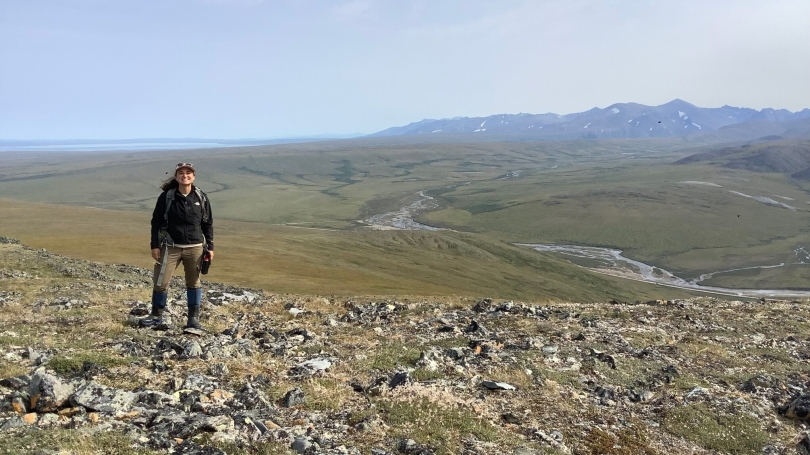
New research from Dartmouth provides the first evidence that the Arctic’s frozen soil is the dominant force shaping Earth’s northernmost rivers. Permafrost, the thick layer of soil that stays frozen for two or more years at a time, is the reason that Arctic rivers are uniformly confined to smaller areas and shallower valleys than rivers to the south, according to a study in the Proceedings of the National Academy of Sciences. The researchers calculate that as climate change weakens Arctic permafrost and polar waterways churn up the thawing soil, every 1.8 degrees Fahrenheit (or 1 degree Celsius) of global warming could release as much carbon as 35 million cars emit in a year.

Computer science PhD candidate, Weicheng Ma, is a co-author of the study. (Photo by Katie Lenhart)
Weicheng Ma, a computer science PhD candidate at the Guarini School of Graduate and Advanced Studies, and Soroush Vosoughi, assistant professor of computer science, look at how stereotypes are encoded in deep learning algorithm designed to process, understand, and generate text and other content when trained on huge datasets.
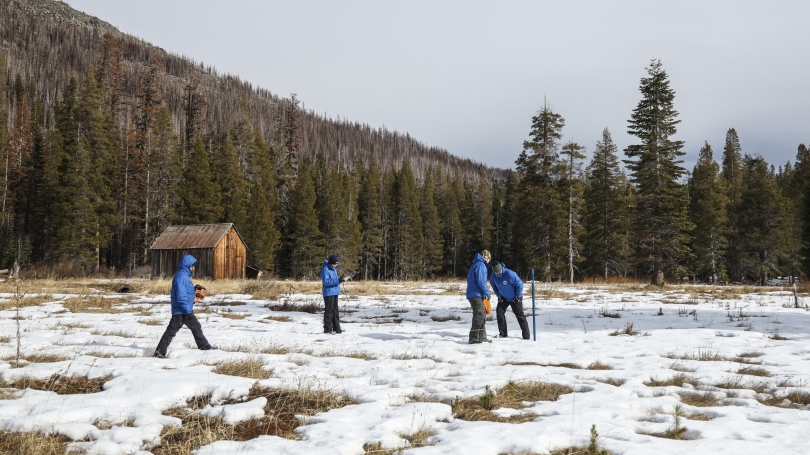
Justin Mankin, associate professor of geography,and Alexander Gottlieb, Guarini doctoral candidate, report on declining seasonal snowpacks in Nature.
Researchers Alexander Gottlieb, a doctoral candidate in the Guarini School of Graduate and Advanced Study, and Justin Mankin, a professor in geology, report in the journal Nature that the extent and speed of seasonal snowpacks throughout most of the Northern Hemisphere potentially puts the hundreds of millions of people in North America, Europe, and Asia who depend on snow for their water on the precipice of a crisis that continued warming will amplify.

Caitlin Kowalski, Guarini '20 awarded L'Oreal Women in Science Fellowship
Postdoctoral associate and microbiologist Caitlin Kowalski, Guarini ’20, has been awarded one of only five 2023 L’Oréal for Women in Science fellowships to help further her research into how certain yeasts that live on human skin can help protect against infection. The $60,000 year-long award also supports her mentorship of other women in STEM fields.

Guarini Receives Grant to Promote Diversity
The Guarini School of Graduate and Advanced Studies has received a five-year, $2 million award from the National Science Foundation through tthe Initiative for Maximizing Student Development Program. The award will support a cohort of students from underrepresented groups. The participants will have access to mentoring, cohort study groups, and many other hallmarks of Guarini’s diversity programming.
Frequently asked questions about ongoing negotiations with GOLD-UE
GRADUATE STUDENT UNIONIZATION
learn more