
 |
 |
| Election Notice. | |
Word Formation in German:
German can create new words with a variety of tools, including suffixes, separable prefixes, inseparable prefixes, and various ways of deriving nouns from strong verbs, nouns from verbs with separable or inseparable prefixes, or adjectives and adverbs from such verbs.
|
|
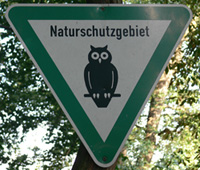 |
| Nature Preserve. | |
The Compound Noun:
Like English, German also offers the possibility of combining of words, especially nouns. The resulting noun chains in English typically feature spaces or hyphens between the different elements, while German ones normally appear as one word. The German penchant for creating complex compound nouns has long been the stuff of comedy. Mark Twain devotes part of his essay on The Awful German Language to these "curiosities," and many people are familiar with ones like "der Donaudampfschifffahrtsgesellschaftskapitän" (the Danube Steamship Navigation Company Captain).
 |
The basic German compound word, like its English relation, consists of two vocabulary items, although longer chains are possible. Take the example: "die Sprachschule." The second element, "Schule", is called the "primary word" (das Grundwort), and it designates the larger set (in this case, schools) of which the compound noun is a part. It also establishes the gender and the plural form of the compound noun. The first item "Sprach", is called the "determiner", or "determinative element" (das Bestimmungswort). It designates the subset of the category that the primary word defines. Thus a "Sprachschule" is a school that teaches languages.
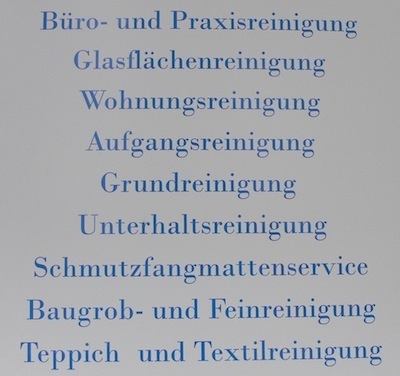
This list of provided cleaning services illustrates some of the possibilities that employ the primary word, Reinigung ("cleaning"):
|
|
 |
|
Cleaning of business and medical offices
Glass surface cleaning Housecleaning Staircase cleaning Thorough cleaning Janitorial cleaning Doormat service Building site clearance and final cleaning Carpet and textile cleaning |
|
- [no connecting element]: "der Arbeitgeber" (employer); "der Arbeitnehmer" (employee);"der Autofahrer" (driver); "der Briefträger" (postman, letter-carrier); "das Gasthaus" (inn); "die Handfläche" (palm of the hand); "der Hausbesitzer" (home-owner); "die Jugendsünde" (youthful folly); "das Muttersöhnchen" (mamma's boy); "das Trinkgeld" (tip).
- ["-e-"]: "hundemüde" (dog-tired); "die Mausefalle" (mousetrap); "der Pferdestall" (horse stable); "das Schweinefleisch (pork); "das Wartezimmer" (waiting room).
- ["-n" or "-en"]: "das Backpfeifengesicht" (a face that makes you want to slap it); "das Bauernbrot (farmhouse bread); "das Freudenhaus" (brothel); "die Gedankenfreiheit" (freedom of thought); "der Kettenraucher" (chain-smoker); "der Tintenkleks" (inkblot).
- ["-ens"]: "die Herzensgüte" (goodness of heart); "das Friedensabkommen" (peace agreement); "das Schmerzensgeld" (compensation for pain and suffering).
- ["-er"]: "der Bilderrahmen" (picture frame); "der Geisterfahrer" (wrong-way driver).
- ["-s-" or "-es-"]: "das Arbeitstier" (eager beaver; workaholic); "der Freundeskreis" (circle of friends); "geistesgestört" (deranged); "der Glückspilz" (lucky fellow); "der Gottesdienst" (church service); "die Jahreszeit" (season [of the year]); "das Landesgeld" (domestic currency); "der Liebeskummer" (lover's grief, heart-sickness); "die Staatspolizei" (state police); "das Tageslicht" (daylight); "der Verbesserungsvorschlag" (suggestion for improvement); "das Verhütungsmittel" (contraceptive); "das Verkehrsamt" (tourist office).
As some of the above examples show, the two parts of the compound may also have a connecting element (die Fuge) that can have various forms:
|
|
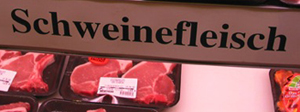 |
| pork |
 |
|
 |
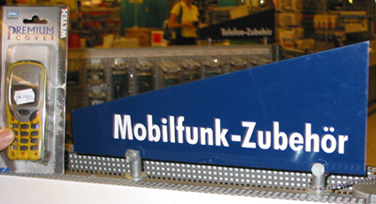
| mobile phone accessories |
|
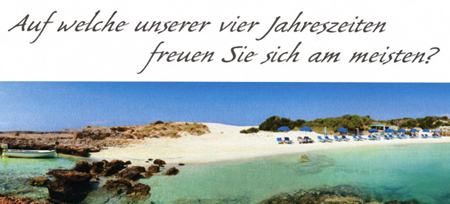
Which of our four seasons do you most look forward to? |
- "Berlin-Kenner" (someone who knows Berlin); "der Balkon-Raucher" (a man who goes out onto the balcony to smoke); "der Cyber-Diebstahl" (cyber-theft), "die E-Mail" (e-mail), "der Jeans-Bügler" (a man who irons his jeans).
While these compounds are normally written as a single word, hyphenated forms occasionally appear in new coinages:
|
|
 |
|
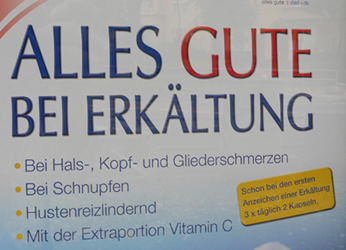
All the best with a cold
• With throat-, head-, and joint-pains
• With sniffles
• Alleviates throat-tickle
• With an extra portion of vitamin C
Two capsules 3 times a day at the first sign of a cold |
|
|
 |
|
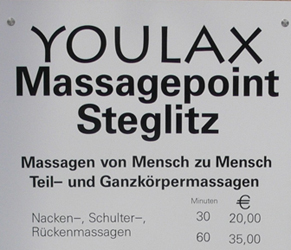
Part- and whole-body massages
Neck-, shoulder-, and back-massages |
Hyphens are also used when a series of compounds share a "primary word".
Thus in the advertisement on the right, for cold medicine, "Halsschmerzen," "Kopfschmerzen," and
"Gliederschmerzen" are compressed to "Hals-, Kopf- und Gliederschmerzen".
On the left, the primary word is first "massages," then "body-massages," with the
determiners "part" and "full";
in the next line, the primary word is again
"massages," while the determiners are "neck," "shoulder," and "back"
- "die Monster Laufzeit" (monstrous contract period)
- "die Baugenehmigung" (building permit); "das Esszimmer" (dining room); "der Fahrgast" (passenger); "das Lehrbuch" (textbook); "das Lesebuch" (storybook; reader); "das Löschwasser" (quench water [water for fire-fighting]); "der Mietvertrag" (rental agreement); "die Mitfahrgelegenheit" (ride; lift); "der Rasierapparat" (electric shaver); "der Rollstuhl" (wheelchair); "der Schreibtisch" (desk); "der Spielplatz" (playground); "die Sprechblase" (speech balloon; speech bubble [in a comic strip]); "die Stehlampe" (floor lamp); "die Tragfähigkeit" (carrying capacity); "die Verschlimmbesserung" (an intended improvement that makes things worse).
Sometimes, perhaps due to the influence of English, some constellations are even written as separate words:
|
|
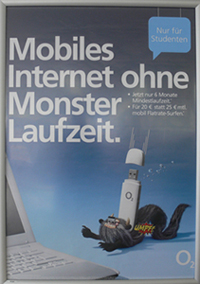 |
| Mobile internet without a monstrous contract period. |
The previous examples of compound nouns are derived from other nouns. But the "determinative element" can also be a verb, which is represented by the stem:
|
|
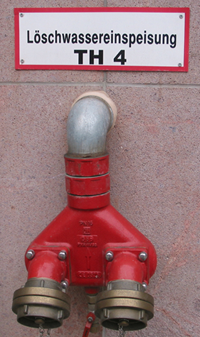 |
| Feed-in of water for fire-fighting. | |
- "der Feinschmecker" (gourmet); "der Fernfahrer" (long-distance trucker); "das Großmaul" (loudmouth); "die Hochkultur" (high culture); "der/die Schnellfahrer/in" (speeder); "die Schwarzmalerei" (doom-saying); "der Schwarzmarkt" (black market); "die Spätschicht" (late shift); "die Sprechstunde" (office hour); "der Wichtigtuer" (pompous ass); "die Zusammensetzung" (compound).
The "determinative element" can also be an adjective or adverb. One could make the case that some of these "determiners" fall into the category of separable prefix, at least when the "primary word," though a noun, derives from a verb. The effect is the same either way.
|
|
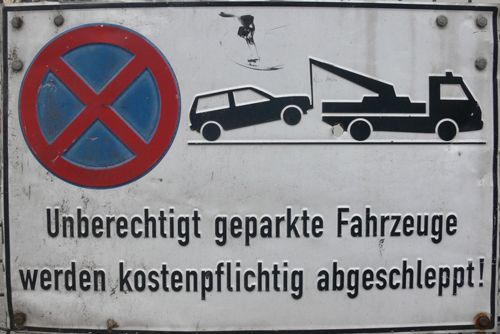 |
| unauthorized parked vehicles will be towed at the owner's expense | |
- "achtgeben" (to be careful; to pay attention); "gutmachen" (to make amends for); "preisgeben" (to relinquish; to disclose); "stattfinden" (to take place); "teilnehmen" (to participate); "wahrnehmen" (to discern; to experience; to avail oneself of).
The "primary word" can also be a verb. The "determiner" then becomes a separable prefix:
- "arbeitsbereit" (ready to work); "arbeitsscheu" (afraid of hard work); "bärenstark" (strong as an ox [bear]); "baufällig" (dilapidated); "berufstätig" (employed [outside the home]); "butterweich" (soft as butter); "gertenschlank" (willowy, svelte, slender as a willow reed); "hustenreizlindernd" (throat-tickle-alleviating); "kostenpflichtig" (liable for the costs); "lebensgefährlich" (life-threatening; mortally dangerous); "linkshändig" (left-handed); "nervtötend" (tedious, pesky); "reisefertig" (ready to leave [on a trip]); "spindeldürr" (skinny as a rail); "steinalt" (old as the hills); "todsicher" (dead certain); "vollautomatisch" (fully automatic); "vollbesetzt" (completely occupied); "vollreif" (fully ripe) "umweltfreundlich" (eco-friendly); "wildfremd" (totally unknown).
The "primary word" can also be an adjective or adverb, so that the compound itself becomes that part of speech:
Intensifiers / Augmentative prefixes
Especially in colloquial speech, German-speakers enjoy a special category of compound nouns or modifiers in which the "determinative element" functions as an augmentative, or intensifying, prefix.
In some cases, the determinative element's meaning is obvious. When derived, for example, from "der Riese" [giant], it keeps the notion of "gigantic": "der Riesenfehler" [huge mistake], "der Riesenhunger" [gigantic hunger], "die Riesenfreude" [huge pleasure], "die Riesensauerei" [gigantic mess], "der Riesenspaß" [a lot of fun]. Similarly, "die Spitze" (as well as "top-") raises something to the highest category: "die Spitzenleistung" [top performance; outstanding achievement], "der Spitzenlohn" [top wage]. "Super" and "ultra" are also used frequently, much as in English: "superbequem" [supercomfortable]; das Superwetter [super weather]; "ultraschnell" [ultrafast].
Another group modifies colors: "dunkelblau" (dark blue); "hellgelb" (light yellow); "pechschwarz" (pitch-black); "rabenschwarz" (crow-black); "schneeweiß" (snow-white); "veilchenblau" (violet).
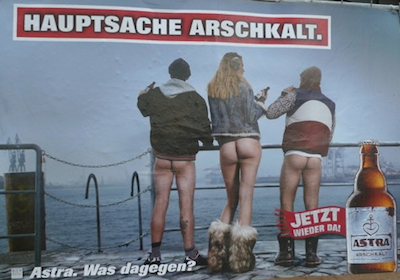
But in many cases, the determiners are not so semantically obvious. For example, a comment on the cold weather can be intensified with a variety of prefixes to become, among a great many other possibilities: "arschkalt"; "saukalt", "scheißkalt", "schweinekalt", or "teufelskalt". In none of these examples does the determinative element (e.g. "der Arsch" [ass], "die Sau" [sow], "die Scheiße" [shit], "das Schwein" [pig], or "der Teufel" [devil]) carry a literal meaning. At the most, they signal a traditionally negative attitude associated with these things.
|
|
 |
Here are just a few other examples of augmentative constructions:
| Prefix Source | Modifier/Noun | Meaning |
| aber- | abertausend | thousands and thousands |
| affen- | affengeil | awesome; really cool |
| die Affenhitze | awful heat | |
| die Affenkälte | awful cold | |
| die Affenliebe | infatuation | |
| der Affenzahn | breakneck speed | |
| der Bär | der Bärenhunger | extreme hunger |
| bärenstark | strong as a bear | |
| die Bombe | Bombenerfolg | huge success |
| bombensicher | dead certain | |
| der Dreck | der Dreckskerl | dirty swine; worthless person |
| erz- | der Erzfeind | archenemy |
| erzfrech | extremely cheeky | |
| die Erzlüge | total lie | |
| erzmisstrauisch | extremely mistrustful | |
| extra- | die Extrawurst | special treatment |
| grotten-1 | grottenfalsch | totally wrong |
| grottenschlecht | terrible | |
| grottenhässlich | extremely ugly | |
| die Hölle | höllenstark | hellishly strong |
| der Hund | hundselend | really wretched |
| hundsgemein | vile | |
| hundsmiserabel | sick as a dog | |
| hundemüde | dog-tired | |
| hyper- | hyperempfindlich | hypersensitive |
| hypernervös | hypernervous | |
| knall- | knallhart | tough as nails; hard-hitting |
| knallrot | bright red | |
| mega- | megacool | really cool |
| der Megahammer | wonderful thing | |
| der Mord | mordsheiß | murderously hot |
| der Mordshunger | ravenous hunger | |
| der Mordsspaß | huge amount of fun | |
| mutterseelen- | mutterseelenallein | all alone |
| ober- | oberpeinlich | extremely embarrassing |
| oberschlau | too clever by half | |
| piek- | piekfein | posh |
| pieksauber | immaculately groomed | |
| quietsch- | quietschfidel | especially jolly |
| quietschvergnügt | happy as can be | |
| die Sau | saukalt | bitter cold |
| saumäßig | beastly; lousy | |
| sauteuer | swinishly expensive | |
| die Scheiße | ([Das ist mir] scheißegal | I don't give a shit |
| Scheißding | shitty thing | |
| scheißfaul | goddamn lazy | |
| scheißhöflich | obsequious | |
| das Schwein | die Schweinearbeit | back-breaking work |
| das Schweinegeld | heaps of money; a bundle | |
| stink- | stinkbesoffen | stinking drunk |
| stinkbürgerlich | disgustingly bourgeois | |
| stinkfaul | bone-lazy | |
| stinklangweiling | totally boring | |
| stinksauer | hopping mad; pissed off | |
| stock- | stockbesoffen | totally drunk; sloshed |
| stockdumm | dumb as dirt | |
| stocksauer | hopping mad; pissed off | |
| der Tod | todmüde | dead tired |
| todsicher | dead certain | |
| ur- | uralt | old as the hills |
| urgesund | extremely healthy |
- "die Hauptachse" (main axle); "die Hauptabteilung" (central department); "der/die Hauptaktionär/in" (majority shareholder); "der Hauptakzent" (main emphasis); "der Hauptbahnhof" (main railway station); "die Hauptbeschäftigung" (main occupation); "die Haupteigenschaft" (primary characteristic; major feature); "der Haupteingang" (main entrance); "das Hauptfach" ([academic] major); "die Hauptfigur" (main character); "der Hauptgrund" (chief reason); "die Hauptperson" (central figure); "das Hauptproblem" (main problem); "die Hauptrolle" (primary role); "die Hauptsache" (most important thing); "die Hauptschuld" (primary share of the blame); "der Hauptsitz" (headquarters); "die Hauptstadt" (capital city); "die Hauptstraße" (main street); "die Haupttätigkeit" (main activity); "der Hauptunterschied" (principal difference); "der Hauptvertreter" (principal representative); "der Hauptwohnsitz" (primary residence); "das Hauptwort" (noun); "das Hauptziel" (primary goal).
Some "determiners" appear so frequently that they have become a standard prefix. A word like "das Haupt," for example, an older term for head (and largely replaced in modern usage by "der Kopf"), appears in a great many well-established compounds, as well as in more spontaneous coinages. It means "central," "chief," "main," "primary," or "principal". Just a few examples:
|
|
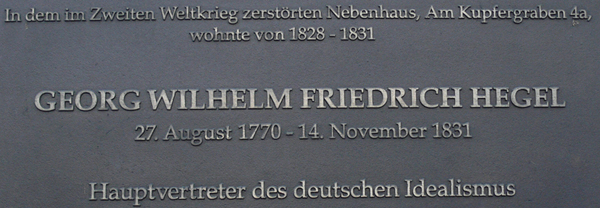 |
| Georg Wilhelm Friedrich Hegel, the principal representative of German Idealism, lived from 1828-1831 in the house next-door (Am Kupfergraben 4a), which was destroyed in World War II. | |
- "altklug" (precocious); "nasskalt" (wet and cold); "schwarzrotgold" (black-red-gold [the colors of the German flag]); "süßsauer" sweet-and-sour.
In some compounds the "determiners" and "primary words" are equal:
- "der Mischmasch" (mishmash, hodgepodge); "schickimicki" (trendy, fancy-schmancy); "der Schnickschnack" (bric-a-brac, knick-knack); "der Wirrwarr" (hurly-burly, imbroglio); "wischiwaschi" (wishy-washy); "larifari" (airy-fairy).
Still another form duplicates sounds, with the stem vowel changing between a high-front position and a lower-back one:
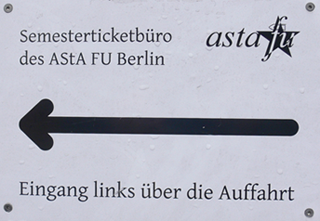
- "die Bankdienstleistungen" (banking services); "das Eintopfgericht" (stew; boiled dinner); "der/die Fußballspieler/in" (soccer player); "die Feuerwehrzufahrt" (fire department access); "die Geschirrspülmaschine" (dishwasher); "das Jugendschutzgesetz" (law for the protection of youth); "die Lebensversicherungsgesellschaft" (life-insurance company); "der Minderwertigkeitskomplex" (inferiority complex); "der Rathaussaal" (city council chamber); "der/die Rollstuhlfahrer/in" (wheelchair-user); "der Schreibtischcomputer" (desktop computer); "das Semesterticketbüro" (Semester Ticket Office [A semester ticket is a public transportation pass available to students during the term]); "der Windschutzscheibenwischer" (windshield wiper).
Most of the previous examples consist of one determiner affixed to one primary word, but more elaborate noun chains are possible:
|
|
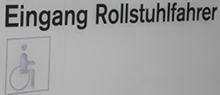 |
| Wheelchair Entrance |
|
|
 |
|
Semester Ticket Office of
AStA (Allgemeiner Studentenausschuss [Students' Association]) of the
Free University of Berlin.
Entrance to the left past the driveway. |
|
|
|
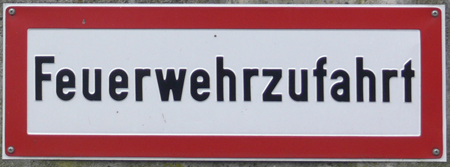 |
| Fire Department Access | |
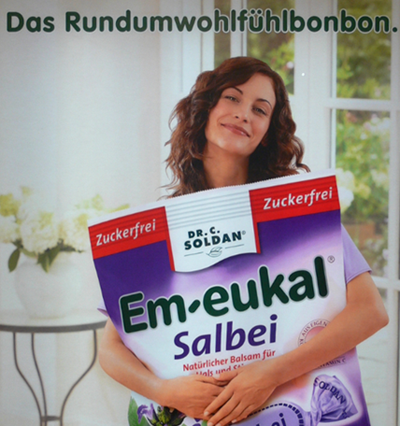
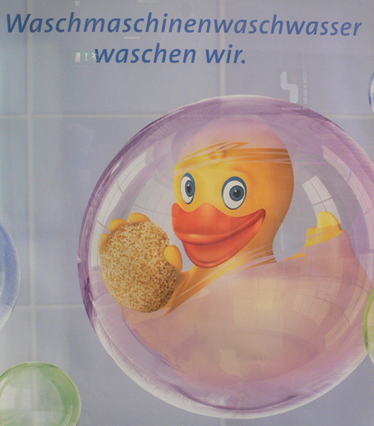
Mark Twain is not the only person to find whimsical possibilities in complex compounds. There is a long tradition of constructing nouns like "die Hottentottenpotentatentantenattentäterin" (the Hottentot potentate's aunt's [female] assassin) or other humorous combinations:
 |
|
 |
| The all-round-feel-good cough-drop |
|
We wash washmachine water [ad by the Berlin Waterworks]. |
A more recent phenomenon is the "Weichei"-definition. A "Weichei" is a wimp or wussie, the opposite of a "real man." Some of the many definitions, which combine noun-compounds with the masculine suffix "-er":
| der Ampelgelb-Bremser = a man who brakes for a yellow light |
| der Abschiedsheuler = a man who weeps when saying good-bye |
| der Apfelschäler = a man who peels an apple (before eating it) |
| der Balkonraucher = a man who goes out on the balcony to smoke |
| der Beipackzettel-Leser = a man who reads warning labels on drug prescriptions |
| der Cabrio-geschlossen-Fahrer = a man who drives a convertible with the top up |
| der Chef-Witz-Lacher = a man who laughs at the boss's jokes |
| der Eincremer = a man who uses skin lotion |
| der Festnetztelefonierer = a man who telephones using a land-line |
| der Frauenversteher = a man who understands women |
| der Geheimzahl-Aufschreiber = a man who writes down a PIN |
| der Handschuhträger = a glove-wearer |
| der Kassenzettel-Nachprüfer = a man who checks the cash-register receipt |
| der Klamotten-am-Vorabend-Ausleger = a man who lays out his clothes the night before |
| der Landungsklatscher = a man who applauds when the plane lands |
| der Mittelspurfahrer = a man who drives in the middle lane |
| der Quotenopfer = a (self-proclaimed) victim of quotas |
| der Rechts-Links-Wangen-Bussi-Geber = a right-left-cheek peck-giver |
| der Schattenparker = a man who parks in the shade |
| der Sitzpinkler = a man who sits to pee |
| der Sockenfalter = a man who folds his socks |
| der Tastaturabdecker = a man who covers the keyborad |
| der Unterhosenbügler = a man who irons his underpants |
| der Vorwärtseinparker = a man who drive forwards into a parallel parking space |
| der Warmduscher = a man who takes warm showers |
| der Weinschorle-Trinker = a man who drinks wine-spritzers |
- In Hans-Ulrich Treichel's novel Tristanakkord (Suhrkamp, 2000), the protagonist is, in a small way, about to assist a famous musician in composing a work. In contemplating the fame that he will achieve, he refers to it as "eine Trittbrettunsterblichkeit" (p. 212). This coinage is made up of six separate elements: "der Tritt" (step) and "das Brett" (board) combine to fashion "das Trittbrett" (running-board, the foot-board that runs along the side of certain trucks and antique automobiles). German usage has given this word a metaphorical connotation: "hanging on" or "freeloading," especially in the term of "Trittbrettfahrer" (literally: running board rider). To "Trittbrett" the author adds "Unsterblichkeit" (immortality). That term is derived from "sterben" (to die); by adding the suffix "-lich" to the stem "sterb-", we get the adjective "sterblich" (mortal). To that comes the suffix "-keit", forming the noun "Sterblichkeit" (mortality). The prefix "un-", just as in English, produces the opposite meaning (immortality). Finally, the author combines "Trittbrett" and "Unsterblichkeit" to create a spontaneous coinage that will appear in no dictionary but is comprehensible to all: "Trittbrettunsterblichkeit" is an immortality that is achieved by riding in someone's wake (or on someone's coattails). The English translation necessarily lacks both the compactness - and the humor - of the German original.
More important are the complex meanings that can be compressed within compounds, constructions that are very hard to translate. Here is an example of one such possibility:
|
|
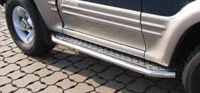 |
| Trittbrett (running-board) | |
|
|
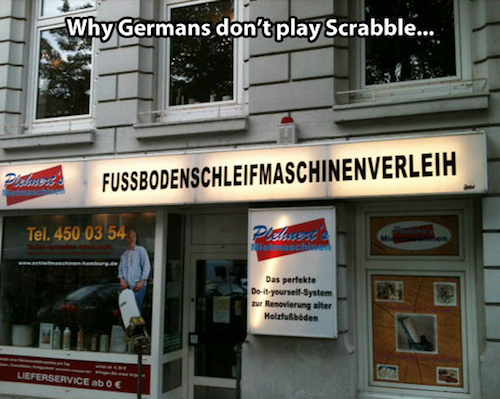 |
| Floor-sander rentals |
- German also uses portmanteau words, which blend two words and combine their meanings. Often these constructions are borrowed wholesale from English, e.g. "brunch", "motel", "smog", "brexit", but others are of German origin:
Portmanteau Words (Kofferwörter or Schachtelwörter)
| Denglisch = Deutsch + Englisch |
| jein = ja + nein |
| Informatik = Information + Mathematik |
| Teuro = teuer + Euro |
| Verschlimmbesserung = Verschlimmerung + Verbesserung |
| Return to the list of contents for "Word Formations" |
1
The etymology of "grotten" is uncertain, but some linguists trace it to "Krote", a dialect form of "Kröte" [toad].
back to text