 |
|
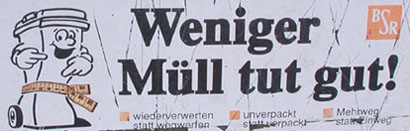
| Less trash is a good thing | |
The comparison of adjectives in English:
To form the comparative of an adjective, English adds -er to shorter words ("prettier") or places more in front of more complicated ones ("more beautiful").
To form the superlative of an adjective, English adds -est ("prettiest") or uses most ("most beautiful").
To form the comparative of an adverb, English adds -er to those that do not end in -ly ("faster") and places more in front of those that do end in -ly ("more quickly").
To form the superlative of an adverb, English adds -est to those that do not end in -ly ("fastest") and places most in front of those that do ("most quickly").

The comparison of adjectives and adverbs in German:
No matter how long the adjective or adverb, German always adds -er ("schöner", "interessanter"). Never use mehr for this purpose. Adjective endings follow the -er. Of course, adverbs and predicate adjectives take no endings.
| Wir haben den süßeren Wein bestellt. |
| We ordered the sweeter wine. |
| Die schlankere Frau ist nicht unbedingt die attraktivere. |
| The slimmer woman isn't necessarily the more attractive one. |
| Er fährt schneller, wenn es nicht regnet. |
| He drives faster when it isn't raining. |
| Sie steht ziemlich links, aber ihr Mann ist konservativer. |
| She's pretty left-wing, but her husband's more conservative. |
To form the superlative, German always adds -st or -est. Other than the few exceptions mentioned below, superlative adjectives always require a further ending:
| Spieglein, Spieglein an der Wand, wer ist die Schönste im ganzen Land? |
| Mirror, mirror on the wall, who's the fairest one of all? |
| Wir haben den trockensten Wein bestellt. |
| We ordered the driest wine. |
| Die schlankste Frau ist nicht unbedingt die attraktivste. |
| The slimmest woman isn't necessarily the most attractive one. |
The superlative forms of adverbs or predicate adjectives take the form of "am -sten:"
| Er singt am lautesten. | He sings the loudest. |
| Ich bin am glücklichsten, wenn ich allein bin. | I'm happiest when I'm alone. |
Some superlative forms of adverbs can end in "-stens" (without "am"):
| Wir essen meistens in der Küche. | We mostly eat in the kitchen. |
| Ich bin bestens versorgt. | I'm very well provided for. |
| Hunde sind hier strengstens verboten. | Dogs are strictly forbidden here. |
| Ihr Wagen wird frühestens Mittwoch fertig sein. | Your car will be ready on Wednesday at the earliest. |
The basic forms:
| Positive | Comparative | Superlative | or |
| klein | kleiner | am kleinsten | der/die/das kleinste |
| intelligent | intelligenter | am intelligentesten | der/die/das intelligenteste |
Some adjectives, almost always monosyllabic, add an umlaut. Here are some of the more common ones:
| alt | älter | am ältesten | old |
| arm | ärmer | am ärmsten | poor |
| dumm | dümmer | am dümmsten | stupid |
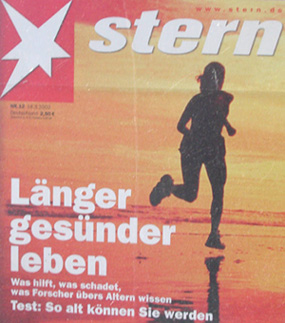
| gesund | gesünder | am gesündesten | healthy |
| grob | gröber | am gröbsten | coarse |
| groß | größer | am größten | large |
| hart | härter | am härtesten | hard |
| jung | jünger | am jüngsten | young |
| kalt | kälter | am kältesten | cold |
| klug | klüger | am klügsten | smart |
| kurz | kürzer | am kürzesten | short |
| lang | länger | am längsten | long |
| oft | öfter | am öftesten | often |
| scharf | schärfer | am schärfsten | sharp; spicy |
| schwach | schwächer | am schwächsten | weak |
| schwarz | schwärzer | am schwärzesten | black |
| stark | stärker | am stärksten | strong |
| warm | wärmer | am wärmsten | warm |
Several other adjectives may or may not take an umlaut (It's up to the speaker, but in most cases the umlaut is unusual):
| blaß | pale | fromm | pious | glatt | slick | krank | sick |
| naß | wet | rot | red | schmal | narrow |
|
|
 |
|
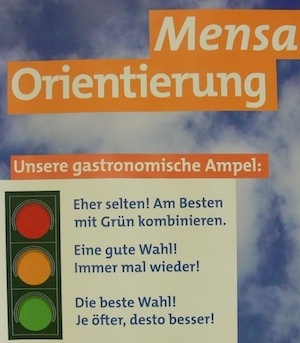
Dining Hall Orientation. Our gastronomic traffic light:
[red] Preferably infrequently! Best combined with green. [yellow] A good choice! Take repeatedly! [green] The best choice! The more often, the better! |
|
Some adjectives or adverbs change their stems in other ways, as well:
| bald | eher | am ehesten | soon |
| gern | lieber | am liebsten | "gladly" |
| gut | besser | am besten | good |
| hoch | höher | am höchsten | high |
| nah | näher | am nächsten | near |
| viel | mehr | am meisten | much |
|
|
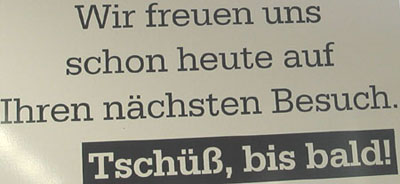 |
| Already today we're looking forward to your next visit | |
|
|
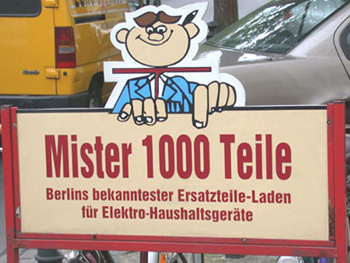 |
| Mr. 1000 Parts - Berlin's best-known spare parts store for electric household appliances | |
Adjectives ending in -el or -er normally drop the -e- before the comparartive -er:
| dunkler | darker |
| teurer | more expensive |
Adjectives ending in -d, -t, -s, -ß, -sch, or -z usually add -est:
| am breitesten | the widest |
| am kürzesten | the shortest |
| am weißesten | the whitest |
Exceptions: "am größten" (the biggest) and adjectives formed from present participles: "am entgenkommendsten" (the most accommodating).
|
|
 |
|
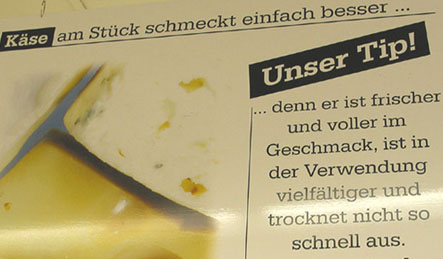
Unsliced cheese simply tastes better.
Our tip! for it has a fresher and fuller taste, can be used in more ways, and doesn't dry out as fast |
|
Using "als" and "wie" in making comparisons:
| Ich bin so gut wie du. | I'm as good as you. |
| Es ist nicht so warm wie gestern. | It's not as warm as yesterday. |
| Das ist genauso dumm wie dein letzter Vorschlag. | That's just as stupid as your last suggestion. |
| Du bist ebenso laut wie ich. | You're just as loud as I am. |
| Sie ist älter als ihr Bruder. | She is older than her brother. |
| Ein Pferd kann schneller laufen als ein Mensch. | A horse can run faster than a human. |
Note: Many Germans use "wie" instead of "als" ("Ich bin besser wie du"), but this construction is considered to be bad grammar. Even speakers who do it themselves will correct a foreigner who makes this mistake.
Intensifiers: to indicate a progressive development, English repeats the comparative ("Things are getting better and better"). German can do that ("Es wird kälter und kälter") or, more usually, use "immer": "Es wird immer besser."
|
|
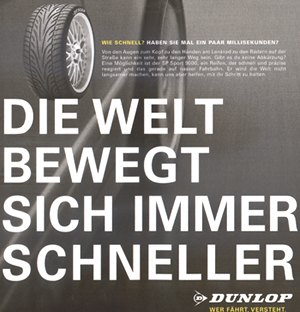 |
| The world is moving faster and faster | |
Similar to English's "The more the merrier," German employs "Je mehr, desto besser."
|
|
 |
| The faster you're on the information highway, the better wired you are to your customers | |
To prefer / like best:
| Ich gehe gern ins Theater | I like to go to the theater. | Ich habe Weißwein gern. | I like white wine. |
| Ich gehe lieber ins Kino. | I prefer to go to the movies. | Ich habe Rotwein lieber. | I prefer red wine. |
| Ich gehe am liebsten ins Konzert. | I most like to go to concerts. | Ich habe Sekt am liebsten. | I like champagne best. |
mehr or eher can be used to compare two qualities of the same person or thing:
| Der Film ist mehr interessant als unterhaltend. | The film is more interesting than entertaining. |
| Deine Witze sind eher traurig als witzig. | Your jokes are more sad than funny. |
| Das ist eher möglich. | That's more likely. |
| Eher geht ein Kamel durch ein Nadelöhr, als dass ein Reicher in den Himmel kommt. | It is easier for a camel to pass through the eye of a needle than for a rich man to go to heaven. |
eher can also mean "rather; preferably":
| Ich gehe eher ins Theater. | I prefer to go to the theater. |
| Eher hungere ich. | I'd rather starve. |
To express the notion of "favorite," use the prefix Lieblings-:
| Meine Lieblingsfarbe ist blau. | My favorite color is blue. |
| Wenn mein Vater spazieren geht, ist sein Lieblingsziel die Kneipe an der Ecke. | When my father goes for a walk, the pub on the corner is his favorite destination. |
aller- intensifies a superlative:
| Das habe ich am allerliebsten. | I like that best of all. |
| Er arbeitet am allerschwersten. | He works the hardest of all. |
The comparative and superlative forms of adjectives have all the possibilities of the positive forms. They can modify nouns or form the basis of adjectival nouns. Logically, however, a superlative cannot of course follow an indefinite article ("ein höchster Berg" [a highest mountain]). Some examples:
| "Ich bin der Größte!" | "I am the greatest!" |
| Der teuerste Wagen gehört meinem älteren Bruder. | The most expensive car belongs to my older brother. |
| Sie hat einen noch besseren Freund gefunden. | She found an even better boyfriend. |
| Eine bessere Gelegenheit findest du nie. | You'll never find a better opportunity. |
| Von ihren Kindern ist das Jüngste am intelligentesten. | Of her children, the youngest is the most intelligent. |
|
|
 |
|
Driving School...
Also for "older people," beginners, and "scaredy-cats"
Training for licenses B, BE (passenger cars), also automatic shift |
|
Similarly, the comparative and superlative forms of adverbs act like the positive forms. Some examples:
| Ich würde das lieber früher als später hören. | I'd rather hear that earlier than later. |
| Wir arbeiten hier seit längerer Zeit. | We've been working here for some time. |
| Wie komme ich am besten in die Stadt? | What's the best way into town? |
| Ein älterer Herr hat mir geholfen. | An older gentleman helped me. |
|
|
 |
|
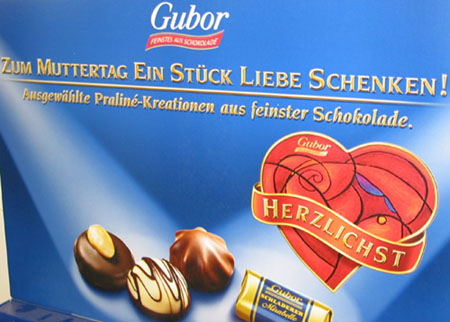
For Mother's Day give a piece of love!
Selected praline-creations from the finest chocolate |
|