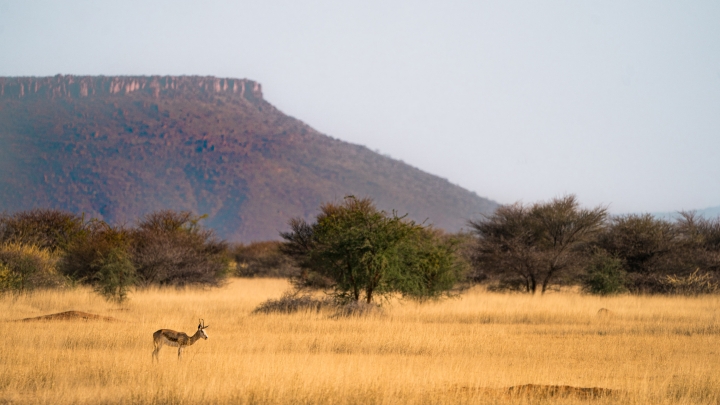
The Foreign Study Program in southern Africa highlights the global teaching and perspective of the Environmental Studies Program. Each fall term, 16 students are admitted to a regional program with and emphasis on conservation and development. The program is designed to give firsthand experience with issues of population/health, land and water use, wildlife management, ecotourism, and resource management across southern Africa. All students take three courses: ENVS 40, which addresses the issues of development and conservation both in the classroom and in the field; ENVS 42, which offers a comprehensive view of the political and social context of initiatives for development and environmental conservation with an emphasis on regional problems and regional opportunities for solutions; and ENVS 84, which is a culminating seminar taught by the Dartmouth faculty director and requires an extensive, independently researched term paper. Various African experts also lecture and lead field exercises during the term. Approximately half of the term is spent in the field, including at least two extended field trips to sites of environmental interest in two or more of the region’s countries. Students examine wildlife management in the national game parks, water projects and their influence on agriculture and wildlife, and community based programs for economic development and environmental protection.
CURRICULUM
ENVS 40: Natural Resources and Environmental Issues in Southern Africa
ENVS 42: Social and Political Aspects of Development Conservation in Southern Africa
ENVS 84: Seminar on Environmental Issues of Southern Africa
Lecture at the Cheetah Conservation Fund (CCF). Dr. Laurie Marker and Dartmouth FSP students discuss saving the wild cheetah. |
Living Accommodations
While in the program’s base city of Pretoria, South Africa, students live in homestays with local families. During their extended field trips, AFSP participants (students and Dartmouth faculty) stay in tents.
Homestay in Pretoria, South Africa. |
Lindsay Brewer '13 plays with children during the homestay. |
Tires and rocks are used to fill the donga and repair the road. |
Randy Sherman '08 helps to fill the donga. |
FACULTY CONTACTS
Bill Roebuck, Doug Bolger, and Ross Virginia
PREREQUISITES for the AFRICA FSP
ENVS 2 or the equivalent 11F, 12F: 12
ENVS 39 12X: 10A
or ENVS 65, with permission 12W, 13W: 10A
And at least one of the following courses (availability subject to change):
AAAS 14/HIST 5.1: Pre-Colonial African History 11F: 10 13W: 10
AAAS 15/HIST 66: History of Africa since 1800 12S, 13S: 10
AAAS 19/HIST 5.8: Africa and the World 12S: 2A 13W: 3B
AAAS 40/WGST 34.2: Gender Identities and Politics in Africa 12W, 13W: 2A
AAAS 46/HIST 67: History of Modern South Africa 11F: 10 13W: 12
AAAS 50/ENVS 45/HIST 75: Colonialism, Development, and the Environment in Africa and Asia 13W: 10
AAAS 52/HIST 68: History of North Africa 12F: 10A
ANTH 36/AAAS 44: Contemporary Africa 12S: 2
GEOG 6/INTS 16: Introduction to International Development
GOVT 42: Politics of Africa 11F: 2 13S: 10
HIST 6: Transnational Migrations in African-American History 12W: 10
THEA 23/AAAS 54: Topics in African Theater and Performance 12W: 2 13W: Arrange
![]() On top of a sand dune in the Namibian Sand Sea. |
2009 Africa Foreign Study Program (AFSP)2008 Africa Foreign Study Program (AFSP)2007 Africa Foreign Study Program (AFSP)2006 Africa Foreign Study Program (AFSP)Archived Program information Prior to 2006 |