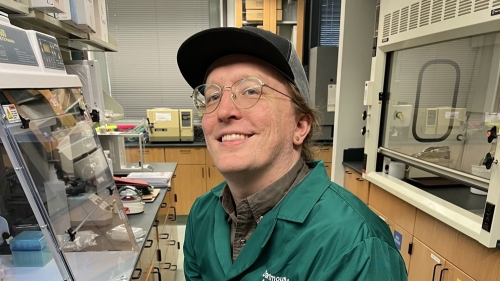
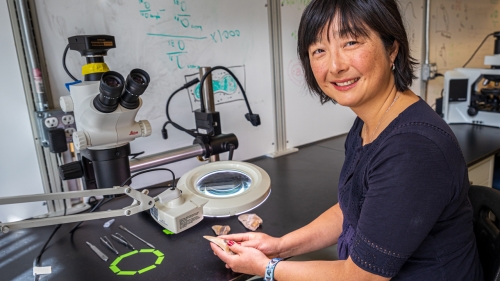
Pallab Sarker

Pallab Sarker

Research Associate in Fish Nutrition and Environmental Sustainability

My research interests span from fish nutrition, physiology and aquaculture which include nutrient requirement of fish; ingredients evaluation for nutritionally balanced, environmentally sustainable and cost-effective aquafeed formulation for aquaculture species; impacts of nutrition on physiology and gene expression.

Current Research at Dartmouth

As a part of integrated food energy system (IFES), currently I am investing my thought about the potential of evaluating fresh and marine water microalgae digestibility and developing various tilapia feed formulae (low phosphorus loading) to replace fish meal and fish oil for sustainable tilapia aquaculture.

Consumer demand for fish products is predicted to grow, with, aquaculture filling the shortfall from static or declining capture fisheries. Governments, industry, and academic stakeholders have invested very significant resources to support research and development activities in aquaculture.

Sustainably produced nutritionally complete aquafeeds must keep pace with consumer demand for edible fish. The over-reliance of the aquaculture industry on marine-derived resources has also raised concern among environmentalists regarding the impacts of fish meal and oil demand on reduction fisheries specifically and marine ecosystems in general. Additionally, the use of fish meal and fish oil in fish feeds has been linked with elevated levels of environmental contaminants in farm-raised fish, raising (unfounded) concerns about human food safety.

Above all these issues have created a strong incentive to drive research for alternative feedstuffs to reduce the reliance on marine-derived fishmeal and fish oil. Our research team at Dartmouth is currently giving efforts in this area to demonstrate that technology can be effective to meet this end. This is one component of research on IFES characterized by nutrient recycling such as fish culture effluents fertilizing microalgae, and coupled to biogas renewable energy and greenhouse aquaponics. I join scientists and engineers (Dartmouth) and practitioners (local IFES) who are collaborating on research on integrated food energy systems for multifunctional sustainability at community and larger scale.

Selected Publications

  • Sarker, P.K., Bureau, D.P., Drew, M., Hua, K., Forster, I., Were, K., Hicks, B., Vandenberg, G.W., 2013. Sustainability issues related to feeding salmonids: a Canadian perspective. Reviews in Aquaculture, 5: 1-21 (in press, January, 2013).
  • Yossa, R., Sarker, P.K., Mock, D.M., Vandenberg, G.W., 2013. Dietary biotin requirement for growth of juvenile zebrafish Danio rerio (Hamilton-Buchanan). Aquaculture Research, 1–11 (Just Accepted Manuscript doi:10.1111/are.12124; Publication Date (Web): 25 Jan 2013).
  • Sarker, P.K., Yossa, R., Karanth, S., Ekker, M., and Vandenberg, G.W., 2012. Influences of dietary biotin and avidin on growth, survival, deficiency syndrome and hepatic gene expression of juvenile Nile tilapia Oreochromis niloticus. Fish Physiology and Biochemistry, 38 (4): 1183-1193.
  • Sarker, P.K., Fournier, J., Boucher, E., Proulx, E., Noüe de al J., Vandenberg, G.W., 2011. Effects of low phosphorus ingredient combinations on weight gain, apparent digestibility coefficients, non-fecal phosphorus excretion, phosphorus retention and loading of large rainbow trout (Oncorhynchus mykiss). Animal Feed Science and Technology, 168, 241-249.

My CV

Complete List of Publications

Office: 112B Fairchild

Phone: 603-646-6461

Email: Pallab.K.Sarker@Dartmouth.edu


Last Updated: 3/18/13