Colleen Glenney Boggs

BoggsAssociate Professor of English

Ph.D. and M.A., University of Chicago
B.A., Yale University


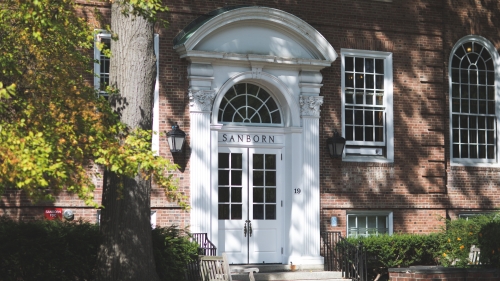
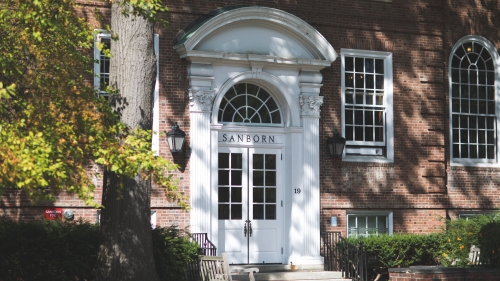
007 B Sanborn House and 262 Leslie Humanities Center, Haldeman
Colleen.G.Boggs@Dartmouth.edu

As a scholar of American Literature, I investigate how language affects our understanding of individuals, nations and species. While most of my work focuses on the nineteenth century, I am also keenly interested in contemporary literary theory, gender and cultural studies.

Because I am a bilingual speaker of English and German, I have always been intrigued by the relationship between multilingualism and national identity. In my book, Transnationalism and American Literature: Literary Translation 1773-1892 (Routledge, 2007), I ask how a work can be or become American absent a unifying mother tongue. Far from being a melting pot in which languages other than English vanish, the United States is now and has historically been an intensely multilingual country. Drawing on historical and contemporary language theory, I argue that the writers who founded American literature (such as Phillis Wheatley, James Fenimore Cooper, Margaret Fuller, Ralph Waldo Emerson, Walt Whitman, Henry Wadsworth Longfellow, Nathaniel Hawthorne and Harriet Beecher Stowe) embraced that multilingualism. They recognized that, to become “American,” a literary work had to be readily available in languages other than English. To circulate their works among the nation’s linguistically different readers, these writers actively promoted literary translation. Because such translation also allowed texts to be exported to other countries, it fulfilled these writers’ desire to create a “world literature” that reached beyond state boundaries. I argue that multilingualism is a hallmark of American literature, which we need to recognize as fundamentally and foundationally transnational.

My second book, Animalia Americana: Animal Representations and Biopolitical Subjectivity (forthcoming, Columbia University Press, 2012), asks why animals appear in virtually all genres of American literature. While animal representations go back to antiquity, the fable tradition uses animals as stand-ins for human beings, and is not interested in animals as such. My book traces a specific literary and cultural history that emerged with the educational writings of John Locke in the seventeenth century. Arguing that we gain our humanity by performing acts of kindness to animals, Locke located subjectivity in the relationship among different species. Children become liberal subjects and good citizens by learning how to treat animals lovingly. But the association of slaves and women with animals complicates these relationships, and American literature constantly interrogates the divisions between species in attempts to foster and to question understandings of subjectivity. Case studies include Edgar Allan Poe, Emily Dickinson, Frederick Douglass, as well as Presidential pets, and the photos from Abu Ghraib.

 My current research focuses on literature written during the Civil War. An edited volume, Options for Teaching the Literatures of the American Civil War, is in development with the Modern Language Association’s publications branch. In my new monograph, Civil War Substitutes, I am tracing how the substitute clause (which gave citizens who had been drafted to military service the option to pay for someone to go in their stead) impacted American literary and political culture. Substitution is a key literary technique (metaphor, allegory) but also a bodily practice (prosthesis) for coping with the war’s wounded, and a psychological condition (doubling/ Doppelgaenger). I aim to understand how these different kinds of substitution speak to one another, and how their convergence during the Civil War reshaped American culture.

Since January, 2012, I have been serving as Director of the Leslie Center for the Humanities at Dartmouth College; for more information on the Leslie Center, see www.dartmouth.edu/~lhc

 Select Publications

Animalia Americana: Animal Representations and Biopolitical Subjectivity, Columbia University Press, forthcoming 2012.

 “Transatlantic Romanticism.” Transatlantic Literary Studies, 1680-1830: An Introduction. Cambridge: Cambridge University Press, 2012: 219-237.

“Animals and the Formation of Liberal Subjectivity in Nineteenth Century American Literature.” Oxford Handbook of Nineteenth-Century American Literature. Ed. Russ Castronovo. Oxford: Oxford University Press, 2012, 197-216.

“American Bestiality: Sex, Animals and the Construction of Subjectivity.” Cultural

Critique 76 (3), Fall 2010: 98-125.

“Emily Dickinson’s Animal Pedagogies.” PMLA, March 2009, 533-541. 

“Introduction: (Un)Gendering the Transatlantic.” Symbiosis 13 (2), special issue

edited by Colleen Glenney Boggs, October, 2009, 93-99.

Transnationalism and American Literature: Literary Translation 1773-1892. New York

and London: Routledge, 2007.

 “Translation in the United States.” Oxford History of Literary Translation in English:

Volume 4: 1790-1900 (5 vols). Oxford and London: Oxford University Press, 2006:20-33.

 “Margaret Fuller’s American Translation.” American Literature 76 (1),

March 2004: 31-58.

 “Specimens of Translation in Walt Whitman’s Poetry.” Arizona Quarterly 58

(3), Autumn 2002: 33-56.

Books in Progress

MLA Options for Teaching the Literatures of the American Civil War (in development with the MLA)

Civil War Substitutes (monograph)

Select  Educational Awards and Honors

Sabbatical Year Fellowship, American Philosophical Society

Curtis R. Welling Fellowship for Arts & Sciences research, Dartmouth College

Diana Korzenik Fellowship, Friends of the Longfellow House

Phi Beta Kappa, Yale University, Alpha Chapter, Connecticut

Courses Taught

The Classical Tradition (Humanities 1/2), Food and Culture (Writing 5), Representing the Past: Fact and Fiction from “Waverley” to “Titanic”(English 7), Introduction to Literary Theory (English 15), American Poetry (English 40), American Prose (English 41), American Fiction to 1900 (English 42), Of Nags, Bitches and Shrews: Women and Animals in Western Literature (English 62/ WGST 60), Whitman and Dickinson (English 66), The Civil War in American Literature (English 71), Foreign Affairs: The Translation of Cultures in Nineteenth Century American Literature (English 72), Whitman (English 72). I also teach a graduate seminar for the American Studies Summer Institute each year.

Last Updated: 1/25/12