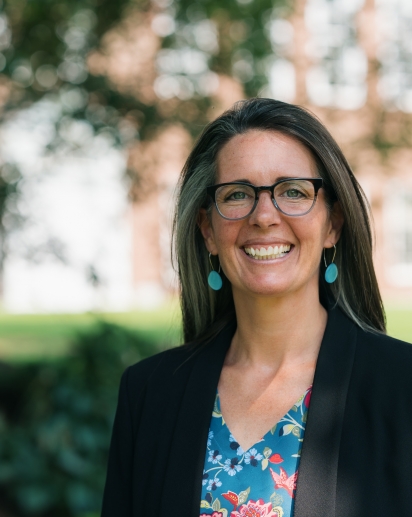
Michele Tine
Assistant Professor

Michele Tine

Michele Tine
Assistant Professor
Department of Education

Ph.D. Boston College, Psychology, 2009

Dartmouth College
205 Raven House
Hanover, NH 03755
Phone: (603) 646-9043
Fax: (603) 646-3968
Email: michele.tine@dartmouth.edu

I am passionate about teaching and learning in theory and practice. My goal in the classroom is to help students acquire knowledge and concepts about child development, apply the principles to problems typical in the field, and transfer and adapt the information to novel contexts. I aim to empower my students to be leaders in the field. Moreover, I am committed to do this with a contagious level of enthusiasm.
Courses
  • Education 10: History and Theory of Human Development and Learning
  • Education 16: Educational Psychology
  • Education 09: Social and Emotional Development
Research and Teaching Interests

My specific program of research stems from my experiences as a 5th grade teacher in a low-socioeconomic urban district. These students appeared to learn in ways that were fundamentally different than students I had taught from middle and high socioeconomic areas. I was motivated to specify these group differences and investigate the underlying cognitive mechanisms that may be responsible. To first gain a thorough understanding of the neurological underpinnings, I spent years working with a lab investigating the electrophysiological patterns of human memory. I went on to earn a PhD in Applied Developmental and Educational Psychology. Now, I am able to synthesize these bases of knowledge in my research focused on the cognitive factors that mediate group differences on different skills. I ask why and how learning is different for different groups of children.

Current projects examine the cognitive patterns of 1) low-SES children on tasks related to working memory, measurement, and literacy, 2) low-performing children on tasks related to algebra, and 3) children with autism on tasks related to theory of mind abilities.

Much of this work has applied implication and application. Identifying the underlying cognitive factors responsible for group differences helps establish cognitive skills that need to be targeted and fostered in intervention programs.

 
top
Courses | Research | Teacher Education | People | Educational Neuroscience Now | Innovative Outreach | About this Department | Home
 
Copyright © 2004 Dartmouth College Department of Education. All Rights Reserved. Site designed by Academic Web Pages.