Mukul Sharma Current Research Interests in Isotope Geochemistry
- Near surface geochemistry of osmium
- Generation of oceanic lithosphere: the role of mantle heterogeneities
- Magma Differentiation and Source Characteristics of Continental Flood Basalts
- Early evolution of the earth: the terrestrial record of 146Sm
- Study on continental weathering using osmium isotopes
- Variations in Solar Magnetic Activity and the Sun-Climate Connection
- Tracing the source of groundwater arsenic in Bangladesh Delta
- Geochemical and isotopic studies of cosmic dust
- Near surface geochemistry of osmium
- Osmium and Iridium Transport through Estuarine Environments
Geochemical and isotopic studies of cosmic dust
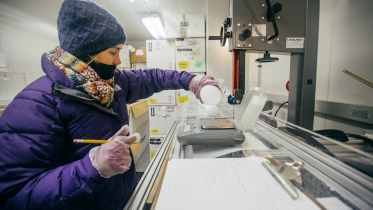
The main objective of this project is to gain an insight into the composition and evolution of micrometeorite parent bodies and to evaluate the mass loss during atmospheric entry and transport. The cosmic spherules constitute the bulk of extraterrestrial material accreted to the earth and could potentially provide a petrogenetic history of millimeter sized and smaller meteoroids that inhabit the inner solar system. They could further yield information about the extraterrestrial contributions to atmospheric aerosols that are critical to stratospheric chemistry and may affect global climate. We are investigating the lanthanide element contents and Sm, Nd, and Os isotopes of the spherules recovered from the bottom of a water-well on South Pole. Our goal is to investigate the evolutionary history of micrometeorites using the Sm and Nd isotope systematics that are well established for larger meteorites. Also, this study would provide a measure of the fraction of Os that is evaporated during atmospheric entry of cosmic dust, which would, in turn, be used to estimate the cosmic dust flux using the Os isotopes. This work is being carried out in collaboration with Susan Taylor, Cold Regions Research and Engineering Laboratory.