Dartmouth College Department of Earth Sciences


College Home | People | Calendar | Search the Dartmouth Web

Mukul Sharma Current Research Interests in Isotope Geochemistry

Early evolution of the earth: the terrestrial record of 146Sm

Short-lived isotopes can provide significant insights into the early evolution of the earth. There is abundant evidence of the widespread occurrence of short-lived 146Sm (t1/2 = 103 million years) in the early solar system. The presence of 146Sm has been inferred also for the parent material of the SNC meteorites and for lunar rocks. This is established by correlated variations of Sm/Nd and 142Nd/144Nd ratios in meteorites. The estimated initial 146Sm/144Sm ratio is 0.008 ± 0.001 at 4.56 billion years. It follows that if crust-mantle differentiation processes occurred early (between 4.5 and 4.3 billion years) on the earth and if they produced reservoirs with high Sm/Nd ratio and if samples were preserved it should be possible to detect 142Nd excesses. For example, a reservoir differentiated 0.1 Ga after the formation of the earth with a Sm/Nd ratio of 0.455 and remained isolated since then would yield 57 mu (muNd(142) = parts per million deviations of the measured 142Nd/144Nd ratio of a sample relative to the present day 142Nd/144Nd ratio in chondrites) excess in 142Nd; if the same reservoir formed at 0.3 Ga after the formation of the earth and remained isolated since then it would yield a 15 mu excess in 142Nd. The coupling of short-lived 146Sm-142Nd system with long-lived 147Sm-143Nd (t1/2 = 106 billion years) system is shown in Fig. 1 and implies that early Archean rocks with high initial eNd(143) (= 0.1 permil deviations of the measured 143Nd/144Nd ratio of a sample relative to the that in chondrites) should be investigated for 142Nd excesses.

Figure 1. Plot showing evolution of mNd(142) and eNd(143); the evolution of eNd(143) is calculated till 3.8 Ga. The solid curves give the fSm/Nd values of two arbitrary reservoirs. The dashed vectors give the time of differentiation after the formation of the earth (modified from Sharma et al., 1996b).

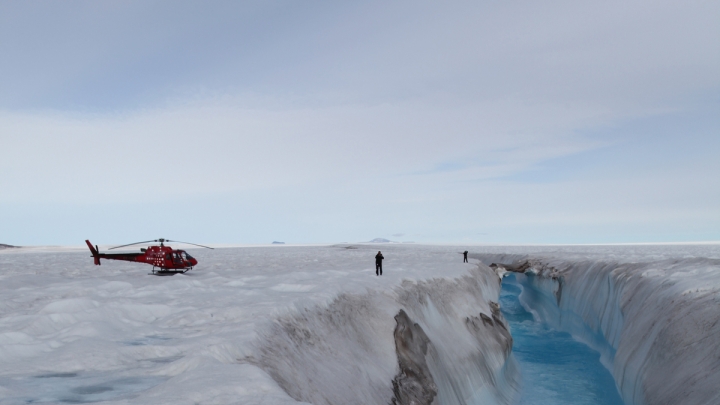
After careful experimentation I have shown that two samples of the 3.8 Ga para-gneisses with apparent epsilon143Nd values of ~ +4 from Isua, Greenland may possess between 30 and 40 mu excesses in 142Nd (Fig. 3) (Sharma et al., 1996a), suggesting that the magmatic precursors of these rocks were derived from a mantle source that was already depleted at 3.8 Ga and had +30 to +40 mu excess in 142Nd. The experimental techniques for this study were developed when I was a postdoctoral fellow at Caltech working with Drs. D. A. Papanastassiou and G. J. Wasserburg. The results are in consonance with the work of Dr. S. Jacobsen at Harvard University. However, questions remain whether the observed 142Nd excess is confined to some rocks or is global. Additional data with new generation mass spectrometers will help ratify this important discovery and to utilize it in formulating the early earth models. I plan to measure the Nd-isotopic composition in standards (normal and gravimetrically enriched in 142Nd) and in some key Archean samples from Greenland and Australia to further address this issue and to assess the extent to which the observed 142Nd excesses are global.

Figure 2. Measurements of mNd(142) of the 0 m and 30 m Standards and of the Isua rocks (solid rectangles; ID 27-2A and IE 715-28; P = powder; R = rock), using a carefully developed but arbitrary Standard Operating Procedure. The internal precision is shown by the smaller error bars. The larger error bars show the external precision, which reflects also the variability of the averages of the 0 m standard, which is a better estimate of the ability to resolve the differences between isotopic ratios. The 2-sigma external reproducibility for the experiments shown by the larger set of error bars is ± 13 m, such that the Isua data and the 30 m standard runs cannot considered resolved from 0 m standard at 6-sigma level (modified from Sharma et al., 1996a).
Dartmouth Earth Sciences | Site Map | Contact Us | ©2003 Dartmouth College - Last Updated