Remote Sensing and GIS at Dartmouth
|
| Blooms of 2 phytoplankton species in the Bering Sea. The coccolith bloom appears as a bright blue-green zone, and another phytoplankton bloom is visibly green. Remotely sensed using SeaWIFS. |
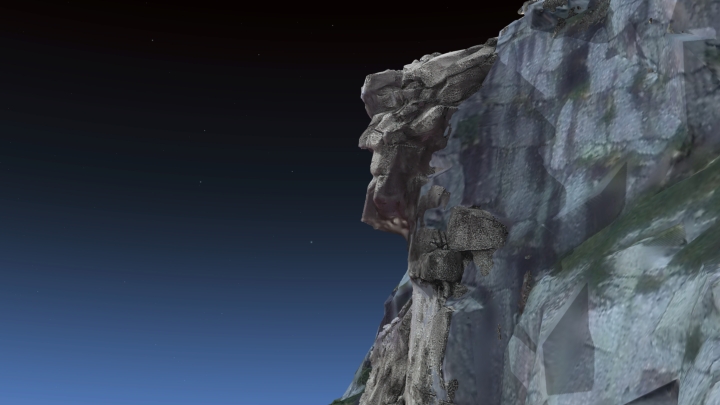
Overview. One of the most fundamental issue that confronts earth scientists is that of scale--it is nearly impossible to sample and chacterize and dat aset large enough to understand all of the variability in a landscape. Consequently, remote observations are useful, and special effort is needed to deal with the resultingly large datasets. Remote sensing, in which spatially resolved images and spectra are collected from aircraft, satellite, or remote stations, and used to identify and map surficial features (e.g., plant species, water temperature, chlorophyll concentration). Geographic information systems (GIS) provides a means of visualizing this data, and is generally useful for the analysis of large spatial datasets. Within Dartmouth Earth Sciences, Dr. Birnie is involved in research using satellite remote sensing, image processing, and global positioning systems (GPS) for a variety of geologic and environmental applications. In addition, a number of other faculty make regular use of such methodology in their research. For example, Dr. Renshaw uses the spatial analysis tools available in GIS to create three-dimensional models of rock strata and water flow.
Laboratory Facilities. Remote sensing and GIS are computationally intense and thus require dedicated computer services. To this end, the department has fully equipped teaching and research GIS laboratorys, and data resources to facilitate many common GIS and remote sensing applications. Additional facilities and expertise for GIS is also available nearby in the Department of Geography.