Here are just a few notes about upcoming events and projects at DCAL and other items of interest to teachers. Navigate the site's resources at the right. For more news, see DCAL News. PDF versions of the current DCAL newsletter and DCALendar now available.
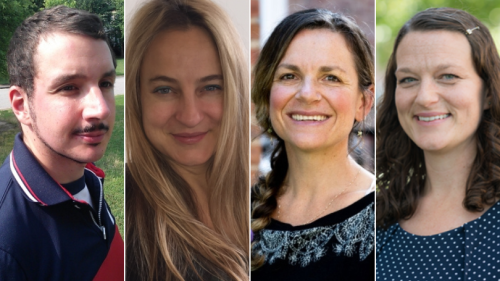
DCAL and the Tucker Foundation invite you to learn from your colleagues about incorporating community-based teaching and learning into your courses. Hear from two faculty members and a Tucker Foundation staff member about ways to deepen student learning in concert with and through the work of the community. Chris Bailey-Kellogg (Computer Science) and Karolina Kawiaka (Studio Art) will share their successes in community-based teaching and learning.
Dartmouth's Academic Honor Principle and COS Procedures. Faculty and deans share many perceptions, perhaps even some counter- and cross-perceptions about the Honor Principle and the COS used to adjudicate alleged infractions. Dean Rovana Popoff, Judicial Affairs Officer April Thompson and Professor Tom Luxon will lead the discussion.
The scholarship on teaching and learning has grown in both quality and quantity in recent years. New modes of teaching and new tools for learning appear with increasing frequency. Recognizing that faculty normally do not have enough time to re-think and re-design courses and teaching methods in light of these advances, DCAL Fellowships provide course relief (one course) and staff support for a term-long effort to improve teaching and learning in a particular course.
DCAL will support a broad range of proposals. Recent successful projects have enabled or enhanced access to library and online resources, improved student-to-student and student-teacher interaction, enabled teaching and learning partnerships between colleagues as well as across disciplines and institutions. Others have used information technology to develop better learning and assessment tools. We are particularly eager to support proposals that benefit from and contribute to the growing body of scholarship on teaching and learning and can serve as both examples and encouragement to other teachers. Proposals that focus on purposeful applications of information technology may also find support from the Computing Technology Venture Fund; DCAL Fellowships grant time and the Venture Fund can provide money.
DCAL Fellows enjoy a one-course reduction in the year of the award. Academic Computing and the Library will assign staff members to support the project. Fellows are expected to hire a student to bring that important perspective to the project. Fellows and their project teams meet regularly to exchange ideas, share information, and encourage each other’s progress. The fellowship will not include funds for hardware purchases, or any wages or salaries other than the student member of the project team. A small pool of funds is available to each fellow to help purchase necessary software and license agreements. The chief benefit of the fellowship is the time realized by a one-course reduction in teaching for the year. Recent DCAL Fellows include Lorie Loeb (CS), Douglas Moody (SPAN), Mark Williams (Film and TV), Ivy Schweitzer (English) and Geoffrey Ruoff (Film and TV).
Applications are due November 1, 2008. Please see the fellowships page for application procedures.
Meet Shigeru Miyagawa, Professor of Linguistics and Kochi-Manjiro Professor of Japanese Language and Culture, at a luncheon conversation at DCAL.
Professor Miyagawa will offer a short presentation about MIT's OpenCourseware Initiative and how Dartmouth faculty and others can benefit from it. Professor Miyagawa is a well-known scholar of syntactic theory and an award-winning teacher and educational innovator. He was on the original faculty team that recommended OpenCourseWare to the MIT administration and now serves on both the MIT OCW Advisory Committee and the MIT Council on Educational Technology. Professor Miyagawa also helped to start the Japan OCW Consortium.
DCAL will make grants of up to $1000 to support attendance at conferences and programs devoted to teaching and learning. These may be special panels organized by your professional organizations at their annual meeting, or by the Educause Learning Initiative or Tomorrow's Professor, or similar events. If you want to attend such a meeting or present on such a panel, DCAL will help you pay for it; we may be able to cover the entire expense! These funds are for travel, lodging, registration and other costs of participation. Direct your inquiries to Elaine Livingston.
We have a diversely talented teaching faculty at Dartmouth and we can learn a great deal from each other. DCAL started this informal network by setting up a system for visiting colleagues' classes, not for evaluation of course, but for sharing and learning from each other. Comments and suggestions are shared only with each other, not with the larger group and certainly not with any chairs, supervisors or deans. This is often referred to as formative, rather than summative, evaluation. DCAL helps the process by hosting the initial meeting of those interested in joining the network, supplying guidelines and helpful forms, and finally by hosting a de-briefing at the end of term. For more details see the Class Visits page of this website. Please sign up on our workshops and events sign-up page or with Elaine Livingston.
The Dartmouth Centers Forum is pleased to announce that the theme for 2008-2009 will be Conflict and Reconciliation. Conflict is seemingly endemic to society and rightly deserves our attention. Yet often efforts to resolve conflict focus on causes, the mitigation of conflict impact upon its victims and place great emphasis on the prevention of future conflicts through structural or policy change. The focus of the Dartmouth Center's Forum theme is to emphasize the role of reconciliation as a method to resolve conflicts no matter what their causes. Conflicts permeate our personal and social relations, and may be internal, local, national or international. Reconciliation, viewed as a process of coming to terms with what is, accepting, forgiving and compromising, and encompasses all the fields of human endeavor. As such it is fertile ground for discussions such as, what makes reconciliation a successful conclusion to conflict? Are there universal processes of reconciliation? Is there a distinction between disputes and conflicts? Are there conflicts within which parties cannot be reconciled? What methods might be employed in the promotion of reconciliation for conflicts, be they personal, societal and global?
A syllabus template is now available on the DCAL website. We hope that this template will give you some ideas and make developing a syllabus for your course a bit easier. Please modify the template as needed to make your own personal syllabus and let us know if you have comments/additions.
DCAL has launched the DCALblog with a focus on learning. The purpose of this blog, entitled Conversations about Teaching and Learning, is to share ideas and information about teaching and learning. We hope it will be a collaborative effort with lots of blog authors and commenters. If you attend a conference, try something in your classroom, read an article or book, or have something to share related to teaching or learning please chime in! Access the blog through the DCAL website – there is a link in the right side bar of the webpage to the blog.
This new DCAL seminar formed on October 25th 2007 as an ongoing forum for informed discussion of teaching and learning languages and cultural competencies. Anyone at Dartmouth interested in these topics is welcome to join us; simply e-mail Tom Luxon, Doug Moody or Nancy Canepa. Our inaugural discussion focused on the May 2007 MLA report entitled "Foreign Languages and Higher Education: New Structures for a Changed World." Future plans include invited speakers, discussion of literature on the subject of language learning and cultural competency and discussion of possible innovations at Dartmouth.
Please e-mail Doug Moody and Nancy Canepa with suggestions for future meetings!
Reducingstereotypethreat.org was created by two social psychologists and professors who sought to offer a resource for faculty, staff, and students regarding stereotype threat. This website offers summaries of research on this topic and discusses unresolved issues and controversies in the research literature on the phenomenon. Included are some research-based suggestions for ameliorating negative consequences of stereotyping, particularly in academic settings.
An excerpt from "Using the 'Beauties of Physics' to Conquer Science Illiteracy": A Conversation with Professor Eric Mazur of Harvard University (New York Times July 17).
Q. When you teach Physics 1b, do you give "fantastic performances?"
A. You know I've come to think of professional charisma as dangerous. I used to get fantastic evaluations because of charisma, not understanding. I'd have students give me high marks, but then say, "physics sucks." Today, by having the students work out the physics problems with each other, the learning gets done. I've moved from being "the sage on the stage" to "the guide on the side."