You may be using a Web browser that does not support standards for accessibility and user interaction. Find out why you should upgrade your browser for a better experience of this and other standards-based sites...

Dartmouth Home  Search  Index

Dartmouth HomeSearchIndex

Dartmouth home page
Comparative Literature Program
Undergraduate MajorHome >  Undergraduate Major >

Thesis Process

A. The Thesis Process

  1. Thesis projects should be worked out in conjunction with your two advisors during spring term, junior year and fall term, senior year. By the last full week of spring term, you should send a description of the topic you intend to pursue to your advisors. Schedule a meeting with each of them (in person or, if you are off campus, by phone) so that you can receive their approval and use the summer to read and prepare. Their written approval of the topic should be filed with the Comparative Literature office.
  2. Summer Assessment and Preliminary Thesis Proposal:
    • Please submit to your two advisors and the program chair by the end of the first week of classes a summer assessment and a preliminary thesis proposal. The summer assessment (approximately 2-3 pages) of the progress you have made in formulating a thesis project may take the form of questions you intend to address in your thesis and a report on the reading you have done over the summer and its relevance to your topic. Your prelimary thesis propsoal (signed and thus approved by your primary advisor) should address the following questions:
    • What is the rationale of your project? What is the comparative nature of your project? Why is your topic important? How are you going to approach your problem conceptually (or theoretically)? At the end of this assessment you should include 4-5 important bibliographical entries of primary and secondary sources such as critical works on the specific works you are studying (this may be a book or an article) or general critical works (either a book or an article). For each of the 4-5 entries you should write one thoughtful paragraph explaining why this work may be important in defining your thesis topic.
    • *Please include also the name of your secondary advisor.
  3. Formal Thesis Proposals, which need to be signed by two advisors and submitted to the Comparative Literature Steering Committee for approval, are due at the end of the seventh week of classes, fall term, senior year.
    • Effective proposals are brief and clear. Show a draft to your advisors, to the chair, and to fellow students.
    • Your first paragraph should state the topic as clearly as possible, including the works you plan to analyze. Say, as clearly as you can, why you are comparing given works to one another.
    • Paragraph 2 should go into some detail about what questions you intend to ask and what approach you intend to use to address them. If you are clear about your methodological orientation, describe it here. You should also include here a sense of the reading you need to do to address your topic (e.g. background reading in given theories, as well as historical background on a given period, criticism on a given author, his/her other works etc.).
    • A fourth paragraph could state some things you hope to find or to get out of the work. If you have no idea what you will find, say so - it's only a proposal.
    • A bibliography has to be appended to the proposal.

B. Writing the Thesis

  • During the summer after junior year, you should be putting together a bibliography and reading your primary and secondary texts. During the fall you should work with your advisors in formulating your formal thesis proposal.
  • Majors work together in a senior methodology seminar (CL85) during the winter term of senior year and begin writing their theses. CL 85 is a course geared to the projects of individual majors. You pursue the research for your own thesis and will have a chance to present some of your work to your fellow majors. By the end of winter term you will be expected to complete most of the research and much of the writing of your thesis.
  • At the same time, you are expected to meet regularly with you advisors. Your primary advisor is your most important resource and all your work should be approved by him/her. Secondary advisors can play a variety of roles - from weekly consultants to readers of the final product. Establish an early understanding of how you and your advisors can best collaborate.
  • During spring term, (CL87), majors work independently with the guidance of their two advisors.

Sample theses (corresponding to major above):

  • "The Subject 'en proces': Identity and Freedom in Kafka's Der ProzeS and Sartre's La nausee" (see sample major #1)
  • "The Transgressive Artist in Short Works of E.T.A. Hoffmann and Nathaniel Hawthorne" (see sample major #2)
  • "Montaigne and Macbeth: Rebellion, Gender and Patriarchy in the Renaissance" (see sample major #3)
  • "Appropriation and Resistance: Ways of Seeing and Being Seen in La Vagabonde, Mitsou, and Photographs of Colette" (see sample major #4)
  • "Love in the Time of Trauma: Desire and Narrative in Hiroshima, mon amour and Beloved" (see sample major #5)

C. Two-Paper Option

You may choose to write two senior papers (about 20 pages each) in lieu of a thesis. This is a non-honors option. You still have to file a preliminary proposal by the end of the first week of classes, fall term, and a final proposal for the first paper by the seventh week of fall term. The first paper will be written during CL85 and must be completed by the end of of winter term. The second paper is usually written in the context of a course taken in spring term or an independent study (CL 79). If you decide to do the two-paper option you will not enroll in CL 87 but rather CL 79 or another course. The two papers may be related, but this is not required. They do have to integrate your areas of interest and the languages you have studied. You will work closely with your advisors while writing both essays.

D. The Oral Presentation

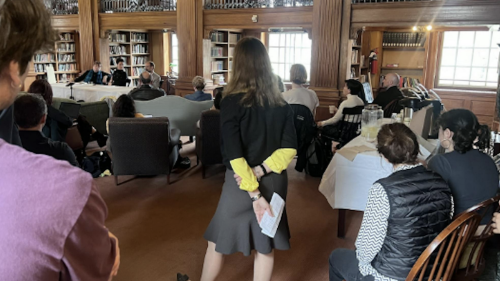
An oral presentation of the work done during the senior year (thesis or essays) is intended as a public acknowledgment of your personal effort and achievement. At this presentation you are asked to share the findings of your research with the community of professors and fellow students who participate in the discipline of Comparative Literature. The oral presentation takes place during April while your thesis/paper is still in progress and you can benefit from questions and suggestions.

Your presentation should be no longer than 20 minutes and should include a general statement about your topic and approach as well as a specific textual reading. Do not try to summarize your entire thesis in 20 minutes.

E. Submission of the Final Thesis or Essays

  • Submission of work in final form - a bound copy - is required certification of major standing. It is imperative, therefore, that you view as part of the writing process the strict adherence to deadlines.
  • Drafts of theses are due to the primary and secondary advisor and the Chair no later than the end of April, spring term.
  • Final bound copies of theses are due to the advisors and the Chair no later than Mid May, spring term.
  • Students writing two essays must submit final copy of the first essay to the primary advisor no later than the end of winter term and the second by the thesis due date.
  • Final copies (3 are required) will be the student's own financial responsibility and will eventually be placed in the Comparative Literature archives.

Last Updated: 1/10/05