6047 Silsby Hall
Hanover, NH 03755
Phone: 603-646-2550
Fax: 603-646-1140
sergei.a.kan at dartmouth.edu
Much of my ethnographic and archival research and writing in the 1980s-1990s focused on the culture and history (and especially religion, both indigenous and Christian) of the Tlingit of Southeastern Alaska and resulted in numerous articles and two monographs. While I continue to work on these subjects and maintain close ties with a number of Tlingit families, my most recent publications deal with a somewhat different set of issues, such as the relationship between Tlingit and anthropologists as well as American attitudes toward images of and relations with the Tlingit in the late 19th and early 20th centuries (as exemplified by the maritime tourism). A long-standing interest in the peoples and cultures of the entire Pacific Northwest Coast has led me to co-editing (with an American and a French colleague) a volume of essays representing some of the major recent work in the field, this book, Coming to Shore: Northwest Coast Ethnology, Traditions and Visions, was published in 2004.
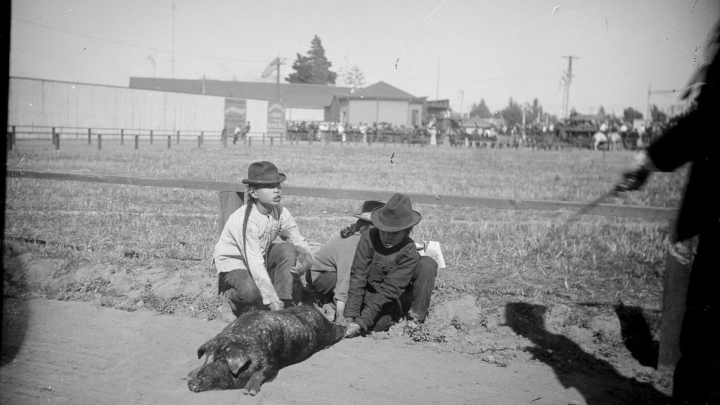
In the fall of 2006 and the summer of 2010, I conducted ethnographic and archival research in southeastern Alaska on a new topic: a collection of photographs taken by Vincent Soboleff (a Russian-American photographer) in a Tlingit community of Killisnoo/Angoon in the 1890s-1920s. This project will result in a book entitled Vincent Soboleff: A Russian-American Photographer in Tlingit Country to be published by the University of Oklahoma Press.
While I still maintain a strong interest in the Tlingit culture and history, I have recently turned my attention to an important but totally neglected topic, the sociocultural history of the community of people of mixed Russian-Native descent (the so-called Creoles), which remained in Sitka after the sale of Alaska to the United States. Most of the information on this subject comes from the various written sources, which I have begun to explore. However, recently I was able to interview several descendants of the Sitka Creoles who shared valuable family history with me.
My graduate training at the University of Chicago under Raymond D. Fogelson and many years of teaching courses on Native North American ethnology and ethnohistory, have inspired me to co-edit (with Pauline Turner Strong) a series of papers by several generations of North Americanists who have also been trained by the same mentor. This volume, which honors Fogelson and is entitled Perspectives on Native North America: Cultures, Histories, and Representations, was published in 2006.
Finally, having always had a strong interest in the history of anthropology, I had been since the late 1990s working on an intellectual biography of Lev Shternberg, one of the leading Russian anthropologists of the late imperial and early Soviet period. He attracted me as both a scholar who played a major role in modernizing Russia's famous Museum of Anthropology and Ethnography (in St. Petersburg) and training the first generation of Soviet ethnographers, but also as someone who became an ethnographer under rather unusual circumstances, i.e., while serving an exile sentence on a remote island in the Russian Far East in the 1890s. This research took me to the Archive of the Russian Academy of Sciences in St. Petersburg. A book Lev Shternberg: Anthropologist, Russian Socialist, Jewish Activist, published in 2009, is the result of this work. In addition, in the last few years, I have published several articles (in English and Russian journals) on the history of Russian/Soviet anthropology and begun a new research project on the life and scholarly legacy of Alexander Goldenweiser (1880-1940), a prominent Russian-American anthropologist of the Boasian school. (See my article on Goldenweiser's political views in Vol. 5 of the Histories of Anthropology Annual, published in 2009).
Selected Recent Publications