|
|
A Tribute to Karen Wetterhahn
Karen E. Wetterhahn was a professor
of chemistry at Dartmouth College and the founding director
of Dartmouth's Toxic Metals Research Program. An expert in
the mechanisms of metal toxicity, Professor Wetterhahn was
best known for her research on chromium. She became ill and
died in 1997, at the age of 48, as a result of a tragic laboratory
accident involving a highly toxic mercury compound.
In addition to her international reputation as a research
chemist, Professor Wetterhahn was known to students and colleagues
at Dartmouth College as a dedicated teacher and mentor. At
the time of her death in 1997 she was Dartmouth's Albert Bradley
Third Century Professor in the Sciences.
Trained as an inorganic chemist,
Professor Wetterhahn also had expertise in biochemistry and
molecular toxicology. Her research involved understanding how
chromium and nickel cause cancer in humans. She was particularly
interested in the way cells metabolize those metals.
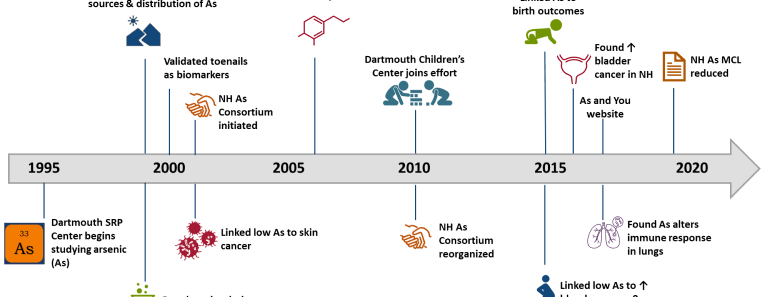
In 1995, Professor Wetterhahn initiated
Dartmouth's Toxic Metals Research Program, an interdisciplinary
project exploring the human health effects of metals that are
common contaminants in the environment, especially at toxic
waste sites. The project, supported by a grant from the National
Institute of Environmental Health Sciences, draws together scientists
from Dartmouth College, Dartmouth Medical School and the Veterans
Affairs Medical Center in White River Junction, Vt.
Professor Wetterhahn played an
integral role in the administration of the sciences at Dartmouth.
As Dean of Graduate Studies (1990), Associate Dean of the Faculty
for the Sciences (1990-94), and Acting Dean of the Faculty of
Arts and Sciences (1995) she helped guide the growth and development
of the science division and its graduate programs. She was instrumental
in developing a curriculum on the life-science area known as
structural biology, which studies the structure of biologically
active molecules such as DNA, RNA and proteins to learn how
they function and interact.
Professor Wetterhahn also worked
to increase the number of women participating in the sciences
and was co-founder of Dartmouth's Women in Science Project,
which provides research internships for first-year women science
majors, along with other programs of academic and professional
support. She was active in the Women in Cancer Research group
and similar national organizations that encourage women to pursue
research careers.
Professor Wetterhahn received her
bachelor's degree, magna cum laude, from St. Lawrence University
in 1970 and her doctorate from Columbia University in 1975.
She joined the faculty of Dartmouth in 1976, following a year
as a National Institutes of Health trainee at the Institute
of Cancer Research, Columbia University College of Physicians
and Surgeons.
She was an Alfred Sloan Fellow
from 1981 to1985, and St. Lawrence University honored her in
1989 with the Alumni Citation in science and education. She
was also a trustee of the Montshire Museum of Science.
The author of more than 85 research
papers, Professor Wetterhahn was a member of several scientific
societies and a past officer of the American Association for
Cancer Research. She was also on the editorial board of numerous
scientific journals. She trained 14 postdoctoral research associates,
20 graduate students and over 50 undergraduate research students
in her laboratory.
In 1996, while preparing an experiment
that involved the use of dimethyl mercury, Professor Wetterhahn
spilled a few drops of the compound on her gloved hand. Though
the latex gloves she was wearing were believed to be protective,
they proved to be inadequate in preventing exposure to this
potent form of mercury. Unknown to Professor Wetterhahn, the
toxin passed through the glove and was absorbed into her system.
Six months later, she slipped into a coma and died from acute
mercury poisoning.
Dartmouth has established several
memorials in honor of Karen Wetterhahn, including a graduate
fellowship in chemistry and an annual faculty award for distinguished
creative or scholarly achievement. A library reading room and
the annual undergraduate science symposium have also been named
in her honor, and her portrait now hangs in Dartmouth's Baker-Berry
Library.
Nancy
Serrell
Center
for Environmental Health Sciences at Dartmouth
Related Link: The
Trembling Edge of Science: Losing world-class chemist
Karen Wetterhahn to mercury poisoning redrew the boundaries of
safety and risk. By Karen Endicott, Dartmouth Alumni Magazine
top
|
|